
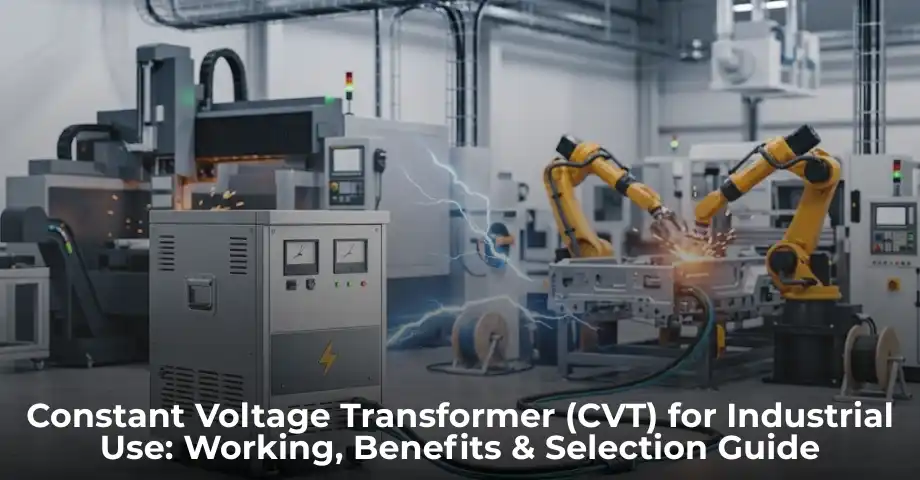
Imagine this: your CNC machine stops mid-operation, a control panel trips without warning, or your testing equipment starts giving inconsistent results — all within the same shift.
In most industrial facilities, these issues are often traced back to one root cause: unstable voltage supply.
Whether it’s a manufacturing unit in Kolkata, a mining operation in Jharkhand, or a processing plant in Odisha or North-East India, voltage fluctuation is not just an electrical issue — it’s a direct threat to productivity, equipment life, and profitability.
This is where a Constant Voltage Transformer (CVT) becomes more than just a device — it becomes a critical power conditioning solution for industrial reliability.
Delta Technocrats provides customized CVT solutions for industries across Eastern India, helping businesses eliminate voltage-related failures and ensure uninterrupted operations.
The Real Problem: Voltage Fluctuation in Industrial Environments
In real-world industrial conditions, voltage is rarely stable. Common scenarios include:
- Sudden voltage drops during heavy load operations
- Voltage spikes due to grid switching or faults
- Fluctuations from diesel generators in remote locations
- Electrical noise interfering with sensitive equipment
While these may appear as routine electrical variations, their consequences are far more serious:
- Unexpected tripping of CNC machines and automation systems
- Damage to PLCs, drives, and control panels
- Frequent breakdowns and rising maintenance costs
- Production losses due to unplanned downtime
For industries running continuous processes, even a few minutes of disruption can translate into significant financial losses and operational setbacks.
Why Conventional Voltage Solutions Often Fall Short
Many industries rely on servo stabilizers or basic voltage regulators to manage fluctuations. While these solutions may work for general applications, they often fail in critical industrial environments.
Here’s why:
- Delayed response to sudden voltage changes
- Limited ability to filter electrical noise and spikes
- Dependence on mechanical components that wear out over time
- Inconsistent performance under severe fluctuation conditions
For precision-driven operations such as CNC machining, laboratory testing, and automated production lines, these limitations can result in repeated failures and costly disruptions.
This creates the need for a more reliable, maintenance-friendly, and consistent voltage regulation solution.
What is a Constant Voltage Transformer (CVT)?
A Constant Voltage Transformer (CVT) is a specialized power conditioning device designed to deliver a stable output voltage regardless of fluctuations in the input supply.
Unlike conventional stabilizers, a CVT operates using a ferroresonant principle, which allows it to:
- Maintain consistent output voltage
- Suppress electrical noise and spikes
- Improve overall power quality
- Provide inherent protection to connected equipment
In industrial environments where power instability is frequent, a CVT acts as a protective shield between the power source and critical machinery.
To explore industrial-grade configurations, you can check our Constant Voltage Transformer for industrial use, designed for demanding applications.
How a CVT Transformer Works in Industrial Applications
The working principle of a CVT is based on ferroresonance — a combination of transformer action and resonant circuitry that stabilizes voltage output.
In practical terms:
- The transformer core operates in a controlled saturated state
- A capacitor creates a resonant circuit within the system
- This resonance maintains a nearly constant output voltage
- Voltage fluctuations, spikes, and electrical noise are absorbed internally
The result is a clean, stable, and reliable power supply — even when the input voltage varies significantly.
This makes CVTs highly effective for:
- Sensitive electronic equipment
- Industrial automation systems
- Precision manufacturing machines
Another major advantage is the absence of moving parts, which significantly reduces maintenance requirements and increases operational reliability.
At this point, it becomes clear that a CVT is not just correcting voltage — it is preventing failures before they occur.
Get expert consultation for your industrial voltage problem and identify the right CVT solution tailored to your application.
Key Benefits of Constant Voltage Transformer for Industrial Use
In industrial environments, power stability is not a luxury — it is a necessity. A single voltage fluctuation can interrupt production, damage expensive equipment, or compromise product quality.
This is why a Constant Voltage Transformer (CVT) is not just another electrical component — it is a strategic investment in operational reliability.
Here’s how CVTs deliver measurable value across industrial operations:
1. Protection of Critical Equipment
Modern industrial systems rely heavily on sensitive electronics such as PLCs, CNC controllers, drives, and instrumentation panels. These components are highly vulnerable to voltage variations.
A CVT ensures that these systems receive a stable and consistent voltage supply, effectively protecting:
- Control panels and automation systems
- Precision machines and CNC equipment
- Testing and measurement instruments
This significantly reduces the risk of unexpected failures and costly repairs.
2. Reduced Downtime and Production Loss
Unstable voltage is one of the leading causes of machine tripping and process interruptions in industrial facilities.
With a CVT in place:
- Machines operate without unexpected shutdowns
- Production cycles remain uninterrupted
- Operational efficiency improves
For industries where every minute counts, this translates directly into higher productivity and profitability.
3. Extended Equipment Lifespan
Continuous exposure to voltage fluctuations puts stress on electrical components, accelerating wear and tear.
By maintaining a stable voltage level, CVTs help:
- Reduce thermal and electrical stress
- Prevent premature component failure
- Increase the lifespan of expensive equipment
This leads to lower maintenance costs and better return on investment over time.
4. Built-in Noise and Spike Suppression
Industrial power systems often carry electrical noise, spikes, and transients — especially in facilities with heavy machinery or generator-based supply.
CVTs naturally filter these disturbances, ensuring:
- Cleaner power supply
- Improved signal accuracy in sensitive equipment
- Reduced interference in automation systems
This makes CVTs particularly valuable in precision-driven environments.
5. Reliable Performance in Challenging Power Conditions
Industries operating in regions like Jharkhand, Odisha, and North-East India frequently face unstable grid conditions and generator-based fluctuations.
CVTs are designed to handle such challenges, providing consistent performance even in difficult power environments.
Delta Technocrats provides customized CVT solutions for industries across Eastern India, ensuring reliable operation even under severe voltage instability conditions.
Real Industrial Applications of CVT Transformers
CVTs are widely used across industries where voltage stability directly impacts performance, accuracy, and output quality.
1. CNC Machines and Precision Manufacturing
CNC machines require precise voltage levels for accurate machining. Even small fluctuations can result in errors, tool damage, or system faults.
With a CVT:
- Machining accuracy is maintained
- System reliability improves
- Downtime due to voltage issues is minimized
2. Printing and Packaging Industries
In printing and packaging, voltage instability can disrupt synchronization, leading to misalignment and product defects.
CVTs help ensure:
- Consistent print quality
- Smooth machine operation
- Reduced rejection rates
3. Textile and Process Industries
Voltage variations can affect motor speed and process consistency in textile and processing units, impacting product quality.
By stabilizing voltage, CVTs enable:
- Uniform production output
- Stable process control
- Reduced wastage
4. Laboratories and Testing Facilities
Accurate testing and measurement require stable and noise-free power supply.
CVTs are ideal for:
- Calibration labs
- R&D centers
- Testing equipment setups
5. Industrial Automation Systems
Automation systems rely on continuous and stable power for seamless operation.
CVTs support:
- Reliable PLC performance
- Consistent sensor readings
- Stable communication networks
CVT vs Other Voltage Stabilization Solutions
Understanding how CVTs compare with other solutions helps industries make informed decisions based on their specific requirements.
CVT vs Servo Stabilizer
- Response Time: CVTs provide instantaneous voltage correction, while servo stabilizers respond with a delay due to mechanical movement
- Maintenance: CVTs have no moving parts, resulting in lower maintenance needs
- Power Quality: CVTs offer built-in noise and spike suppression, unlike servo stabilizers
- Best Use Case: CVTs are ideal for sensitive equipment, whereas servo stabilizers are suitable for general-purpose loads
CVT vs UPS (Uninterruptible Power Supply)
- Function: CVT stabilizes voltage, while UPS provides backup power during outages
- Cost Efficiency: CVTs are more economical for voltage correction alone
- Application: CVTs are used for continuous voltage conditioning, while UPS systems are used for short-term power backup
In many industrial setups, CVTs are used alongside other systems to create a complete power protection framework.
For instance, integrating voltage stabilization with feeder protection solutions for industrial systems helps safeguard electrical infrastructure from faults and overloads.
Similarly, industries aiming for advanced system reliability can explore industrial protection relay solutions in India to enhance overall protection.
Understanding modern protection technologies is equally important. This detailed numerical vs conventional protection relay comparison can help in evaluating system upgrades.
When combined, these solutions create a robust ecosystem where voltage stability, fault protection, and operational reliability work together.
Get expert consultation for your industrial voltage problem to identify the right combination of solutions for your facility.
How to Select the Right Constant Voltage Transformer (CVT) for Industrial Use
Selecting the right Constant Voltage Transformer is not just a technical decision — it is a business-critical choice that directly affects equipment safety, production continuity, and long-term operational costs.
Many industries invest in voltage solutions but fail to see results simply because the system was not properly selected for their application.
To ensure you make the right decision, here are the key factors to evaluate:
1. Load Requirement and Proper Capacity Sizing
The most common mistake industries make is incorrect sizing. A CVT must be selected based on actual load conditions, not rough estimates.
You should consider:
- Total connected load (kVA/kW)
- Starting current of machines
- Future expansion plans
An undersized CVT can lead to overload and failure, while oversizing increases unnecessary investment. Accurate sizing ensures both performance and cost efficiency.
2. Type of Load: Sensitive vs General Equipment
CVTs are specifically designed for sensitive and critical applications. Identifying your load type is essential.
CVTs are ideal for:
- CNC machines and precision equipment
- Automation systems (PLC, drives, robotics)
- Laboratory and testing instruments
If your operations depend on accuracy and reliability, a CVT becomes a necessity rather than an option.
3. Input Voltage Fluctuation Range
Understanding your actual power conditions is crucial. Many industrial sites experience wide voltage variations throughout the day.
Evaluate:
- Minimum and maximum input voltage levels
- Frequency and severity of fluctuations
- Presence of spikes and electrical disturbances
This ensures the selected CVT can handle real operating conditions without performance compromise.
4. Operating Environment and Site Conditions
Industrial environments are rarely ideal. Factors such as temperature, dust, and humidity can affect equipment performance.
For industries in regions like Jharkhand, Odisha, and North-East India, where power and environmental conditions can be challenging, selecting a robust and well-designed CVT is critical.
Delta Technocrats provides customized CVT solutions for industries across Eastern India, ensuring systems are designed specifically for regional and operational challenges.
5. Noise Suppression and Power Quality Requirements
If your application involves sensitive electronics or precision measurement, power quality becomes a key factor.
A well-designed CVT should provide:
- Effective noise filtering
- Spike and transient suppression
- Clean and stable output voltage
This is particularly important for laboratories, automation systems, and testing facilities.
6. Common Selection Mistakes to Avoid
- Choosing based only on price rather than application suitability
- Ignoring actual voltage fluctuation range
- Not planning for future load expansion
- Using conventional stabilizers where CVT is required
A structured and informed approach ensures that your CVT investment delivers long-term value.
Beyond CVT: Building a Complete Industrial Power Protection Strategy
While a CVT plays a critical role in voltage stabilization, industrial power systems require a more comprehensive protection approach.
Voltage fluctuation is just one aspect of power-related issues. Industries must also address:
- Overcurrent and fault protection
- Short circuit conditions
- System overloads
- Electrical fault isolation
This is where integrating CVTs with advanced protection systems becomes essential.
For example, implementing feeder protection solutions for industrial systems ensures that faults are detected and isolated before they escalate into major failures.
Similarly, adopting industrial protection relay solutions in India helps create a more intelligent and resilient electrical infrastructure.
As industries move toward automation and smart systems, upgrading to advanced protection technologies becomes increasingly important. This numerical vs conventional protection relay comparison explains how modern systems improve reliability and response time.
When combined, CVTs and protection systems create a complete ecosystem that not only stabilizes voltage but also safeguards the entire electrical network.
Why Choosing the Right CVT Supplier is Critical
The performance of a CVT depends not only on the product but also on the expertise of the supplier.
A reliable supplier ensures:
- Accurate load analysis and system recommendation
- Customization based on industrial application
- Compliance with industry standards and quality benchmarks
- Reliable after-sales support and service
Industries operating in Eastern India benefit significantly from working with suppliers who understand local power challenges and industrial requirements.
Delta Technocrats specializes in delivering application-specific CVT solutions, helping industries achieve stable power, reduced downtime, and improved equipment reliability.
Conclusion: Turn Voltage Stability into a Competitive Advantage
Voltage fluctuation is often treated as a routine electrical issue, but in reality, it is a major factor affecting productivity, equipment health, and operational costs.
A Constant Voltage Transformer offers a reliable and efficient solution by delivering consistent voltage, protecting critical equipment, and improving overall power quality.
For industries aiming to reduce downtime, minimize maintenance costs, and ensure uninterrupted operations, investing in the right CVT is a strategic decision.
Get the Right CVT Solution for Your Industrial Application
If your operations are affected by unstable power supply, it is time to implement a solution designed specifically for industrial conditions.
Explore our Constant Voltage Transformer for industrial use to find the right configuration for your requirements.
Whether you are running a manufacturing plant, processing unit, or automation facility, the right CVT can significantly improve operational reliability and equipment safety.
Get expert consultation for your industrial voltage problem and let our team help you identify the most effective power conditioning solution for your application.
FAQ
1. What is a Constant Voltage Transformer (CVT)?
A Constant Voltage Transformer (CVT) is a power conditioning device that provides a stable output voltage even when the input supply fluctuates. It protects sensitive industrial equipment from voltage variations, spikes, and electrical noise.
2. What is the difference between a CVT and a voltage stabilizer?
A CVT provides instant voltage correction and filters electrical noise, while a voltage stabilizer (like servo stabilizer) has a slower response and mainly corrects voltage without advanced filtering. CVTs are better for sensitive and precision equipment.
3. Where is a CVT used in industrial applications?
CVTs are used in industries where stable voltage is critical, such as CNC machines, automation systems, laboratories, printing units, textile industries, and manufacturing plants.
4. How does a Constant Voltage Transformer work?
A CVT works on the ferroresonant principle, using a combination of transformer action and resonance to maintain a constant output voltage. It absorbs fluctuations and ensures a stable power supply to connected equipment.
5. When should you use a CVT in your factory?
You should use a CVT when your facility experiences frequent voltage fluctuations, equipment tripping, inconsistent machine performance, or when operating sensitive electronics like PLCs, CNC machines, or testing equipment.
6. What is the price of a Constant Voltage Transformer in India?
The price of a CVT depends on factors such as capacity (kVA), application type, input voltage range, and customization requirements. For accurate pricing, it is best to get a quotation based on your specific industrial needs.