
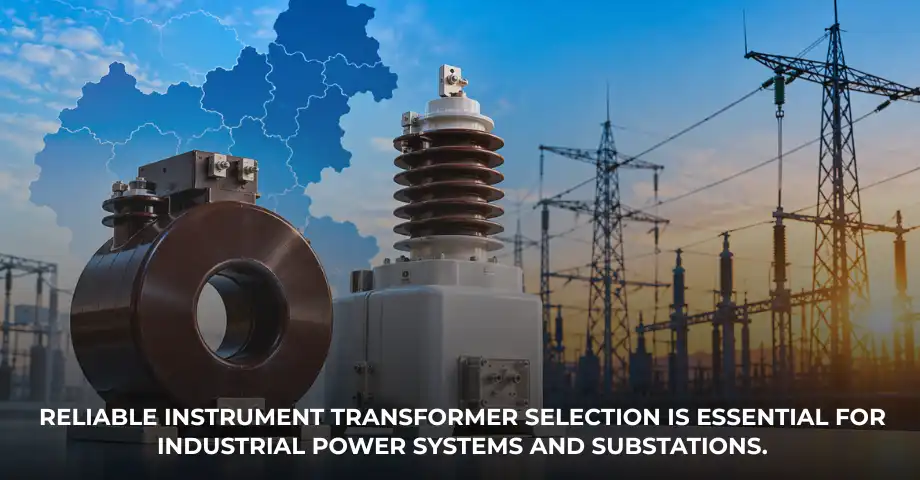
If you are buying a CT PT supplier in Eastern India for a plant, substation or metering point, the nominal ratio is only the starting point. A current transformer (CT) or potential transformer (PT) also has to match the accuracy class, burden, insulation level, short-time rating and installation conditions of the circuit it serves. A mismatch shows up later as metering error, relay misoperation or a rejected inspection.
Delta Technocrats, based in Raniganj, West Bengal, lists CT and PT supply for industries, solar, wind and utility switchyards. This page explains what to specify, how to avoid common selection errors and how to send us an enquiry that can be quoted quickly.
Request a CT/PT quotationView product range
CT and PT Range Listed by Delta Technocrats
The figures below are the ranges published on our Products page. They show the scope of the range, not a promise that every combination of voltage, ratio, accuracy and construction is available in one model. Share your exact requirement and we will confirm what can be supplied against the product datasheet.
| Parameter | Medium and high voltage (indoor and outdoor) | Low voltage |
|---|---|---|
| Insulation level | 3.3 kV to 800 kV | 0.66 kV to 3 kV |
| Primary current | 50 A to 3,150 A | Up to 5,000 A |
| Secondary current | As per specification | 5 A or 1 A |
| Short-time rating | 21.5 kA to 40 kA | As per specification |
| Accuracy class | Up to 0.2S | As per specification |
| Applications | Industries, solar, wind and utility switchyards | |
Construction, insulation type (for example resin-cast or oil-filled) and ratings depend on the order specification. Our Products page shows the product photographs.
CT vs PT: What Changes When You Specify Them
| Item | Current transformer (CT) | Potential / voltage transformer (PT/VT) |
|---|---|---|
| Connection | In series with the circuit | Across the voltage being measured |
| Secondary | 1 A or 5 A | Commonly 110 V or 110/√3 V |
| Key selection data | Ratio, class, burden, withstand, protection duty | Ratio, class, burden, insulation, installation |
| Hazard if mishandled | Open secondary can develop dangerous voltage | Short-circuited secondary can damage the unit |
For the full technical comparison, read CT vs PT: key differences. If you are new to the category, start with what an instrument transformer is and how a current transformer works.
Six Checks Before You Order a CT or PT
Accuracy class: metering vs protection
| Use | Typical CT classes | Typical PT classes |
|---|---|---|
| Revenue and energy metering | 0.2S, 0.5S, 0.2, 0.5 | 0.2, 0.5 |
| Indication and monitoring | 1 | 1 |
| Overcurrent and earth fault protection | 5P, 10P (for example 5P20: composite error up to 5% at 20 times rated current) | 3P, 6P |
| Differential and high-impedance schemes | PX / PS (defined by knee-point voltage) | — |
The S classes (0.2S, 0.5S) keep their accuracy limits down to a lower fraction of rated current than the standard 0.2 and 0.5 classes, which matters for lightly loaded feeders. Verify exact limit points in the applicable standard. A metering class does not make a CT suitable for protection, and the reverse is also true. More detail is in our guide to current transformer accuracy classes.
Burden: an illustrative wiring example
Burden is the load on the secondary, in VA: the meter or relay input plus the lead resistance. Take a 2.5 mm² copper run of 50 m each way, so about 100 m of loop. Its resistance is roughly 0.7 Ω. Burden from the wiring alone is I² × R:
| Secondary rating | Calculation | Wiring burden |
|---|---|---|
| 5 A | 5² × 0.7 | about 17.5 VA |
| 1 A | 1² × 0.7 | about 0.7 VA |
Illustrative figures only, not a project result. Add the connected meter or relay burden and use actual cable data and temperature.
If the CT is rated for, say, 10 VA, the 5 A secondary is already overloaded by the cable before any meter or relay is connected. This is why long runs often use 1 A secondaries. Burden outside the rated range degrades accuracy and, for protection CTs, can bring on saturation earlier.
Where CTs and PTs Sit in a Protection Scheme
Current inputs from CTs drive overcurrent protection, earth-fault protection, differential protection and busbar protection. Voltage inputs from PTs support distance protection and voltage-dependent functions. For equipment-specific schemes, see our guides on transformer protection, feeder protection relays, generator protection and motor protection relays. The CT or PT must be chosen together with the relay and its settings. See protection relay coordination and the overview of numerical vs conventional relays.
Delta Technocrats also supplies protective relays, HT VCB panels and control and relay panels, and handles relay retrofitting, so the instrument transformer can be coordinated with the rest of the scheme. For automation and monitoring, see substation automation.
Combined CT-PT Units and the “CVT” Confusion
A combined CT-PT unit houses both transformers in one assembly, commonly used at medium-voltage metering points. IEC 61869-4 covers combined instrument transformers. Confirm the construction and whether the metering and protection duties are separated.
“CVT” has two meanings. A capacitor (capacitive) voltage transformer is a high-voltage voltage transformer for switchyards; Delta lists it separately under capacitive voltage transformers, and its upkeep is covered in the CVT maintenance checklist. A constant voltage transformer is a different device for stabilising supply to sensitive loads; see constant voltage transformer for industrial use. Neither is an inductive PT.
Standards and Documents to Ask For
BIS adopts the IEC 61869 series as IS 16227: Part 1 (general), Part 2 (current transformers), Part 3 (inductive voltage transformers), Part 4 (combined) and Part 100 (guide for CTs in protection). Older datasheets and tenders may still cite the earlier IS 2705 series, so check which standard your tender names and which edition applies. Metering accuracy for billing is also governed by CEA metering regulations and your utility or state commission code.
- Product datasheet with ratio, class, burden, insulation level and short-time rating
- Routine and type-test documents where your contract requires them, for the specific model
- Rating plate details that match the purchase order
Do not assume a certificate for one model applies to another. We share documentation against the configuration you order.
CT PT Supply Across West Bengal, Jharkhand, Odisha and North-East India
Delta Technocrats started with industrial customers in the Asansol-Durgapur steel belt and works with plants and utilities across West Bengal, Jharkhand, Odisha and the North-East. Buyers often search by location, such as CT PT supplier in West Bengal or CT PT supplier in Jharkhand, but the technical specification is the same everywhere: application, ratio, class, burden, insulation and site conditions. Tell us the delivery location and we will confirm supply and delivery arrangements for that site rather than assume stock or a local office.
How to Request a CT/PT Quote
- System voltage and required insulation level
- CT ratio and secondary current, or PT ratio and secondary voltage
- Metering, protection or combined use, with relay or meter make if known
- Accuracy class and rated burden
- Indoor or outdoor installation and site conditions
- Short-time withstand rating, quantity, delivery location and tender specification
Frequently Asked Questions
What is the difference between a CT and a PT?
A CT provides a scaled current signal and is connected in series with the circuit. A PT provides a scaled voltage signal and is connected across the voltage. They serve meters and relays differently and are selected on different data.
Can one CT serve both metering and protection?
Only if it has separate cores or ratings suited to each duty. Confirm this from the specification and datasheet, because metering and protection classes behave differently under fault current.
What does 0.2S mean on a CT?
It is a metering accuracy class. The S classes hold their accuracy limits down to a lower fraction of rated current than the standard 0.2 class, which helps on lightly loaded feeders.
Should I choose a 1 A or 5 A secondary?
It depends on the relay or meter input and the cable length. A 1 A secondary produces far less wiring burden on long runs, as the example above shows.
Do you supply CT and PT in Jharkhand and Odisha?
Send the project location with your specification and we will confirm supply and delivery arrangements for that site.
What details do I need for an 11 kV or 33 kV CT/PT quote?
Do not rely on voltage alone. Give the ratio, accuracy class, burden, insulation level, installation type, short-time rating and whether the duty is metering, protection or both.
Conclusion
CTs and PTs sit at the heart of metering and protection, so the right choice depends on the application and not on voltage alone. Ratio, accuracy class, burden, insulation, short-time rating and installation conditions should be reviewed together, and matched to the meters and relays they will feed.
For buyers looking for a CT PT supplier in Eastern India, a clear specification is the fastest route to an accurate quotation. Use the checklist above, ask for the datasheet and test documents for the exact model, and have the final selection confirmed by a qualified electrical engineer before purchase and installation.
Need a CT or PT for your project?
Send your specification and delivery location to our team. For related needs, see our protection relays and transformer protection pages, or download the product catalogue.
Request a CT/PT quotationCall +91 94347 39700