

In most industrial facilities, motors run almost everything. They drive pumps, conveyors, compressors, crushers, and production machines. From steel plants in Jharkhand to manufacturing units in West Bengal and mining operations in Odisha, motors keep operations moving.
But motors also face constant electrical stress.
Overloading, voltage fluctuations, overheating, and insulation breakdown can damage a motor faster than many operators expect. When a motor fails, the consequences go beyond equipment replacement. Production stops, maintenance teams rush in, and downtime begins to affect business output.
This is exactly why motor protection relays are used in modern industrial systems.
They monitor motor conditions continuously and react immediately when something goes wrong.
In this guide, you will understand how motor protection relays work, why they are essential for industrial reliability, and how industries can select the right protection system.
Why Motors Fail in Industrial Environments
Industrial motors operate under demanding conditions every day.
Heavy loads, continuous operation, and environmental stress gradually affect performance. Without proper monitoring, small electrical issues can quickly become major failures.
Some of the most common problems include:
Overloading when the motor carries more load than designed
Voltage imbalance that stresses windings
Overheating caused by poor ventilation or excessive current
Phase failure due to supply issues
Ground faults resulting from insulation breakdown
In industrial regions across Eastern India, these conditions are quite common. Reliable protection relays help detect these issues early and prevent serious damage.
What Are Motor Protection Relays

Motor protection relays are devices designed to monitor the electrical and thermal condition of motors and protect them from abnormal operating situations.
They constantly observe electrical parameters like current, voltage, and phase balance. When unsafe conditions appear, the relay sends a signal to disconnect the motor from the supply.
This quick action prevents damage to windings, bearings, and insulation.
Without proper motor protection relays, motors can overheat, stall, or suffer internal damage that requires expensive repair or replacement.
How It Works
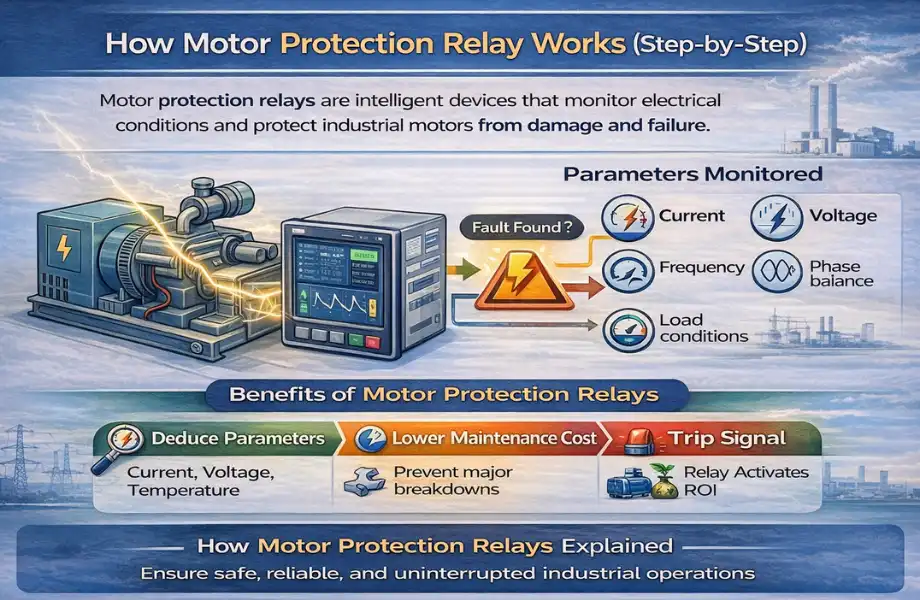
The working principle is simple but highly effective.
Motor protection relays measure current and voltage flowing through the motor. These values are compared with safe operating limits defined in the relay settings.
When the relay detects conditions such as:
Overload
Phase imbalance
Earth fault
Locked rotor
Overtemperature
it automatically trips the motor circuit breaker.
The response usually occurs within milliseconds, stopping damage before it spreads.
This automatic response is why motor protection relays are widely used in modern industrial control systems.
Types of Motor Protection Relays
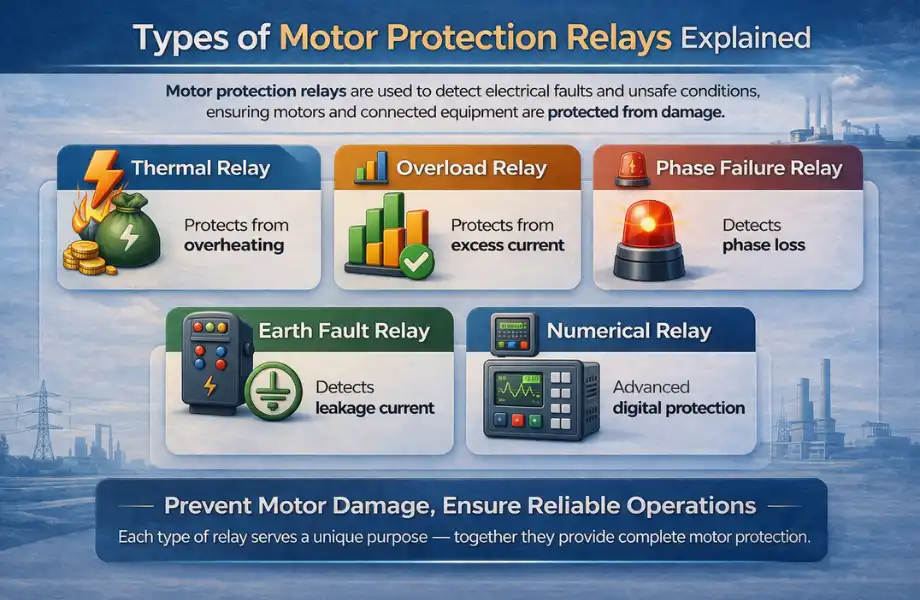
Different motor applications require different protection functions.
Overload Protection Relay
This protects motors from excessive current that may cause overheating.
Phase Failure Relay
Detects loss of one phase in three-phase supply systems.
Earth Fault Relay
Identifies leakage current flowing to ground.
Thermal Protection Relay
Monitors motor temperature to prevent overheating.
Numerical Motor Protection Relays
Modern industrial facilities increasingly use numerical motor protection relays because they combine multiple protection functions in one device.
These systems offer better accuracy and faster response compared to traditional relays.
Where Protection Relays Are Used
Motor protection relays are used across many industries.
Steel plants rely on them to protect conveyor motors and rolling mill drives.
Mining operations use them for crushers, pumps, and ventilation systems.
Manufacturing facilities depend on them to protect production line equipment.
Power plants use them to safeguard auxiliary motors supporting turbines and cooling systems using advanced systems like generator protection relays.
Across West Bengal, Jharkhand, Odisha, and the North-East, these systems help ensure reliable motor operation in demanding industrial environments.
Benefits
Installing reliable motor protection relays provides several advantages.
They prevent motor burnout caused by overload.
>They reduce unexpected downtime in production lines.
>They extend motor life by protecting internal components.
>They improve safety in electrical systems.
>They reduce maintenance costs and repair time.
For industries where motors operate continuously, these benefits make a significant operational difference.
Modern Numerical Motor Protection Systems
Industrial facilities today are increasingly upgrading to numerical motor protection relays.
These systems provide advanced monitoring features such as:
Real-time diagnostics
Multiple protection functions in one device
Digital fault recording
Easy integration with automation systems
Because of these capabilities, numerical motor protection relays offer better reliability and easier maintenance compared to older electromechanical systems.
Industries across Eastern India often rely on experienced providers like Delta Technocrats for reliable protection systems that suit industrial operating conditions.
Many facilities also integrate solutions like Delta PQC Active to improve power quality and enhance electrical system protection.
How to Choose the Right Motor Protection Relays
Selecting the right protection system requires careful planning.
Consider the motor capacity and load type.
Evaluate environmental conditions such as humidity, dust, and temperature.
Study the electrical supply stability.
Ensure proper coordination with feeder and transformer protection relays.
Choosing reliable motor protection relays ensures that motors operate safely even under demanding industrial conditions.
Final Thoughts
Industrial motors work continuously to keep production moving. When they fail, the consequences can be costly and disruptive.
Motor protection relays act as the first line of defense against electrical faults, overloads, and abnormal operating conditions.
By detecting problems early and isolating motors quickly, protection relays help industries maintain reliable operations, protect equipment, and reduce downtime.
For industries across Eastern India, investing in dependable motor protection relays is an important step toward ensuring long-term operational stability.