
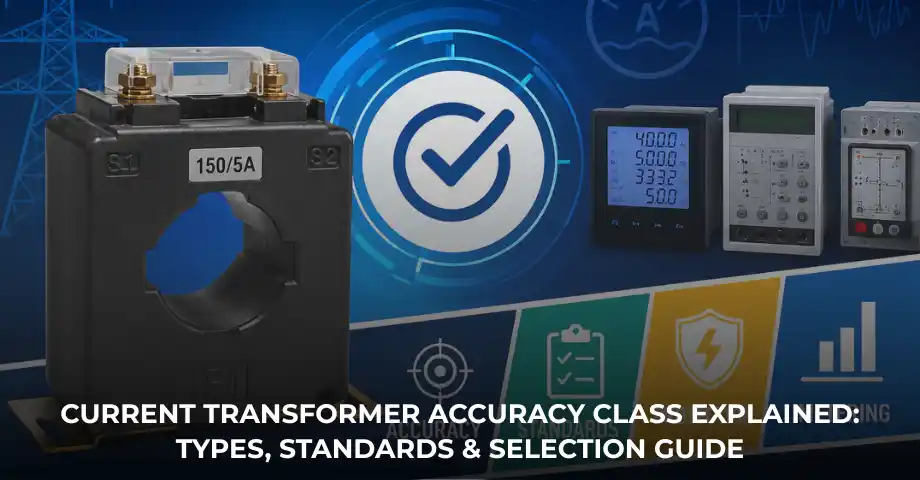
When selecting a current transformer (CT), many engineers focus primarily on the CT ratio and current rating. While these specifications are important, choosing the correct current transformer accuracy class is equally critical for accurate metering, reliable energy monitoring, and dependable protection system performance.
An incorrectly selected CT accuracy class can result in inaccurate energy billing, incorrect monitoring data, nuisance relay trips, or even failure of protection systems during fault conditions. Whether the application involves industrial metering, feeder protection, transformer protection, or generator protection, understanding CT accuracy classes helps ensure that the current transformer performs as intended.
As a type of instrument transformer, a current transformer is designed to reproduce primary current in a reduced and measurable form while maintaining a specified level of accuracy. Understanding CT accuracy classes is essential for electrical engineers, consultants, panel builders, and maintenance professionals responsible for designing and operating power systems.
Expert Note: In industrial substations and power distribution systems, improper CT accuracy class selection is one of the most common causes of metering inaccuracies and protection relay maloperation. Engineers should evaluate CT ratio, burden, fault current levels, and relay requirements before finalizing CT specifications.
What Is Current Transformer Accuracy Class?
The current transformer accuracy class defines the maximum permissible error between the actual primary current and the current reproduced at the CT secondary under specified operating conditions.
In simple terms, the accuracy class indicates how accurately a current transformer can measure or reproduce electrical current. Lower error percentages indicate higher accuracy.
For example:
- Class 0.2 CT = Maximum error of 0.2%
- Class 0.5 CT = Maximum error of 0.5%
- Class 1.0 CT = Maximum error of 1%
Protection CTs use a different classification system. Instead of classes such as 0.2 or 0.5, they use designations like 5P10, 5P20, and 10P20 that describe performance during fault conditions.
Why CT Accuracy Matters in Industrial Applications
Current transformers play a critical role in industrial power systems. Their output is used by energy meters, monitoring equipment, PLCs, SCADA systems, protection relays, and power quality analyzers.
Accurate Energy Billing
Industrial facilities and utilities rely on precise current measurements for billing and cost allocation. Even small errors can lead to significant financial losses over time.
Reliable Energy Monitoring
Energy management systems require accurate data to identify inefficiencies, monitor demand, and optimize power consumption.
Effective Relay Protection
Protection relays depend on accurate current signals to detect faults and isolate affected equipment. Improper CT accuracy can impact the performance of feeder protection relays, transformer protection schemes, and generator protection systems.
Improved System Reliability
Accurate current measurement supports better fault detection, equipment protection, and overall power system stability.
Understanding Current Transformer Accuracy Standards
Current transformer performance is governed by international and national standards that define testing procedures, accuracy limits, burden requirements, and performance criteria.
IEC 61869 Standard
IEC 61869 is the most widely accepted international standard for instrument transformers. It specifies:
- Accuracy classes
- Testing methods
- Rated burden requirements
- Thermal performance
- Protection CT classifications
- Performance verification criteria
IS 2705 Standard
In India, current transformers are commonly manufactured and tested according to IS 2705 standards, which align closely with IEC requirements.
How to Read a Current Transformer Accuracy Class
Understanding CT markings helps engineers select the right transformer for the application.
Class 0.5
A Class 0.5 CT indicates that measurement error will not exceed 0.5% under specified operating conditions.
Class 0.2
A Class 0.2 CT offers higher measurement accuracy and is commonly used in revenue metering applications.
5P10
- 5 = Maximum composite error of 5%
- P = Protection class
- 10 = Accuracy Limit Factor (ALF)
10P20
- 10 = Maximum composite error of 10%
- P = Protection class
- 20 = Accuracy Limit Factor
Common Current Transformer Accuracy Classes Explained
| Accuracy Class | Type | Typical Application |
|---|---|---|
| 0.1 | Metering | Revenue Metering |
| 0.2 | Metering | High Accuracy Metering |
| 0.5 | Metering | Energy Monitoring |
| 1.0 | Metering | General Measurement |
| 5P10 | Protection | Feeder Protection |
| 5P20 | Protection | Transformer Protection |
| 10P20 | Protection | Generator Protection |
CT Accuracy Classes for Metering Applications
Metering CTs are designed to provide highly accurate current measurements under normal operating conditions.
| Accuracy Class | Maximum Error | Typical Application |
|---|---|---|
| 0.1 | 0.1% | Revenue Metering |
| 0.2 | 0.2% | Industrial Billing Systems |
| 0.5 | 0.5% | Energy Monitoring Systems |
| 1.0 | 1% | General Industrial Measurement |
Class 0.5 CTs are among the most commonly used metering CTs in industrial facilities because they provide an excellent balance between accuracy and cost.
CT Accuracy Classes for Protection Applications
Protection CTs are designed to remain accurate during fault conditions when current levels can rise many times above normal operating values.
They are commonly used with:
- Protection relays
- Switchgear systems
- Motor protection systems
- Generator protection systems
- Transformer protection systems
- Circuit breaker control schemes
Industrial power systems frequently combine CTs with transformer protection relays, generator protection relays, and modern numerical protection relays to ensure rapid fault detection and isolation.
What Is Accuracy Limit Factor (ALF)?
The Accuracy Limit Factor (ALF) is one of the most important specifications for protection CTs.
ALF indicates the multiple of rated current up to which a CT can reproduce current accurately before significant saturation occurs.
Examples:
- 5P10 → ALF = 10
- 5P20 → ALF = 20
- 10P20 → ALF = 20
A 100/5A CT with a 5P10 rating can accurately reproduce current up to approximately 1000A before reaching its accuracy limit.
What Does 5P10 Mean?
A 5P10 current transformer consists of:
- 5% maximum composite error
- Protection class designation
- Accuracy Limit Factor of 10
These CTs are commonly used for feeder protection systems and medium-voltage switchgear installations.
What Does 10P20 Mean?
A 10P20 CT has a maximum composite error of 10% and an ALF of 20. These CTs are often used in generator protection and high-capacity industrial systems where fault currents are significantly higher.
Metering CT vs Protection CT
| Feature | Metering CT | Protection CT |
|---|---|---|
| Purpose | Measurement | Fault Protection |
| Typical Classes | 0.2, 0.5, 1.0 | 5P10, 5P20, 10P20 |
| Focus | Normal Operating Current | Fault Current |
| Used With | Energy Meters | Protection Relays |
| Saturation Characteristic | Earlier Saturation | Higher Saturation Point |
Understanding this distinction is important when designing systems involving relays, switchgear, and circuit breakers.
CT Accuracy Class Chart
| Application | Recommended Accuracy Class |
|---|---|
| Revenue Metering | 0.2 |
| Industrial Energy Monitoring | 0.5 |
| General Measurement | 1.0 |
| Feeder Protection | 5P10 |
| Transformer Protection | 5P20 |
| Generator Protection | 10P20 |
How Current Transformer Ratio Affects Accuracy
CT ratio selection has a direct impact on measurement accuracy.
For example, installing a 1000/5A CT on a feeder carrying only 100A most of the time can reduce measurement accuracy at low loads. Selecting a ratio that closely matches the expected operating current helps improve accuracy and overall system performance.
If you’re new to CT selection, understanding the differences between a current transformer and potential transformer can help clarify their respective applications.
How Burden Affects CT Accuracy
The burden of a CT represents the total load connected to its secondary circuit, including meters, relays, monitoring devices, and wiring resistance.
If the connected burden exceeds the CT’s rated burden:
- Measurement errors increase
- Phase angle errors increase
- Protection performance deteriorates
- Relay operation becomes less reliable
Common CT Burden Ratings
| CT Type | Common Burden Ratings |
|---|---|
| Metering CT | 5 VA, 10 VA, 15 VA |
| Protection CT | 10 VA, 15 VA, 30 VA |
| High Burden Protection CT | 30 VA, 45 VA, 60 VA |
Practical Examples of CT Accuracy Class Selection
Energy Monitoring Application
For a 400A industrial feeder connected to an energy management system, a 400/5A Class 0.5 CT is often an ideal choice.
Feeder Protection Application
For an 800A feeder protected by relays, a 5P10 CT is commonly selected.
Transformer Protection Application
Transformer differential protection systems typically require protection CTs such as 5P20 to ensure accurate fault current reproduction.
How to Choose the Right Current Transformer Accuracy Class
- Select Class 0.2 or 0.5 for accurate metering.
- Select 5P10 for feeder protection.
- Select 5P20 for transformer protection.
- Select 10P20 for generator protection.
- Evaluate CT ratio and burden carefully.
- Consider relay specifications and fault current levels.
Frequently Asked Questions
What is the most commonly used CT accuracy class?
Class 0.5 is commonly used for industrial metering applications, while 5P10 is frequently used for feeder protection systems.
What is the difference between 5P10 and 5P20 CT?
Both have a 5% composite error limit, but 5P20 has a higher Accuracy Limit Factor and can accurately reproduce higher fault currents.
Can a metering CT be used for protection?
Generally no. Metering CTs are optimized for measurement accuracy and may saturate during fault conditions, affecting relay operation.
Which CT class is used for energy billing?
Class 0.2 CTs are commonly used for revenue metering and billing applications.
How does CT burden affect accuracy?
Excessive burden increases measurement errors and can reduce protection system reliability.
Conclusion
The current transformer accuracy class plays a vital role in ensuring accurate measurement and dependable protection in industrial power systems. Metering CTs such as Class 0.2 and Class 0.5 are designed for precise energy measurement, while protection CTs such as 5P10, 5P20, and 10P20 are engineered to maintain accuracy during fault conditions.
When selecting a CT, engineers should evaluate accuracy class, CT ratio, burden requirements, fault levels, and relay specifications. A properly selected current transformer improves measurement accuracy, enhances protection system performance, and increases overall system reliability.
At Delta Technocrats, we provide high-quality current transformers, protection relays, switchgear components, and power protection solutions for industrial applications. Our team can help you select the appropriate CT ratio, burden rating, and accuracy class to ensure safe and reliable operation of your electrical systems.