
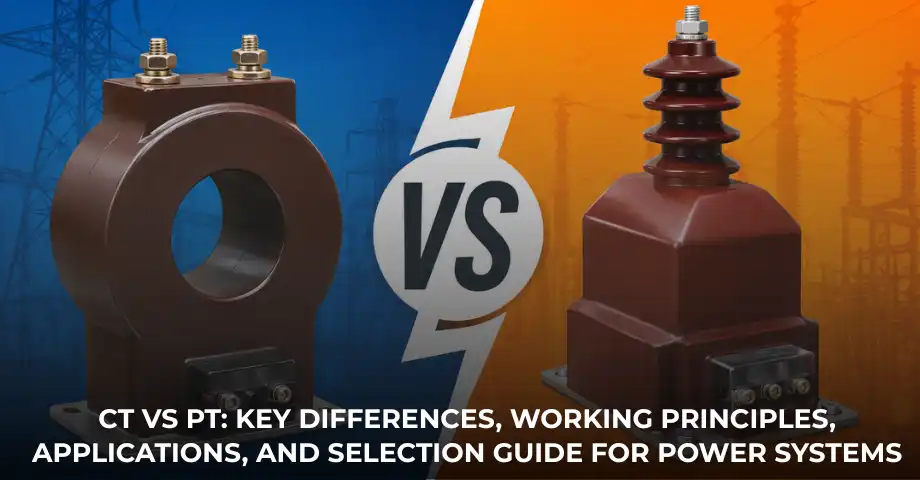
Current Transformers (CTs) and Potential Transformers (PTs) are among the most critical components used in electrical substations, industrial power systems, utility networks, and power generation facilities. Although both belong to the category of instrument transformers, they serve different purposes and are designed to measure different electrical parameters.
Whether you are designing a substation, specifying protection systems, selecting metering equipment, or troubleshooting relay operations, understanding the difference between CT and PT is essential. These devices enable safe measurement of high currents and voltages while providing the accurate inputs required by protective relays, energy meters, SCADA systems, and monitoring equipment.
In this guide, we will explore the working principles, construction, applications, ratings, selection criteria, and practical uses of CTs and PTs in power systems. We will also look at real-world industrial examples that highlight why proper instrument transformer selection is crucial for system reliability.
Before diving into the comparison, it is useful to understand the broader concept of instrument transformers, which form the foundation of modern power system measurement and protection.
What Are Instrument Transformers?
Instrument transformers are specialized transformers designed to reduce high electrical quantities to safe and standardized values suitable for measurement and protection equipment.
They perform two critical functions:
- Electrical isolation between high-voltage power circuits and low-voltage instruments
- Accurate transformation of current or voltage for monitoring and protection
The two main types of instrument transformers are:
- Current Transformer (CT) – used for current measurement
- Potential Transformer (PT) – used for voltage measurement
Without CTs and PTs, direct connection of measuring instruments and protective relays to high-voltage systems would be unsafe and impractical.
CT vs PT Difference Table
For engineers and maintenance professionals, the easiest way to understand the difference between a current transformer and a potential transformer is through a direct comparison.
| Parameter | Current Transformer (CT) | Potential Transformer (PT) |
|---|---|---|
| Full Form | Current Transformer | Potential Transformer |
| Primary Function | Measures current | Measures voltage |
| Connection | Connected in series with the circuit | Connected in parallel with the circuit |
| Input Quantity | High current | High voltage |
| Output Quantity | 1A or 5A current | 110V or 63.5V voltage |
| Primary Winding | Very few turns | Large number of turns |
| Secondary Winding | More turns than primary | Fewer turns than primary |
| Purpose | Current measurement and protection | Voltage measurement and protection |
| Metering Use | Energy meters and ammeters | Voltmeters and power quality monitoring |
| Protection Use | Overcurrent, differential, earth fault protection | Distance, over-voltage, under-voltage protection |
| Typical Secondary Rating | 1A or 5A | 110V or 63.5V |
| Accuracy Classes | 0.1, 0.2, 0.5, 5P, 10P | 0.1, 0.2, 0.5, 1.0 |
| Installation Location | Feeders, transformers, generators, busbars | Busbars, feeders, transmission lines |
| Safety Consideration | Secondary should never be open-circuited | Secondary can be open-circuited safely |
| Typical Ratio Example | 400/5A | 11kV/110V |
| Main Application | Current monitoring and protection | Voltage monitoring and protection |
What Is a Current Transformer (CT)?
A Current Transformer (CT) is an instrument transformer designed to convert high primary current into a proportional low secondary current. The most common secondary ratings are 5A and 1A.
The CT is connected in series with the power circuit, meaning the primary conductor carries the full load current. The secondary winding produces a scaled-down current that can be safely used by meters, protection relays, and monitoring devices.
For example, a 500/5A CT converts a primary current of 500A into a secondary current of 5A.
Common CT Applications
- Feeder protection
- Transformer differential protection
- Generator protection
- Motor protection
- Energy metering
- Load monitoring
- SCADA systems
What Is a Potential Transformer (PT)?
A Potential Transformer (PT), also called a Voltage Transformer (VT), is used to reduce high system voltage to a standardized low voltage suitable for measurement and protection equipment.
The PT is connected in parallel with the circuit and continuously supplies a scaled representation of the actual system voltage.
For example, an 11kV/110V PT converts 11,000 volts into 110 volts for safe measurement and relay operation.
Common PT Applications
- Voltage monitoring
- Revenue metering
- Power quality analysis
- Synchronization systems
- Distance protection schemes
- Under-voltage and over-voltage protection
- Frequency monitoring
CT vs PT Working Principle
Current Transformer Working Principle
A CT operates on the principle of electromagnetic induction. When current flows through the primary conductor, it creates magnetic flux in the transformer core. This magnetic flux induces a proportional current in the secondary winding.
The current ratio remains consistent, enabling accurate measurement across a wide operating range.
Potential Transformer Working Principle
A PT also works on electromagnetic induction. The primary winding is connected across the system voltage, and a proportional reduced voltage is generated in the secondary winding.
This allows meters and protection relays to monitor system voltage without being exposed to dangerous voltage levels.
Why CT and PT Are Used in Substations
Modern substations rely heavily on CTs and PTs because direct measurement of transmission and distribution voltages and currents is neither safe nor practical.
In a typical 33kV or 132kV substation, CTs and PTs provide the critical data required for:
- Protection relays
- Energy meters
- SCADA systems
- Remote monitoring platforms
- Fault analysis systems
- Load management systems
Without instrument transformers, operators would have no reliable way to monitor or protect high-voltage electrical networks.
Real Industrial Example: 33kV Manufacturing Plant Expansion
A large manufacturing facility expanded its production capacity and added a new 33kV incoming feeder to support additional electrical loads.
During the project, the engineering team selected a 100/5A CT based on historical loading data. However, after expansion, actual load currents frequently exceeded 200A.
The undersized CT began operating outside its optimal range, resulting in inaccurate current measurements and occasional nuisance tripping of protection relays.
The facility experienced multiple production interruptions before engineers identified the root cause.
After replacing the CT with a properly selected 300/5A protection-grade CT, relay performance stabilized, measurement accuracy improved, and unwanted trips were eliminated.
This example demonstrates why CT ratio selection is not merely a specification exercise—it directly impacts operational reliability and production continuity.
Role of CT and PT in Power System Protection
One of the most important applications of CTs and PTs is supplying measurement signals to protective relays.
Modern protection systems cannot function without accurate current and voltage inputs.
Feeder Protection
CTs detect overloads, short circuits, and earth faults, while PTs provide voltage references required for directional and distance protection functions.
These measurements are essential for effective feeder protection relay systems.
Transformer Protection
Differential protection schemes compare current measurements from CTs installed on both sides of the transformer. PTs may also provide additional voltage inputs for advanced protection functions.
This is why accurate instrument transformers are critical for reliable transformer protection relays.
Generator Protection
Generators require continuous monitoring of current, voltage, frequency, and fault conditions.
CTs and PTs provide the essential measurements used by generator protection relay systems to safeguard valuable power generation assets.
Numerical Relays
Modern digital relays receive inputs from CTs and PTs and perform sophisticated calculations involving power, frequency, power factor, impedance, and fault analysis.
The increasing adoption of numerical protection relays has made accurate instrument transformer selection more important than ever.
Metering CT vs Protection CT
One of the most overlooked aspects of CT selection is understanding the difference between metering CTs and protection CTs.
Metering CT
Metering CTs are designed for maximum accuracy under normal operating conditions.
Applications include:
- Revenue metering
- Energy audits
- Demand monitoring
- Power consumption analysis
Common accuracy classes include 0.1, 0.2, and 0.5.
Protection CT
Protection CTs are designed to remain accurate during fault conditions when current levels may be many times higher than normal operating current.
Applications include:
- Overcurrent protection
- Differential protection
- Earth fault protection
- Distance protection
Common classes include 5P10, 5P20, and 10P10.
Using a metering CT for protection applications can result in relay maloperation during faults.
Real Protection Case Study: Differential Relay Nuisance Tripping
An industrial facility installed a new power transformer protected by a differential relay scheme.
Shortly after commissioning, the transformer experienced repeated trips despite showing no signs of internal faults.
Detailed investigation revealed that CT ratios on the high-voltage and low-voltage sides were not properly matched to the transformer configuration.
The resulting current imbalance was interpreted by the differential relay as an internal fault.
After correcting the CT ratios and relay settings, the nuisance tripping was eliminated and the transformer operated normally.
This case highlights an important reality in power system protection: relay performance is only as reliable as the instrument transformers supplying the measurement signals.
CT vs PT Accuracy Classes
Accuracy class selection depends on the intended application.
CT Accuracy Classes
- Class 0.1 – Precision revenue metering
- Class 0.2 – High-accuracy billing applications
- Class 0.5 – Standard industrial metering
- Class 5P – Protection applications
- Class 10P – Protection applications
PT Accuracy Classes
- Class 0.1
- Class 0.2
- Class 0.5
- Class 1.0
The correct accuracy class ensures reliable measurements and proper relay operation.
How to Select the Right CT and PT
Proper instrument transformer selection is essential for both safety and performance.
CT Selection Factors
- Maximum load current
- Fault current level
- Accuracy class
- Burden requirement
- Protection or metering application
- Thermal withstand capability
PT Selection Factors
- System voltage level
- Required transformation ratio
- Accuracy class
- Burden rating
- Insulation requirements
- Indoor or outdoor installation
For industrial and utility projects, selecting high-quality instrument transformers from experienced suppliers helps ensure long-term reliability and compliance with protection requirements.
Common CT and PT Selection Mistakes
- Choosing incorrect transformation ratios
- Ignoring burden calculations
- Selecting the wrong accuracy class
- Using metering CTs for protection schemes
- Incorrect polarity connections
- Improper grounding practices
- Opening a CT secondary circuit under load
These mistakes can lead to inaccurate metering, relay maloperation, unnecessary outages, and equipment damage.
Frequently Asked Questions
Can a CT measure voltage?
No. A CT is specifically designed for current measurement and protection applications.
Can a PT measure current?
No. A PT is designed exclusively for voltage measurement.
Why should a CT secondary never be left open?
An open CT secondary can generate dangerously high voltages that may damage equipment and create serious safety hazards.
Why is a PT connected in parallel?
A PT must measure the voltage across the circuit, which requires a parallel connection.
Which is more important in a substation, CT or PT?
Both are equally important because modern protection and monitoring systems require accurate current and voltage measurements.
Conclusion
Understanding the difference between CT and PT is essential for designing reliable electrical systems, selecting the right protection equipment, and ensuring accurate metering. While CTs measure current and PTs measure voltage, both serve as the backbone of power system monitoring, protection, and control.
From industrial plants and commercial facilities to utility substations and power generation stations, CTs and PTs provide the measurement foundation required by modern relay protection systems. Proper selection of ratios, accuracy classes, burden ratings, and application-specific configurations can significantly improve system reliability, operational safety, and protection performance.
As power systems continue to become smarter and more automated, the importance of accurately specified instrument transformers will only continue to grow.