
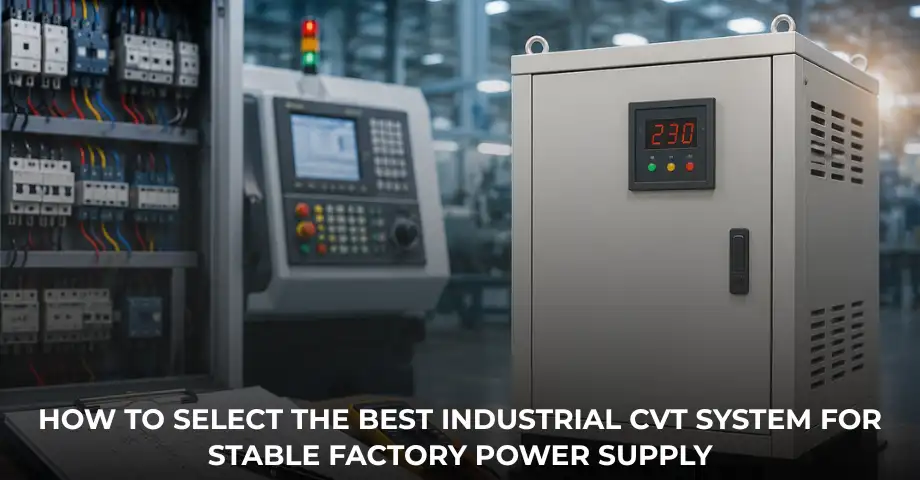
Modern manufacturing facilities depend heavily on stable electrical power for uninterrupted operations. CNC machines, PLC systems, automation equipment, servo drives, testing systems, and sensitive industrial electronics require consistent voltage to operate efficiently. However, many factories regularly face voltage fluctuations, electrical noise, harmonics, and unstable utility supply conditions that negatively impact productivity and equipment reliability.
Choosing the right industrial Constant Voltage Transformer (CVT) system is one of the most effective ways to ensure stable factory power supply and protect sensitive industrial equipment from electrical disturbances.
This guide explains how to select the best industrial CVT system for manufacturing environments, what factors industries should evaluate before installation, and how the right voltage protection strategy can improve operational reliability and reduce machine downtime.
Why Stable Power Supply Is Critical for Modern Factories
Industrial facilities today operate with highly sensitive automation systems that cannot tolerate unstable voltage conditions. Even small voltage variations can affect machine accuracy, control logic, and production consistency.
Factories commonly experience:
- Voltage fluctuations
- Sudden voltage dips
- Power surges
- Electrical noise
- Harmonic disturbances
- Unbalanced incoming supply
- Transient switching spikes
These electrical problems often result in:
- CNC machine tripping
- PLC communication failure
- Servo drive malfunction
- Production interruptions
- Control board damage
- Machine calibration issues
- Increased maintenance costs
- Unexpected equipment downtime
Industries operating precision manufacturing systems cannot rely solely on basic electrical protection methods. They require advanced industrial power conditioning solutions capable of maintaining a stable voltage supply under varying load and utility conditions.
For industries dealing with unstable power environments, implementing proper industrial voltage fluctuation solutions becomes essential for maintaining production continuity and machine reliability.
What Is an Industrial Constant Voltage Transformer?
An industrial Constant Voltage Transformer (CVT) is a specialized power conditioning device designed to maintain stable output voltage even when the input voltage fluctuates significantly.
Unlike conventional stabilizers, industrial CVTs provide:
- Continuous voltage correction
- Electrical noise filtering
- Transient suppression
- Improved power conditioning
- Enhanced protection for sensitive equipment
- Reliable voltage regulation under dynamic load conditions
Industrial CVTs are widely used for:
- CNC machines
- PLC panels
- Laboratory equipment
- Automation systems
- Robotics
- Medical equipment
- Testing instruments
- Semiconductor manufacturing systems
Industries looking for reliable constant voltage transformer solutions for industrial use often deploy CVTs in applications where even minor voltage instability can impact operational accuracy and machine safety.
Why Standard Stabilizers Are Often Insufficient for Sensitive Industrial Equipment
Many factories initially attempt to solve voltage fluctuation problems using standard voltage stabilizers. While stabilizers can help regulate incoming supply voltage to some extent, they may not provide the level of protection required for sensitive automation equipment.
Industrial machines such as CNC systems and PLC-controlled production lines are highly sensitive to:
- Voltage spikes
- Electrical transients
- Noise interference
- Frequency disturbances
- Fast voltage variations
A standard stabilizer may not adequately filter electrical noise or respond effectively to rapid fluctuations. In contrast, industrial CVT systems provide cleaner and more stable power output, making them more suitable for high-precision industrial applications.
Key Factors to Consider When Selecting an Industrial CVT System
1. Evaluate the Nature of Voltage Fluctuation in Your Factory
The first step in choosing the right CVT is understanding the actual power quality condition of the facility.
Industries should analyze:
- Frequency of voltage fluctuations
- Voltage variation range
- Load instability patterns
- Presence of harmonic distortion
- Utility supply reliability
- Power factor conditions
Factories experiencing continuous voltage instability often require industrial-grade CVTs with higher regulation accuracy and stronger noise filtering capabilities.
Understanding the causes of industrial voltage fluctuation helps industries select the most appropriate power conditioning solution for their operational environment.
2. Identify the Type of Equipment Requiring Protection
Different industrial machines have different power sensitivity levels.
For example:
- CNC machines require stable voltage for precision machining accuracy
- PLC systems require uninterrupted control voltage stability
- Servo drives require clean power for smooth motor operation
- Testing equipment requires highly accurate voltage regulation
- Automation systems require noise-free electrical supply
Selecting the wrong CVT type or capacity can lead to insufficient protection and recurring machine problems.
3. Proper CVT Sizing for Factory Applications
One of the most common industrial mistakes is undersizing the CVT system.
Industries often calculate only the running load while ignoring:
- Startup current
- Inrush current
- Load expansion plans
- Motor starting conditions
- Dynamic load variation
Improper sizing can cause:
- Overheating
- Poor voltage regulation
- Reduced equipment life
- Frequent tripping
- Protection failure
An industrial CVT should always be selected with sufficient safety margin based on actual operating conditions rather than theoretical load values alone.
4. Check Voltage Regulation Accuracy
Voltage regulation accuracy is critical in sensitive manufacturing environments.
High-precision equipment often requires:
- Tight voltage tolerance
- Fast correction response
- Stable output under varying load conditions
Factories operating automation-heavy systems should prioritize industrial CVTs designed specifically for precision voltage correction applications.
5. Consider Harmonic and Electrical Noise Protection
Modern industrial facilities contain multiple nonlinear loads such as:
- VFD drives
- Servo systems
- Switch-mode power supplies
- Automation controllers
- Robotic systems
These systems generate harmonics and electrical noise that can affect nearby equipment.
Industrial CVTs with advanced noise filtering and power conditioning capabilities help reduce:
- Signal interference
- Control instability
- Communication errors
- Sensitive electronics failure
How Industrial CVTs Protect CNC Machines and PLC Systems
CNC machines and PLC-based automation systems represent major investments for manufacturing companies. Even short-duration voltage instability can disrupt machine operations and lead to production losses.
Common issues caused by unstable power include:
- CNC spindle interruption
- Servo positioning errors
- PLC memory corruption
- Unexpected machine shutdowns
- Program execution faults
- Reduced machining accuracy
Industrial CVTs help maintain:
- Consistent machine voltage
- Stable control system performance
- Reliable automation operation
- Reduced downtime risk
- Longer equipment lifespan
For factories operating critical automation systems, stable voltage supply is not just an electrical requirement — it directly affects production quality and operational profitability.
Signs Your Factory Needs an Industrial CVT System
Many industries continue operating with unstable power conditions without realizing the long-term damage caused to equipment.
Common warning signs include:
- Frequent machine tripping
- PLC restarting issues
- Control panel malfunction
- Servo drive faults
- Burnt electronic components
- Production inconsistencies
- Unexpected downtime during voltage fluctuation
- Repeated maintenance of sensitive machines
Factories facing these issues should evaluate their overall power quality environment and implement industrial-grade voltage protection systems.
Common Mistakes Industries Make While Choosing CVT Systems
Selecting Based Only on Price
Low-cost systems may not provide the necessary protection quality required for industrial environments.
Ignoring Load Expansion
Future machine additions should always be considered during CVT sizing.
Choosing Domestic-Grade Systems for Industrial Applications
Industrial environments require robust systems designed for continuous operation under demanding conditions.
Ignoring Harmonic Conditions
Factories with heavy automation systems must consider harmonic distortion before selecting a CVT.
Not Evaluating Machine Sensitivity
Different industrial machines require different levels of voltage stability and noise protection.
Importance of Integrated Industrial Protection Systems
While industrial CVTs provide critical voltage stabilization and power conditioning, factories should also implement comprehensive electrical protection systems for complete operational reliability.
Additional protection solutions may include:
- Protection relays
- Surge protection systems
- Transformer protection systems
- Power monitoring solutions
- Industrial grounding systems
Advanced industrial protection relays play an important role in protecting electrical infrastructure against abnormal operating conditions and equipment faults.
Industries operating large transformer systems may also require specialized transformer protection solutions to improve overall electrical reliability and infrastructure safety.
Choosing the Right Industrial CVT Supplier
Selecting the right CVT system is not only about choosing equipment specifications. It also depends on choosing an experienced industrial power solution provider who understands manufacturing environments and application-specific challenges.
A reliable supplier should provide:
- Load analysis support
- Application-based recommendations
- Proper system sizing guidance
- Industrial installation expertise
- After-sales technical support
- Power quality consultation
Experienced industrial solution providers can help factories identify hidden electrical risks and recommend long-term voltage protection strategies suitable for critical manufacturing operations.
Delta Technocrats provides industrial voltage protection and power quality solutions designed for demanding factory applications where stable voltage supply and operational reliability are essential.
Conclusion
Stable power supply is one of the most important requirements for modern industrial operations. Voltage fluctuations, electrical noise, and unstable utility conditions can severely affect CNC machines, PLC systems, automation equipment, and sensitive industrial electronics.
Selecting the right industrial CVT system requires careful evaluation of:
- Factory load conditions
- Machine sensitivity
- Voltage fluctuation patterns
- Power quality requirements
- Future expansion plans
- Protection requirements
A properly selected industrial Constant Voltage Transformer not only protects equipment but also improves production reliability, reduces downtime, enhances machine lifespan, and supports long-term manufacturing efficiency.
For industries aiming to improve factory power stability and protect critical automation systems, investing in the right industrial CVT solution is a strategic operational decision rather than simply an electrical upgrade.