
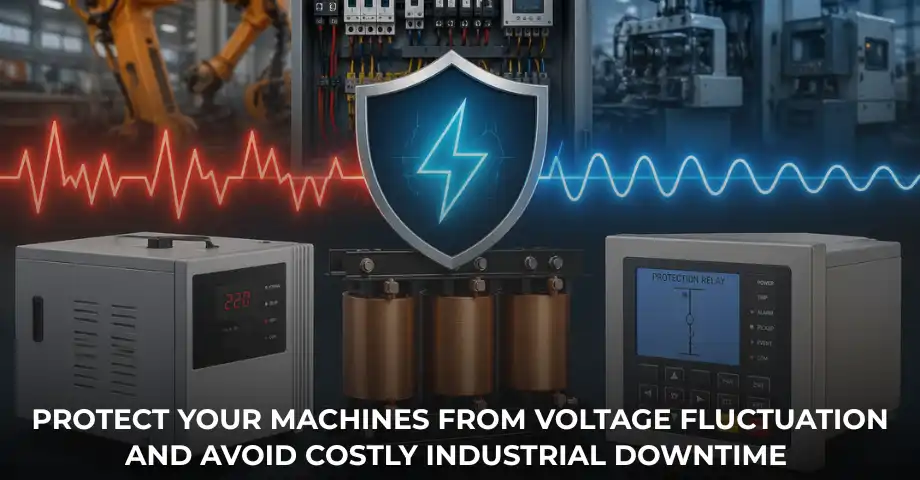
In many industrial facilities across India, production disruptions are not always caused by major equipment failures. More often, they begin with something far less obvious — unstable voltage.
A CNC machine suddenly stops mid-operation. A PLC panel resets without warning. Motors start overheating despite normal load conditions. These are not random faults; they are early indicators of voltage fluctuation affecting your electrical system.
The real challenge is that voltage fluctuation rarely causes immediate breakdown. Instead, it gradually weakens machines, increases maintenance frequency, and eventually leads to costly downtime and production losses.
For industries dealing with inconsistent power supply and heavy electrical loads, finding the right voltage fluctuation solution is not optional — it is essential for operational reliability.
Understanding Voltage Fluctuation in Industrial Environments
Voltage fluctuation refers to variations in electrical voltage beyond the safe operating limits required by industrial equipment. While minor fluctuations are expected, frequent or wide variations can significantly impact machine performance.
In industrial setups, especially in India, this issue is more pronounced due to a combination of infrastructure constraints and internal load conditions. Unlike residential systems, factories operate with dynamic loads, heavy machinery, and extended distribution networks.
Some of the most common causes of industrial voltage fluctuation include:
- Frequent starting and stopping of high-capacity machines
- Unstable grid supply or power quality issues
- Long cable runs causing voltage drop
- Improper transformer sizing or overloading
- Unbalanced electrical loads across phases
These factors contribute to continuous voltage variation, which directly affects equipment efficiency and lifespan.
Why Voltage Fluctuation Damages Industrial Machines
Every industrial machine is designed to operate within a defined voltage range. When voltage deviates from this range, even slightly, it can disrupt performance and cause long-term damage.
Sensitive systems such as CNC machines and PLC panels rely on stable voltage for precise control. Even minor fluctuations can result in system errors, loss of accuracy, or unexpected shutdowns.
On the other hand, heavy-duty equipment like motors and compressors may continue operating under fluctuating voltage but experience internal stress. Low voltage increases current draw, leading to overheating, while high voltage can damage insulation and reduce component life.
Over time, this results in:
- Frequent tripping and process interruptions
- Increased wear and tear of electrical components
- Higher maintenance and repair costs
- Reduced efficiency and energy wastage
- Shortened equipment lifespan
Even a short downtime can result in significant production losses in industrial environments, especially in sectors like manufacturing, textiles, and pharmaceuticals.
Which Machines Are Most at Risk?
Not all machines respond equally to voltage fluctuation. Understanding this difference is crucial for selecting the right protection strategy.
Sensitive Equipment
Machines such as PLC panels, CNC systems, and laboratory instruments are highly sensitive to voltage variations. These systems require consistent and precise voltage to function correctly.
Industries experiencing recurring voltage instability, especially in sensitive operations, often require more precise solutions such as constant voltage transformers.
For such applications, you can explore constant voltage transformer solutions designed for industrial use.
Heavy Load Equipment
Motors, compressors, pumps, and molding machines can tolerate minor variations but are affected by large or frequent fluctuations, particularly during startup cycles.
Continuous exposure to unstable voltage reduces their operational efficiency and accelerates wear.
The Real Cost of Ignoring Voltage Fluctuation
Many industries underestimate the impact of voltage fluctuation because the effects are not always immediate. However, the long-term consequences can be severe.
Unplanned downtime disrupts production schedules, increases maintenance costs, and leads to missed delivery timelines. Repeated electrical stress also reduces equipment lifespan, forcing premature replacement and higher capital investment.
In reality, the cost of ignoring voltage issues is often far greater than implementing a proper power fluctuation solution in industry.
Best Solutions for Voltage Fluctuation in Industry
Protecting machines from voltage fluctuation requires a structured and layered approach. Instead of relying on a single device, industries should implement multiple solutions based on their operational needs.
Electrical System Optimization
The foundation of any solution begins with proper electrical design. Load balancing, correct cable sizing, and proper earthing help minimize voltage instability at the source.
Servo Voltage Stabilizers
Servo stabilizers are widely used in industrial environments where voltage variations are significant. They regulate voltage dynamically and are suitable for heavy equipment such as motors and compressors.
However, stabilizers have limitations in terms of response time and precision, making them less effective for sensitive electronic systems.
Constant Voltage Transformer (CVT)
For high-precision applications, Constant Voltage Transformers provide a more advanced and reliable solution.
CVTs offer instant voltage correction, high output stability, and noise isolation. This makes them ideal for CNC machines, PLC panels, and other sensitive equipment.
You can review detailed specifications of constant voltage transformers for industrial use to understand their applications.
Protection Relays
Protection relays provide system-level safety by detecting abnormal electrical conditions and isolating faults before damage occurs.
Implementing industrial protection relays along with solutions like feeder protection relays and transformer protection relays enhances overall system reliability.
CVT vs Stabilizer: Which One Should You Choose?
| Feature | CVT | Stabilizer |
|---|---|---|
| Response Time | Instant | Slight delay |
| Output Precision | Very high | Moderate |
| Best Application | Sensitive equipment | Heavy load machinery |
| Noise Filtering | Yes | Limited |
For sensitive electronic systems, CVT is the preferred solution. For heavy-duty applications with wide voltage variations, stabilizers are more suitable. In many cases, a combination of both provides the best results.
When Do You Need a Constant Voltage Transformer?
A CVT becomes essential in situations where voltage stability directly impacts performance and accuracy. This includes:
- Frequent voltage fluctuations in the power supply
- Operation of sensitive equipment such as CNC or PLC systems
- Use of generator-based power systems
- Precision-driven industrial processes
In such cases, relying only on stabilizers may not provide adequate protection.
Common Mistakes Industries Make
Many industries attempt to solve voltage problems but end up using incorrect solutions due to lack of proper assessment.
Some common mistakes include choosing equipment with incorrect capacity, ignoring the actual fluctuation range, and using stabilizers where precision-based solutions like CVT are required.
A proper evaluation of load conditions and equipment sensitivity is essential before selecting a solution.
Maintenance and Long-Term Reliability
Installing protection systems is only the first step. Regular maintenance ensures that these systems continue to perform effectively over time.
Routine inspections help identify potential issues early and prevent unexpected failures. Following a structured approach improves reliability and extends equipment lifespan.
For practical guidance, refer to this CVT maintenance checklist to maintain optimal performance.
Conclusion: Choosing the Right Voltage Fluctuation Solution
Voltage fluctuation is a common but critical issue in industrial environments. However, with the right approach, its impact can be effectively controlled.
By combining electrical system optimization, stabilizers, constant voltage transformers, and protection relays, industries can protect their machines, reduce downtime, and improve operational efficiency.
Consult with experts to identify the most suitable voltage fluctuation solution based on your equipment, load conditions, and operational requirements.
To explore complete industrial solutions, visit the Delta Technocrats homepage.
Frequently Asked Questions (FAQs)
What is the best voltage fluctuation solution for industry?
The best voltage fluctuation solution for industry depends on the type of equipment and operating conditions. For heavy machinery with large load variations, servo voltage stabilizers are commonly used. However, for sensitive equipment such as CNC machines and PLC systems, Constant Voltage Transformers (CVT) provide better protection due to their high precision and instant response. In many industrial setups, a combination of stabilizers, CVTs, and protection relays offers the most effective solution.
How do you fix voltage fluctuation in factories?
Fixing voltage fluctuation in factories requires a combination of electrical system improvements and protective devices. This includes proper load balancing, correct transformer sizing, and installation of equipment such as stabilizers, CVTs, and protection relays. Identifying the root cause of fluctuation is essential before selecting the appropriate solution, as different machines require different levels of protection.
Is CVT better than a stabilizer?
CVT and stabilizers serve different purposes, so one is not universally better than the other. CVTs are better suited for sensitive equipment that requires precise and stable voltage, as they provide instant correction and high accuracy. Stabilizers, on the other hand, are more suitable for heavy-duty machinery that can tolerate slight variations but needs voltage regulation over a wider range. In many cases, both are used together in industrial environments.
Which machines need voltage protection?
Machines that rely on electronic controls or precision operations require voltage protection. This includes CNC machines, PLC panels, laboratory equipment, and automation systems. Additionally, heavy equipment such as motors, compressors, and pumps also benefits from protection, as voltage fluctuation can cause overheating, inefficiency, and reduced lifespan.
When should you use a CVT?
A constant-voltage transformer should be used when equipment requires a stable and precise voltage to operate correctly. This is especially important in cases of frequent voltage fluctuation, use of sensitive machines like CNC or PLC systems, a generator-based power supply, or precision-driven industrial processes. CVTs ensure consistent output voltage and help prevent operational disruptions.