
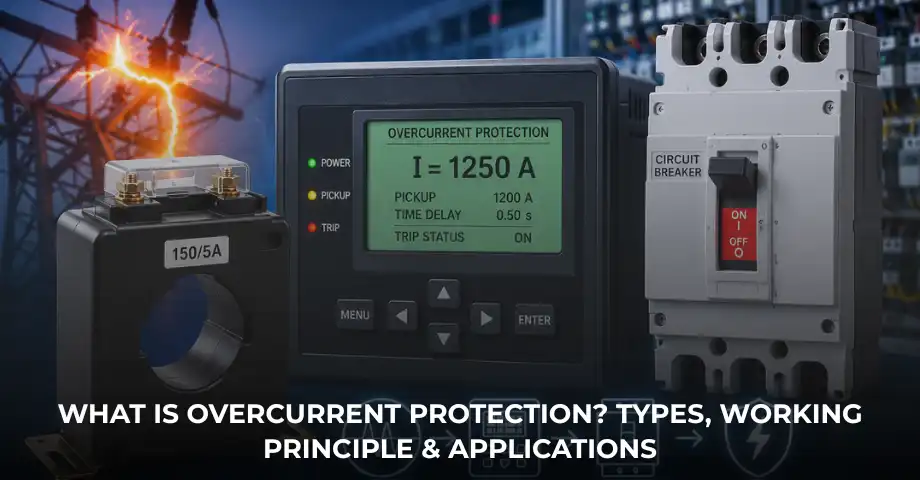
Electrical faults are one of the biggest threats to industrial power systems. A sudden short circuit, equipment failure, or overloaded circuit can cause severe damage to transformers, motors, generators, switchgear, and other critical assets. In addition to costly repairs, electrical faults can lead to production downtime, safety hazards, and even fire risks.
This is where overcurrent protection plays a crucial role. Overcurrent protection is one of the most widely used protection methods in electrical systems because it helps detect abnormal current levels and disconnect faulty equipment before significant damage occurs.
Whether protecting industrial feeders, transformers, motors, generators, or distribution panels, overcurrent protection forms the foundation of a reliable electrical protection system. Modern protection schemes combine current transformers, protection relays, and circuit breakers to quickly identify faults and isolate affected sections of the network.
In this guide, we’ll explain what overcurrent protection is, how it works, the different types of overcurrent protection, and where it is used in industrial applications.
What Is Overcurrent Protection?
Overcurrent protection is a protective function designed to detect electrical currents that exceed the normal operating limits of a circuit or piece of equipment and automatically disconnect the affected circuit before damage occurs.
In a properly designed electrical system, equipment operates within specified current ratings. However, abnormal conditions such as short circuits, overloads, insulation failures, or equipment malfunctions can cause current to rise beyond safe levels. If these excessive currents are not cleared quickly, they can damage conductors, transformers, motors, generators, and switchgear.
The primary purpose of overcurrent protection is to:
- Protect electrical equipment from damage
- Prevent overheating of cables and conductors
- Reduce fire hazards
- Improve system reliability
- Minimize production downtime
- Enhance personnel safety
In modern industrial facilities, overcurrent protection is commonly implemented using current transformers, protection relays, and circuit breakers.
Why Is Overcurrent Protection Important?
Electrical systems are constantly exposed to operating conditions that can create abnormal current flow. Without adequate protection, even a minor fault can escalate into a major equipment failure.
Protects Expensive Equipment
Industrial transformers, motors, generators, and switchgear represent significant capital investments. Overcurrent protection helps prevent costly damage caused by excessive fault currents.
Reduces Downtime
Unexpected equipment failures can disrupt production schedules and reduce operational efficiency. Fast fault detection minimizes downtime and speeds up system recovery.
Improves Safety
Excessive current can create dangerous situations, including arc flashes, overheating, and electrical fires. Proper protection improves workplace safety for maintenance personnel and operators.
Enhances System Reliability
A well-designed protection system ensures faults are isolated quickly without affecting the entire electrical network.
What Causes Overcurrent?
Understanding the causes of overcurrent is essential for selecting the correct protection system.
Overload Conditions
An overload occurs when equipment draws more current than its rated capacity over an extended period. Common examples include overloaded motors, excessive connected loads, and mechanical equipment jams.
Short Circuits
A short circuit occurs when conductors with different electrical potentials come into direct contact. This can generate extremely high fault currents capable of causing severe equipment damage within milliseconds.
Ground Faults
Ground faults occur when current unintentionally flows to earth due to insulation failure or damaged equipment. These faults often require specialized protection schemes in addition to standard overcurrent protection.
Equipment Failure
Transformer winding failures, motor insulation breakdown, damaged cables, and defective switchgear components can all create abnormal current conditions.
Incorrect System Design
Improper conductor sizing, incorrect protection settings, or poor coordination between protective devices can contribute to overcurrent conditions.
How Does Overcurrent Protection Work?
An overcurrent protection system continuously monitors current flowing through electrical equipment and initiates a trip command when current exceeds predetermined limits.
The process typically works as follows:
- A current transformer measures line current.
- The current signal is sent to a protection relay.
- The relay compares actual current against configured settings.
- If the current exceeds the pickup value, the relay initiates a protection sequence.
- The relay sends a trip signal to the circuit breaker.
- The circuit breaker disconnects the faulty section of the system.
The accuracy of the current measurement depends heavily on the proper selection of CTs and their accuracy class. If you’re unfamiliar with CT selection, our guide on Current Transformer Accuracy Class explains how CT accuracy affects relay performance and protection reliability.
Since current transformers are a type of instrument transformer, they play a critical role in ensuring protection relays receive accurate current information.
Components of an Overcurrent Protection System
An effective overcurrent protection system consists of several key components working together.
Current Transformer (CT)
The CT reduces high primary current to a manageable secondary current that can be safely measured by protection relays. Proper CT ratio selection is essential for accurate fault detection.
If you’re new to current transformers, you may also find our comparison of CT vs PT (Current Transformer vs Potential Transformer) useful.
Protection Relay
The relay acts as the decision-making device. It continuously monitors current levels and determines when a fault condition exists.
Modern facilities increasingly use numerical protection relays because they offer improved accuracy, flexibility, event recording, and communication capabilities.
Circuit Breaker
The circuit breaker physically interrupts current flow after receiving a trip command from the protection relay.
Industrial systems rely on properly rated circuit breakers to safely isolate faults and prevent equipment damage.
Control and Trip Circuit
The control circuit links the relay and circuit breaker, ensuring reliable operation during fault conditions.
Types of Overcurrent Protection
Different applications require different protection characteristics. The most common types of overcurrent protection include:
Instantaneous Overcurrent Protection
Instantaneous overcurrent protection operates without intentional time delay. As soon as current exceeds the preset threshold, the relay sends a trip signal.
This type of protection is commonly used for:
- Short circuit protection
- Busbar protection
- High fault current applications
Definite Time Overcurrent Protection
In definite time protection, the relay trips after a fixed delay once current exceeds the pickup setting.
This approach provides better coordination between multiple protective devices in a distribution network.
Inverse Time Overcurrent Protection
Inverse time protection operates faster as fault current increases. The higher the fault current, the shorter the operating time.
This characteristic makes it highly effective for feeder and distribution system protection.
Very Inverse Overcurrent Protection
Very inverse protection provides even faster operation at higher fault currents and is commonly used in industrial distribution systems.
Extremely Inverse Overcurrent Protection
Extremely inverse protection is often applied where rapid fault clearance is required, particularly in transformer and generator protection schemes.
Overcurrent Relay Types Comparison
| Relay Type | Operating Principle | Typical Application |
|---|---|---|
| Instantaneous | No intentional delay | Short Circuit Protection |
| Definite Time | Fixed delay | Industrial Feeders |
| Inverse Time | Operating time decreases as current increases | Distribution Systems |
| Very Inverse | Faster operation at higher currents | Feeder Protection |
| Extremely Inverse | Very rapid fault clearance | Transformer Protection |
Overcurrent Protection vs Overload Protection
Many people use the terms overcurrent protection and overload protection interchangeably, but they are not the same.
| Feature | Overcurrent Protection | Overload Protection |
|---|---|---|
| Purpose | Protect against excessive current | Protect against prolonged overloads |
| Response Time | Fast | Slower |
| Fault Types | Short Circuits, Ground Faults, Overloads | Mainly Overloads |
| Devices Used | Relays, Breakers, Fuses | Thermal Overload Relays |
Applications of Overcurrent Protection
Feeder Protection
Overcurrent relays are extensively used in feeder protection systems to detect faults and isolate faulty sections of distribution networks.
Learn more about feeder protection relays and their industrial applications.
Transformer Protection
Transformers are vulnerable to internal faults, overloads, and external short circuits. Overcurrent protection serves as a critical layer of defense.
For deeper insights, see our guide on transformer protection relays.
Generator Protection
Generators require specialized protection schemes capable of handling high fault levels and dynamic operating conditions.
Read our detailed article on generator protection relays.
Motor Protection
Industrial motors are commonly protected against overloads, phase failures, and overcurrent conditions using dedicated protection relays.
You can also explore our article on motor protection relays and industrial motor failures.
Switchgear Protection
Overcurrent protection is a fundamental requirement in low-voltage and medium-voltage switchgear systems.
Relay Coordination in Overcurrent Protection
Relay coordination ensures that only the protective device closest to a fault operates while upstream devices remain energized.
Proper coordination provides:
- Selective fault isolation
- Reduced downtime
- Improved system reliability
- Better protection performance
Coordination studies typically involve evaluating relay settings, CT ratios, breaker characteristics, and system fault levels.
Common Mistakes in Overcurrent Protection Design
- Selecting the wrong CT ratio
- Ignoring CT accuracy class requirements
- Incorrect relay pickup settings
- Poor relay coordination
- Improper circuit breaker selection
- Failure to consider future load growth
A properly engineered protection system avoids these issues and improves long-term reliability.
Frequently Asked Questions
What is overcurrent protection?
Overcurrent protection is a protective function that detects excessive current and disconnects the affected circuit to prevent equipment damage.
What causes overcurrent?
Overcurrent can be caused by overloads, short circuits, ground faults, insulation failure, or equipment malfunctions.
What is an overcurrent relay?
An overcurrent relay is a protection device that monitors current levels and trips a circuit breaker when current exceeds preset limits.
What is the difference between overload and overcurrent?
Overcurrent includes overloads, short circuits, and fault currents, while overload protection specifically addresses prolonged overloading conditions.
Why is relay coordination important?
Relay coordination ensures only the faulted section of the system is disconnected, minimizing downtime and improving reliability.
Conclusion
Overcurrent protection is one of the most important protection functions used in industrial electrical systems. By detecting abnormal current levels and isolating faults quickly, it helps protect transformers, motors, generators, feeders, switchgear, and other critical assets from costly damage.
An effective overcurrent protection system relies on the proper coordination of current transformers, protection relays, and circuit breakers. Factors such as CT accuracy, relay settings, breaker characteristics, and fault current levels must all be considered during system design.
At Delta Technocrats, we provide advanced protection relays, current transformers, circuit breakers, and industrial power protection solutions designed to improve electrical system reliability and safety. Whether you’re upgrading an existing protection scheme or designing a new installation, our team can help you select the right protection solution for your application.