
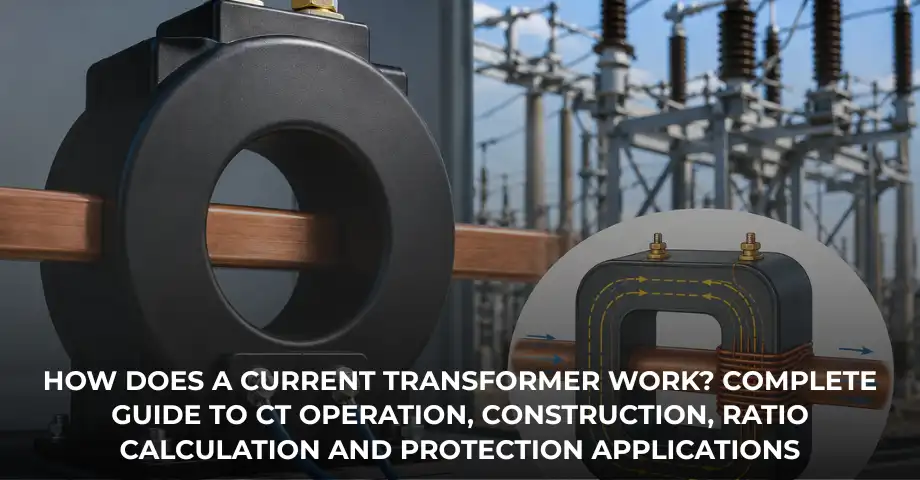
Current transformers (CTs) are among the most important components used in electrical power systems, industrial plants, substations, switchgear, and protection schemes. They enable engineers to safely measure, monitor, and protect electrical equipment carrying high currents without directly connecting meters or relays to high-current conductors.
Whether used for energy metering, feeder protection, transformer protection, generator protection, or motor protection, current transformers play a critical role in ensuring safe and reliable operation of electrical systems.
In this guide, we will explain the current transformer working principle, construction, operation, CT ratio calculation, protection applications, and industrial uses in detail.
What Is a Current Transformer?
A Current Transformer (CT) is a type of instrument transformer designed to reduce high primary currents to a lower, standardized secondary current that can be safely measured by meters, protection relays, and monitoring devices.
Current transformers are widely used in electrical distribution systems where direct measurement of high currents would be unsafe and impractical.
If you want to understand the broader category of instrument transformers, read our guide on What Is an Instrument Transformer?.
Typical CT secondary current ratings include:
- 1 Ampere
- 5 Amperes
For example, a CT with a ratio of 500/5A converts a primary current of 500A into a secondary current of 5A.
Current Transformer Construction
The construction of a current transformer is relatively simple but highly precise to ensure measurement accuracy and reliable protection performance.
Main Parts of a Current Transformer
1. Magnetic Core
The magnetic core provides a low-reluctance path for magnetic flux. High-quality silicon steel laminations are commonly used to minimize losses and improve accuracy.
2. Primary Winding
The primary winding carries the load current. Depending on CT type, it may consist of:
- A single conductor passing through the core
- A bar conductor
- A dedicated winding
3. Secondary Winding
The secondary winding consists of multiple turns of insulated copper wire wound around the core.
This winding supplies proportional current to:
- Energy meters
- Ammeter circuits
- Protection relays
- Monitoring systems
4. Insulation System
The insulation separates primary and secondary circuits and ensures safe operation under high-voltage conditions.
5. Secondary Terminals
These terminals connect the CT output to meters, relays, and protection devices.
How Does a Current Transformer Work?
The working principle of a current transformer is based on electromagnetic induction, similar to a conventional power transformer.
When alternating current flows through the primary conductor, it produces a magnetic field around the conductor.
This magnetic field generates magnetic flux in the CT core. The changing magnetic flux induces a current in the secondary winding according to Faraday’s Law of Electromagnetic Induction.
The induced secondary current is directly proportional to the primary current and inversely proportional to the turns ratio of the transformer.
Step-by-Step CT Operation
- Load current flows through the primary conductor.
- The primary current creates magnetic flux in the core.
- The flux links with the secondary winding.
- A proportional current is induced in the secondary winding.
- The secondary current is supplied to meters or relays.
- Measurement and protection devices operate safely using the reduced current value.
This process allows electrical systems carrying hundreds or thousands of amperes to be monitored accurately using standard 1A or 5A devices.
Current Transformer Ratio Explained
The CT ratio indicates the relationship between primary current and secondary current.
CT Ratio = Primary Current / Secondary Current
Common CT ratios include:
- 100/5A
- 200/5A
- 400/5A
- 500/5A
- 800/5A
- 1000/5A
- 2000/5A
The selected ratio must match the expected load current and protection requirements.
CT Ratio Calculation Example
Suppose an industrial feeder normally carries 350A of load current.
An engineer may select a 400/5A CT.
In this case:
Primary Current = 400A
Secondary Current = 5A
If the feeder current reaches 200A:
Secondary Current = (200 × 5) ÷ 400
Secondary Current = 2.5A
The connected meter or relay receives 2.5A while the actual line current remains 200A.
Factors Affecting CT Ratio Selection
- Maximum load current
- Future expansion plans
- Relay requirements
- Metering accuracy needs
- Fault current levels
- System protection philosophy
Types of Current Transformers
1. Wound Type Current Transformer
The primary winding is physically wound on the core and connected in series with the circuit.
2. Bar Type Current Transformer
A solid conductor forms the primary winding and passes through the CT core.
These are widely used in switchgear and substations.
3. Window Type Current Transformer
The primary conductor passes through a window opening in the CT.
These CTs are commonly used in industrial panels and distribution boards.
Metering Current Transformers
Metering CTs are designed for high accuracy during normal operating conditions.
Their primary purpose is to provide accurate current values for:
- Energy meters
- Power analyzers
- Demand monitoring systems
- Billing applications
Metering CTs help industries monitor energy consumption and improve operational efficiency.
Applications of Metering CTs
- Energy management systems
- Industrial power monitoring
- Commercial buildings
- Utility metering installations
Protection Current Transformers
Protection CTs are specifically designed to provide reliable current signals during fault conditions.
Unlike metering CTs, protection CTs must remain accurate during high fault currents and avoid excessive saturation.
They provide current inputs to protection relays that detect abnormal operating conditions and initiate circuit breaker tripping.
Protection CT Applications
- Overcurrent protection
- Earth fault protection
- Differential protection
- Restricted earth fault protection
- Distance protection
Modern protection systems often integrate CTs with advanced relay technologies. Learn more about Numerical vs Conventional Protection Relays.
Current Transformer Applications in Power Systems
1. Feeder Protection
Current transformers continuously monitor feeder currents and provide signals to protection relays.
Explore how Feeder Protection Relays enhance electrical system reliability.
2. Transformer Protection
Transformer differential protection schemes rely on CTs installed on both sides of the transformer.
Read more about Transformer Protection Relays for industrial applications.
3. Generator Protection
Power plant generators use CTs for differential protection, overcurrent protection, and earth fault detection.
Learn about Generator Protection Relays used in modern power systems.
4. Motor Protection
Industrial motors depend on CT-based protection systems to detect overloads, phase imbalance, and fault conditions.
See how Motor Protection Relays help prevent costly equipment failures.
5. Switchgear and Substations
CTs are extensively used in:
- HT switchgear
- LT switchgear
- Distribution substations
- Transmission substations
- Industrial power distribution systems
Common Current Transformer Installation Mistakes
Open-Circuit Secondary
One of the most dangerous mistakes is opening the secondary circuit while current is flowing through the primary conductor.
This can generate dangerously high voltages across the secondary terminals and may damage equipment or endanger personnel.
Incorrect Polarity Connections
Wrong polarity can result in inaccurate measurements and malfunctioning protection schemes.
Wrong CT Ratio Selection
Oversized CTs may reduce measurement accuracy, while undersized CTs can cause saturation and protection issues.
Improper Grounding
Incorrect grounding practices can introduce safety risks and measurement errors.
Current Transformer vs Potential Transformer
Current transformers measure current, whereas potential transformers (PTs) measure voltage.
Both are essential instrument transformers used in metering and protection systems.
For a detailed comparison, read our guide on Current Transformer vs Potential Transformer (CT vs PT).
Role of CTs in Reliable Industrial Power Systems
Accurate current monitoring is only one aspect of maintaining a reliable electrical infrastructure. Industries also face challenges such as voltage fluctuations, power quality issues, and equipment protection requirements.
Organizations can improve system reliability through proper protection design, voltage regulation equipment, and monitoring solutions. Learn more about Industrial Voltage Fluctuation Causes and Solutions and the benefits of a Constant Voltage Transformer for Industrial Applications.
Conclusion
Current transformers are indispensable components in modern electrical systems. By reducing high currents to manageable levels, they enable accurate metering, reliable monitoring, and effective protection of electrical assets.
Understanding current transformer construction, working principles, CT ratio selection, protection requirements, and industrial applications helps engineers design safer and more efficient power systems.
Whether used in substations, switchgear, industrial plants, transformers, generators, or motor protection systems, the correct selection and installation of CTs play a crucial role in ensuring dependable power system operation.