
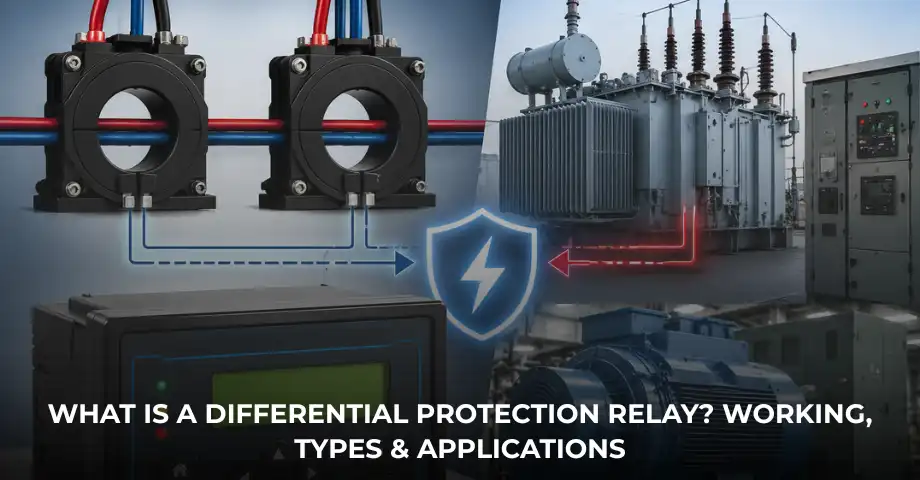
Electrical systems in industrial plants rely on effective protection schemes to prevent equipment damage, costly downtime, and safety hazards. Among the various protective devices used in substations and power systems, the Differential Protection Relay is considered one of the fastest and most dependable solutions for detecting internal electrical faults. It continuously compares the current entering and leaving a protected zone and isolates faulty equipment within milliseconds whenever an abnormal current difference is detected.
Differential protection is widely used for power transformers, generators, large motors, busbars, and reactors because these assets are expensive and critical to continuous plant operation. Unlike conventional overcurrent relays that respond only when current exceeds a preset value, differential relays identify faults based on current imbalance, providing excellent selectivity and reducing unnecessary tripping.
This guide explains how differential protection relays work, their major types, applications, benefits, and why they play an essential role in modern industrial electrical systems.
What Is a Differential Protection Relay?
A Differential Protection Relay is a protective relay that detects internal faults by comparing the current entering and leaving a specific section of an electrical system. Under normal operating conditions, these currents remain almost equal. If an internal fault such as a winding short circuit, insulation failure, or earth fault occurs, the current balance changes immediately. The relay senses this difference and sends a trip signal to the circuit breaker, disconnecting the faulty equipment before extensive damage occurs.
This operating principle follows Kirchhoff’s Current Law, which states that the current entering a closed electrical circuit must equal the current leaving it. Any significant imbalance indicates that current is flowing through an unintended path caused by an internal fault.
Quick Definition
A Differential Protection Relay compares the current entering and leaving electrical equipment. If the difference exceeds the preset operating value, it immediately trips the associated circuit breaker to isolate the faulty equipment.
Differential protection is commonly integrated with several other protection methods to ensure complete equipment safety. For a broader understanding of transformer protection philosophy, read our guide on Transformer Protection System.
Why Differential Protection Is Important
Electrical equipment such as transformers, generators, and large motors represents a major investment for industrial facilities. Internal electrical faults can rapidly develop into catastrophic failures if they are not detected and cleared quickly.
Differential protection provides one of the fastest methods for identifying these faults because it continuously monitors current balance instead of waiting for current to rise above a fixed limit.
Its key benefits include:
- Fast fault detection and isolation
- Excellent protection against internal faults
- High operating reliability
- Improved equipment life
- Reduced production downtime
- Enhanced personnel safety
- Lower maintenance and repair costs
Because the relay responds only to faults inside the protected zone, it offers excellent selectivity and avoids unnecessary tripping caused by external disturbances.
Working Principle of a Differential Protection Relay
The working principle of a differential protection relay is straightforward. Current Transformers (CTs) are installed at both ends of the equipment being protected. These CTs continuously measure the current entering and leaving the protection zone.
During normal operation:
- Incoming Current ≈ Outgoing Current
- Differential Current ≈ Zero
- Relay remains stable.
During an internal fault:
- Incoming Current ≠ Outgoing Current
- Differential Current increases.
- The relay detects the imbalance.
- The circuit breaker trips immediately.
Example
| Condition | Incoming Current | Outgoing Current | Relay Status |
|---|---|---|---|
| Normal Operation | 500 A | 498–500 A | No Trip |
| Internal Fault | 500 A | 320 A | Trips Instantly |
Instead of measuring primary current directly, the relay analyses the secondary current supplied by the Current Transformers, ensuring accurate protection even in high-voltage installations.
Key Point
Differential protection operates only for faults occurring within its protection zone. External faults generally produce balanced current on both sides, preventing unnecessary relay operation.
The accuracy of Current Transformers has a significant impact on relay performance. Learn more in our guide on Current Transformer Accuracy Class.
Main Components of a Differential Protection Scheme
Current Transformers (CTs)
CTs measure the incoming and outgoing current of the protected equipment. Correct CT ratio, polarity, and accuracy class are essential for reliable differential protection.
If you would like to understand how CTs and PTs work together, read What Is an Instrument Transformer?.
Differential Protection Relay
The relay compares both CT currents, calculates differential current, applies percentage bias where necessary, and sends a trip command whenever the operating value is exceeded.
Circuit Breaker
Once the relay detects an internal fault, the associated circuit breaker disconnects the faulty equipment from the electrical system.
Auxiliary DC Supply
Modern numerical relays rely on a dependable DC supply from station batteries or UPS systems to remain operational during electrical faults.
Protection Wiring
Correct CT wiring, trip circuits, relay terminals, and communication cables ensure dependable relay operation throughout the equipment’s service life.
Factors Affecting Differential Protection Performance
Although differential protection offers exceptional reliability, its performance depends on proper system design and commissioning.
Common factors affecting relay performance include:
- Incorrect CT polarity
- CT saturation
- Mismatch between CT ratios
- Transformer tap changer position
- Magnetising inrush current
- Incorrect relay settings
- Installation and wiring errors
Modern numerical relays compensate for many of these issues through adaptive algorithms, harmonic restraint, event recording, and self-diagnostic features.
Compared with conventional electromechanical relays, numerical relays offer greater accuracy, communication capability, and disturbance recording. Learn more in our comparison of Numerical vs Conventional Protection Relays.
Types of Differential Protection Relays
Different electrical applications require different differential protection methods. Modern protection systems generally use one of the following relay types.
1. Percentage Differential Relay
The Percentage Differential Relay is the most widely used protection relay for transformers and other critical equipment. It introduces a restraining characteristic that prevents false tripping during external faults or CT mismatches while remaining highly sensitive to genuine internal faults.
Typical applications include:
- Power Transformers
- Distribution Transformers
- Generator Transformers
- Industrial Substations
2. Biased Differential Relay
Biased differential relays improve stability during high external fault currents by using restraining current. They reduce nuisance tripping caused by CT saturation and are commonly used for transformer protection.
3. High Impedance Differential Relay
High impedance differential protection uses stabilising resistors to maintain relay stability during external faults. These schemes are commonly applied to busbar protection where matching CT characteristics are available.
4. Low Impedance Differential Relay
Modern substations generally use low impedance numerical relays that provide automatic CT ratio compensation, vector group correction, harmonic restraint, event recording, SCADA communication, and advanced self-monitoring functions.
Applications of Differential Protection Relays
Differential protection is widely used for protecting high-value electrical equipment where rapid fault clearance is essential.
Its most common applications include:
- Power Transformers
- Generators
- Large Industrial Motors
- Busbars
- Reactors
- Alternators
Differential Protection for Power Transformers
Power transformers are among the most critical assets in any electrical network. Internal faults such as winding failures, insulation breakdown, and inter-turn short circuits require immediate isolation to prevent severe damage.
Differential protection compares the current measured by CTs installed on both the HV and LV sides of the transformer. Modern numerical relays automatically compensate for CT ratio, transformer ratio, vector group, phase shift, and tap changer position before calculating differential current.
If an internal fault occurs, the relay issues an instantaneous trip signal, protecting the transformer from catastrophic failure.
For more detailed information about transformer relay applications, read Transformer Protection Relays for Industries in Eastern India.
How Differential Relays Handle Transformer Inrush Current
One challenge in transformer protection is distinguishing a genuine internal fault from the high magnetising inrush current that occurs during transformer energisation.
Modern numerical differential relays solve this problem using second harmonic restraint. Since inrush current contains a high level of second harmonic content, the relay recognises it as a normal operating condition and blocks tripping until the transformer reaches steady-state operation.
This feature prevents unnecessary outages while ensuring rapid operation for actual internal faults.
Differential Protection for Generators
Generators used in power plants and industrial facilities require dependable protection because internal stator winding faults can cause severe damage and prolonged downtime. Differential protection continuously compares the current entering and leaving the stator winding, enabling it to detect faults almost instantly.
Typical faults detected include:
- Phase-to-phase faults
- Phase-to-earth faults
- Inter-turn winding faults
- Internal insulation failures
Fast fault isolation helps minimise repair costs and prevents extensive damage to generator windings. Learn more in our guide on Generator Protection Relays for Power Plants.
Differential Protection for Industrial Motors
Large industrial motors are used in steel plants, cement factories, mining operations, water treatment facilities, and manufacturing industries. Because these motors operate continuously under heavy loads, internal winding faults must be detected quickly to prevent costly production losses.
Differential protection compares the current flowing into and out of the motor winding. If an internal stator fault develops, the relay immediately trips the circuit breaker.
Common motor faults detected include:
- Stator winding short circuits
- Phase-to-phase faults
- Phase-to-earth faults
- Inter-turn insulation failures
Differential protection is usually combined with overload, earth fault, and thermal protection for complete motor safety. You can read more in our article on Industrial Motor Failure & Motor Protection Relays.
Differential Protection for Busbars
Busbars distribute power to multiple outgoing feeders inside substations and industrial switchgear. Because several circuits are connected to a single busbar, an internal fault can interrupt the entire electrical system.
Busbar differential protection compares the total incoming current with the total outgoing current. During normal operation, these values remain balanced. If an internal fault occurs, the relay detects the imbalance and trips all associated circuit breakers within milliseconds.
This fast operation helps minimise equipment damage and improves overall system stability.
Advantages of Differential Protection Relays
| Advantage | Benefit |
|---|---|
| Fast Operation | Rapid isolation of internal faults. |
| High Sensitivity | Detects even low-level internal faults. |
| Excellent Selectivity | Operates only inside the protected zone. |
| Improved Equipment Life | Reduces thermal and mechanical damage. |
| Enhanced Safety | Protects personnel and electrical assets. |
| High Reliability | Suitable for critical industrial applications. |
Limitations of Differential Protection Relays
Although highly dependable, differential protection has a few practical limitations:
- Requires CTs at both ends of the protected equipment.
- Installation cost is higher than simple overcurrent protection.
- Incorrect CT polarity or ratio can affect relay performance.
- Proper relay settings and commissioning are essential.
- Protection zones must be carefully designed.
Fortunately, modern numerical relays minimise these limitations using adaptive algorithms, harmonic restraint, self-diagnostics, and digital communication.
Differential Protection Relay vs Overcurrent Relay
| Feature | Differential Relay | Overcurrent Relay |
|---|---|---|
| Operating Principle | Compares incoming and outgoing current. | Measures current magnitude. |
| Main Purpose | Internal fault protection. | Overload and external fault protection. |
| Operating Speed | Very Fast | Moderate |
| Protection Zone | Specific equipment only. | Entire feeder or circuit. |
| Typical Applications | Transformers, generators, motors, busbars. | Feeders, cables, distribution systems. |
Most industrial substations use both relay types together. Differential protection acts as the primary protection for internal faults, while overcurrent protection provides backup protection for overloads and external short circuits.
Learn more in our detailed guide on Overcurrent Protection.
Differential Protection in Feeder Protection
Although feeder circuits are generally protected using overcurrent and earth fault relays, differential protection is used on important transmission feeders and high-value industrial installations where extremely fast fault clearance is required.
Critical feeder applications include:
- Transmission lines
- High-voltage cable feeders
- Industrial captive power plants
- Long-distance feeders
- Critical manufacturing facilities
Read more about feeder protection in our article on Feeder Protection Relays.
Choosing the Right Differential Protection Relay
Selecting the correct relay depends on the equipment and operating conditions. Before selecting a relay, engineers should evaluate:
- Equipment type
- Voltage and current rating
- Available fault current
- CT ratio and accuracy class
- Transformer vector group
- Harmonic restraint capability
- Communication protocols
- SCADA compatibility
- Manufacturer support
Correct CT selection is equally important. If you are new to instrument transformers, read our article on CT vs PT (Current Transformer vs Potential Transformer).
Maintenance Best Practices
Routine inspection and testing help ensure reliable relay performance throughout its service life.
Recommended maintenance includes:
- Check CT polarity and wiring.
- Verify relay settings.
- Perform secondary injection testing.
- Inspect trip circuits.
- Review event logs.
- Check DC auxiliary supply.
- Verify SCADA communication.
- Inspect terminals for loose connections.
Preventive maintenance significantly improves protection reliability and reduces unexpected equipment failures.
Why Choose Delta Technocrats?
Delta Technocrats provides complete electrical protection solutions for industries across Eastern India. Our experienced engineers design, supply, install, test, and commission reliable protection systems for substations, power plants, and industrial facilities.
Our solutions include:
- Transformer Protection Systems
- Numerical Protection Relays
- Generator Protection
- Motor Protection Systems
- Feeder Protection Relays
- Current & Potential Transformers
- Substation Automation & SCADA
- Protection Testing & Commissioning
- Power Quality Solutions
Whether you are modernising an existing substation or planning a new installation, our team can recommend the most suitable protection solution for your application.
Frequently Asked Questions (FAQs)
1. What is a differential protection relay?
It is a relay that compares the current entering and leaving electrical equipment. If the difference exceeds a preset value, it trips the circuit breaker to isolate the fault.
2. Where is differential protection used?
It is commonly used for transformers, generators, motors, busbars, reactors, and other high-value electrical equipment.
3. Why is differential protection faster than overcurrent protection?
Because it detects current imbalance instead of waiting for current to exceed a preset level, allowing much faster fault clearance.
4. Can differential protection detect external faults?
No. It is designed to operate only for faults occurring within its protection zone.
5. What causes a differential relay to trip?
Internal winding faults, insulation failures, phase faults, and earth faults typically cause relay operation.
6. What is harmonic restraint?
Harmonic restraint allows the relay to distinguish transformer energisation inrush current from genuine internal faults, preventing unnecessary tripping.
7. Why are Current Transformers important?
CTs provide the current measurements used by the relay. Correct CT ratio, polarity, and accuracy are essential for dependable protection.
8. Can differential protection replace overcurrent protection?
No. Both protection methods complement each other. Differential protection safeguards against internal faults, while overcurrent protection provides backup protection for overloads and external faults.
Conclusion
Differential Protection Relays play a critical role in protecting transformers, generators, motors, busbars, and other valuable electrical equipment from internal faults. Their ability to detect current imbalance enables rapid fault isolation, reducing equipment damage, improving plant reliability, and enhancing operational safety.
Modern numerical differential relays offer advanced features such as harmonic restraint, adaptive algorithms, self-diagnostics, event recording, and SCADA integration, making them an essential component of today’s industrial power systems.
For complete electrical protection, differential protection is typically used alongside overcurrent, feeder, and transformer protection schemes to ensure reliable operation of the entire power network.
To continue learning about electrical protection systems, explore these related guides:
- Transformer Protection System
- Transformer Protection Relays for Industries
- Overcurrent Protection
- Feeder Protection Relays
- Numerical vs Conventional Protection Relays
- Current Transformer Accuracy Class
- CT vs PT
- Power Factor Correction
Need Expert Electrical Protection Solutions?
Delta Technocrats offers end-to-end solutions for transformer protection, numerical relays, instrument transformers, power quality improvement, substation automation, testing, and commissioning. Contact our experts to design a reliable protection system for your industrial electrical infrastructure.