
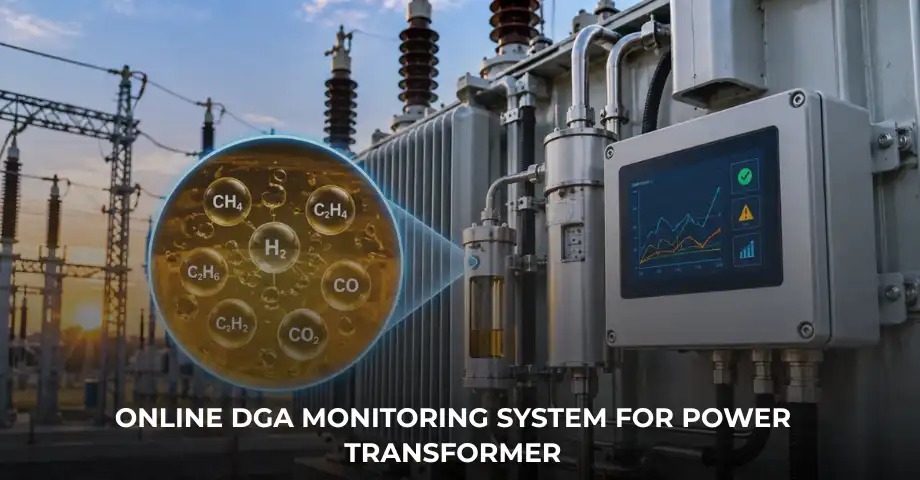
Power transformers are among the most valuable assets in electrical transmission, distribution, and industrial power systems. Their reliable operation is essential for maintaining uninterrupted power supply, protecting downstream equipment, and ensuring overall grid stability. However, transformers are continuously exposed to electrical, thermal, and mechanical stresses that gradually deteriorate insulation and internal components over time.
One of the earliest indicators of internal transformer faults is the generation of gases within the insulating oil. Faults such as overheating, insulation degradation, partial discharge, and electrical arcing produce specific gases that dissolve in transformer oil. By continuously monitoring these gases, maintenance engineers can identify developing problems long before they result in catastrophic transformer failures.
An Online DGA Monitoring System provides continuous Dissolved Gas Analysis (DGA) without requiring transformer shutdown. Unlike traditional laboratory oil testing, online monitoring delivers real-time information about transformer health, enabling predictive maintenance, reducing unplanned outages, and extending transformer service life.
Today, Online DGA Monitoring Systems are widely used in power utilities, industrial substations, renewable energy projects, steel plants, cement plants, refineries, and other facilities where transformer reliability is critical.
In this guide, you’ll learn what an Online DGA Monitoring System is, how it works, its major components, the key gases it monitors, and why it has become one of the most valuable tools for transformer asset health management.
What Is an Online DGA Monitoring System?
An Online DGA Monitoring System is an intelligent transformer monitoring solution that continuously measures the concentration of dissolved gases present in transformer insulating oil. These gases are generated when internal electrical or thermal faults begin to develop inside the transformer.
The monitoring system automatically extracts oil samples, analyses dissolved gas concentrations using specialised sensors, and transmits the results to monitoring software or SCADA systems in real time. If abnormal gas levels are detected, the system immediately generates alarms, allowing maintenance engineers to investigate the transformer before a serious failure occurs.
Unlike periodic laboratory oil testing, an online system operates continuously while the transformer remains energised, making it ideal for critical transformers where uninterrupted operation is essential.
Quick Definition
An Online DGA Monitoring System continuously measures dissolved gases in transformer oil to detect developing electrical and thermal faults, enabling predictive maintenance and improving transformer reliability.
Online DGA monitoring forms an important part of modern Transformer Condition Monitoring strategies, helping maintenance teams make decisions based on the actual health of the transformer rather than fixed maintenance intervals.
Why DGA Monitoring Is Important
Most transformer failures do not occur suddenly. They usually begin with small internal defects such as insulation deterioration, overheating, loose electrical connections, partial discharge, or winding faults. As these faults develop, they generate characteristic gases that dissolve in the insulating oil.
By continuously monitoring these gases, engineers can detect problems months—or even years—before they become critical.
The benefits of continuous DGA monitoring include:
- Early fault detection.
- Reduced risk of catastrophic transformer failure.
- Improved transformer reliability.
- Extended equipment life.
- Reduced maintenance costs.
- Improved operational safety.
- Support for predictive maintenance.
- Reduced unplanned outages.
Instead of relying solely on scheduled oil testing, utilities and industries can continuously assess transformer condition and plan maintenance activities more effectively.
What Is Dissolved Gas Analysis (DGA)?
Dissolved Gas Analysis (DGA) is one of the most widely accepted diagnostic techniques for evaluating the internal condition of oil-filled transformers. It involves measuring the concentration of gases dissolved in transformer oil and interpreting the results to identify developing faults.
When transformer insulation or oil is subjected to abnormal electrical or thermal stress, the insulating materials begin to decompose. Different fault types generate different combinations of gases.
By analysing these gases, engineers can determine whether the transformer is experiencing:
- Overheating.
- Partial discharge.
- Electrical arcing.
- Insulation degradation.
- Winding faults.
- Core faults.
- Loose electrical connections.
DGA has become an industry-standard diagnostic method because it identifies developing faults before they become visible through conventional inspections.
How an Online DGA Monitoring System Works
An Online DGA Monitoring System continuously samples transformer oil, analyses dissolved gas concentrations, and compares the results with predefined alarm thresholds.
The operating sequence generally includes the following steps:
1. Oil Sampling
The monitoring unit continuously extracts a small quantity of transformer oil without interrupting transformer operation.
2. Gas Extraction
Specialised extraction technology separates dissolved gases from the transformer oil.
3. Gas Measurement
Advanced sensors measure the concentration of individual gases such as hydrogen, methane, ethylene, acetylene, carbon monoxide, and carbon dioxide.
4. Data Analysis
The monitoring controller analyses gas trends, compares values with predefined limits, and identifies abnormal operating conditions.
5. Alarm Generation
If gas concentrations exceed preset alarm levels, the system automatically generates alerts for maintenance personnel.
6. Communication
Monitoring data is transmitted to SCADA systems, asset management software, or cloud platforms for remote monitoring and long-term trend analysis.
Key Advantage
Unlike periodic laboratory testing, an Online DGA Monitoring System continuously monitors transformer health, allowing engineers to identify abnormal gas generation immediately instead of waiting for the next scheduled oil test.
Main Components of an Online DGA Monitoring System
A modern Online DGA Monitoring System combines intelligent sensors, communication technology, and diagnostic software to provide continuous transformer health assessment.
Oil Sampling Unit
The sampling unit continuously extracts transformer oil while maintaining normal transformer operation.
Gas Extraction Module
This module separates dissolved gases from transformer oil using specialised extraction techniques.
Gas Sensors
Highly sensitive gas sensors measure the concentration of dissolved gases with excellent accuracy and repeatability.
Monitoring Controller
The controller processes sensor data, performs diagnostic analysis, records historical trends, and manages alarm functions.
Communication Interface
Communication modules support integration with SCADA systems, substation automation platforms, and remote asset monitoring software using protocols such as IEC 61850, Modbus, and DNP3.
Monitoring Software
The software provides real-time dashboards, gas trend analysis, historical records, alarm management, and maintenance reports.
Key Gases Monitored in Transformer Oil
Each gas generated inside transformer oil provides valuable information about the type of fault developing within the transformer.
Hydrogen (H₂)
Hydrogen is often associated with partial discharge and low-energy electrical faults. An increasing hydrogen concentration may indicate the early stages of insulation deterioration.
Methane (CH₄)
Methane is generally produced during low-temperature thermal faults and minor oil decomposition.
Ethane (C₂H₆)
Ethane is typically generated when transformer oil experiences moderate thermal overheating.
Ethylene (C₂H₄)
Ethylene indicates higher temperature thermal faults and is commonly associated with severe overheating of transformer oil.
Acetylene (C₂H₂)
Acetylene is one of the most critical gases monitored because it is strongly associated with electrical arcing and high-energy discharge inside the transformer.
Carbon Monoxide (CO)
Carbon Monoxide is primarily generated by the thermal decomposition of cellulose insulation, making it an important indicator of paper insulation ageing.
Carbon Dioxide (CO₂)
Carbon Dioxide is also produced during insulation ageing. The relationship between CO and CO₂ often helps engineers assess the condition of transformer paper insulation.
Did You Know?
Rather than relying on a single gas, modern Online DGA Monitoring Systems analyse gas combinations, concentration trends, and gas generation rates to accurately diagnose developing transformer faults.
Factors That Influence DGA Results
Accurate interpretation of Dissolved Gas Analysis requires consideration of several operating conditions that can influence gas generation.
Important factors include:
- Transformer loading.
- Oil temperature.
- Age of insulation.
- Moisture content.
- Previous fault history.
- Transformer design.
- Cooling system performance.
- Maintenance history.
For this reason, DGA results should always be analysed alongside other transformer health indicators such as temperature, moisture, load current, and insulation condition.
Modern asset monitoring platforms combine Online DGA with comprehensive transformer diagnostics to provide a complete picture of transformer health. This integration will be discussed in the next section.
Types of Online DGA Monitoring Systems
Online DGA Monitoring Systems are available in different configurations depending on the level of transformer monitoring required, transformer rating, criticality, and maintenance strategy. The appropriate solution depends on whether continuous screening or comprehensive fault diagnosis is required.
Single Gas Monitoring Systems
Single gas monitors measure one key gas, most commonly Hydrogen (H₂), which is an early indicator of many transformer faults.
These systems are typically used for:
- Distribution transformers.
- Medium-sized power transformers.
- Condition-based maintenance programmes.
- Early fault screening.
Although economical, single gas monitors provide limited diagnostic information compared to multi-gas systems.
Multi-Gas DGA Monitoring Systems
Multi-gas monitoring systems continuously analyse several dissolved gases simultaneously, providing a much more detailed understanding of transformer health.
Typical gases monitored include:
- Hydrogen (H₂)
- Methane (CH₄)
- Ethane (C₂H₆)
- Ethylene (C₂H₄)
- Acetylene (C₂H₂)
- Carbon Monoxide (CO)
- Carbon Dioxide (CO₂)
These systems are widely used for critical transmission transformers, generator transformers, and large industrial transformers where maximum reliability is required.
Comprehensive Asset Monitoring Systems
Modern transformer monitoring platforms combine Online DGA with additional sensors such as:
- Oil temperature.
- Winding temperature.
- Moisture in oil.
- Bushing monitoring.
- Tap changer monitoring.
- Partial discharge monitoring.
- Load current monitoring.
This integrated approach provides a complete assessment of transformer health and supports predictive maintenance programmes.
Benefits of an Online DGA Monitoring System
Continuous transformer monitoring provides significant operational and financial benefits compared with traditional maintenance methods.
Early Fault Detection
The system identifies abnormal gas generation during the earliest stages of fault development, allowing maintenance teams to take corrective action before serious damage occurs.
Reduced Unplanned Outages
By detecting developing faults early, utilities and industries can schedule maintenance during planned shutdowns instead of responding to emergency failures.
Improved Transformer Reliability
Continuous monitoring provides confidence that transformers are operating within safe limits while reducing the risk of unexpected failures.
Extended Transformer Life
Timely maintenance based on actual transformer condition helps extend equipment service life and improves return on investment.
Lower Maintenance Costs
Condition-based maintenance eliminates unnecessary inspections while reducing costly emergency repairs.
Enhanced Safety
Early fault detection reduces the likelihood of transformer explosions, oil fires, and catastrophic equipment failures.
Better Asset Management
Historical gas trend analysis enables maintenance engineers to prioritise maintenance activities according to transformer condition rather than age alone.
Applications of Online DGA Monitoring Systems
Online DGA Monitoring Systems are widely used wherever transformer reliability is critical to business continuity.
Power Transmission Utilities
Transmission companies use continuous DGA monitoring to protect high-value grid transformers and minimise the risk of widespread outages.
Power Generation Plants
Thermal, hydroelectric, nuclear, and renewable energy plants rely on DGA monitoring to safeguard generator transformers and station transformers.
Industrial Facilities
Steel plants, cement factories, chemical industries, mining operations, paper mills, and manufacturing plants use online monitoring to protect production-critical transformers.
Renewable Energy Projects
Wind farms and solar power plants use DGA monitoring to maximise transformer availability and improve long-term asset performance.
Commercial Infrastructure
Data centres, airports, hospitals, metro rail systems, and large commercial buildings also benefit from continuous transformer health monitoring.
Online DGA vs Laboratory DGA: Key Differences
Both online and laboratory DGA play important roles in transformer maintenance. However, they differ significantly in how data is collected and how quickly faults can be detected.
| Feature | Online DGA Monitoring | Laboratory DGA |
|---|---|---|
| Monitoring Frequency | Continuous | Periodic Sampling |
| Transformer Shutdown | Not Required | Usually Not Required |
| Fault Detection | Real-Time | Delayed |
| Trend Analysis | Continuous | Limited |
| Alarm Generation | Automatic | Manual Interpretation |
| Best Application | Critical Transformers | Routine Maintenance |
Many organisations combine both methods by using online monitoring for critical transformers while periodically validating results through accredited laboratory testing.
Integration with SCADA and Asset Health Monitoring
Modern Online DGA Monitoring Systems are designed to integrate seamlessly with SCADA platforms, Substation Automation Systems (SAS), and enterprise asset management software.
Integration allows operators to:
- Monitor transformer health remotely.
- View real-time gas concentration trends.
- Receive automatic alarms.
- Analyse historical performance.
- Plan predictive maintenance.
- Generate maintenance reports.
For a broader understanding of intelligent substation monitoring, read our articles on SCADA for Electrical Substations and Substation Automation.
How to Select the Right Online DGA Monitoring System
Selecting the appropriate monitoring system depends on transformer criticality, operating conditions, and maintenance objectives.
Important selection criteria include:
- Transformer rating.
- Criticality of the installation.
- Number of gases monitored.
- Sensor accuracy.
- Communication protocols.
- SCADA compatibility.
- Diagnostic software capabilities.
- Future expansion requirements.
- Manufacturer support.
Critical transmission transformers generally justify comprehensive multi-gas monitoring systems, while smaller transformers may only require single-gas monitoring depending on operational requirements.
Maintenance Best Practices
Although Online DGA Monitoring Systems require relatively little maintenance, routine inspection ensures long-term measurement accuracy and dependable operation.
Recommended maintenance activities include:
- Inspect oil sampling connections.
- Verify sensor calibration.
- Review alarm settings.
- Check communication with SCADA.
- Inspect power supply.
- Update monitoring software where required.
- Review historical gas trends regularly.
- Maintain calibration and maintenance records.
Routine preventive maintenance ensures reliable fault detection throughout the service life of the monitoring system.
Why Choose Delta Technocrats?
Delta Technocrats provides advanced Online Asset Health Monitoring solutions that help utilities and industries improve transformer reliability, reduce maintenance costs, and maximise equipment availability.
Our expertise includes:
- Online DGA Monitoring Systems
- Transformer Condition Monitoring
- Substation Automation Systems
- SCADA Integration
- Transformer Protection Systems
- Numerical Protection Relays
- Protection Testing & Commissioning
- Electrical EPC Services
From system design and equipment selection to installation, commissioning, and long-term technical support, our experienced engineers deliver customised monitoring solutions for utilities, industries, and infrastructure projects across Eastern India.
Frequently Asked Questions (FAQs)
1. What is an Online DGA Monitoring System?
An Online DGA Monitoring System continuously measures dissolved gases in transformer oil to detect developing electrical and thermal faults while the transformer remains in service.
2. Why is Online DGA Monitoring important?
It enables early fault detection, reduces the risk of transformer failure, supports predictive maintenance, and improves transformer reliability.
3. Which gases are monitored in DGA?
Typical gases include Hydrogen, Methane, Ethane, Ethylene, Acetylene, Carbon Monoxide, and Carbon Dioxide.
4. What is the difference between Online DGA and laboratory DGA?
Online DGA provides continuous real-time monitoring, while laboratory DGA analyses oil samples collected periodically.
5. Can Online DGA integrate with SCADA?
Yes. Modern systems support communication protocols such as IEC 61850, Modbus, and DNP3 for seamless integration with SCADA and asset management platforms.
6. Which transformers require Online DGA Monitoring?
Critical transmission transformers, generator transformers, industrial power transformers, renewable energy transformers, and high-value utility assets benefit most from continuous DGA monitoring.
7. Does Online DGA replace laboratory testing?
No. Online DGA complements laboratory testing by providing continuous monitoring between scheduled oil analyses.
8. How often should an Online DGA Monitoring System be maintained?
Routine inspection, calibration verification, communication checks, and software updates should be performed according to the manufacturer’s recommendations.
Conclusion
Online DGA Monitoring Systems have become one of the most effective technologies for protecting power transformers against unexpected failures. By continuously analysing dissolved gases in transformer oil, these systems provide early warning of developing electrical and thermal faults, enabling maintenance teams to take corrective action before serious damage occurs.
Combined with SCADA, Substation Automation, and comprehensive transformer condition monitoring, Online DGA plays a vital role in predictive maintenance, asset management, and improving the long-term reliability of critical electrical infrastructure. As utilities and industries increasingly adopt condition-based maintenance strategies, continuous DGA monitoring is becoming an essential investment for safeguarding valuable transformer assets.
To further explore transformer monitoring and electrical protection technologies, you may also find these guides useful: