
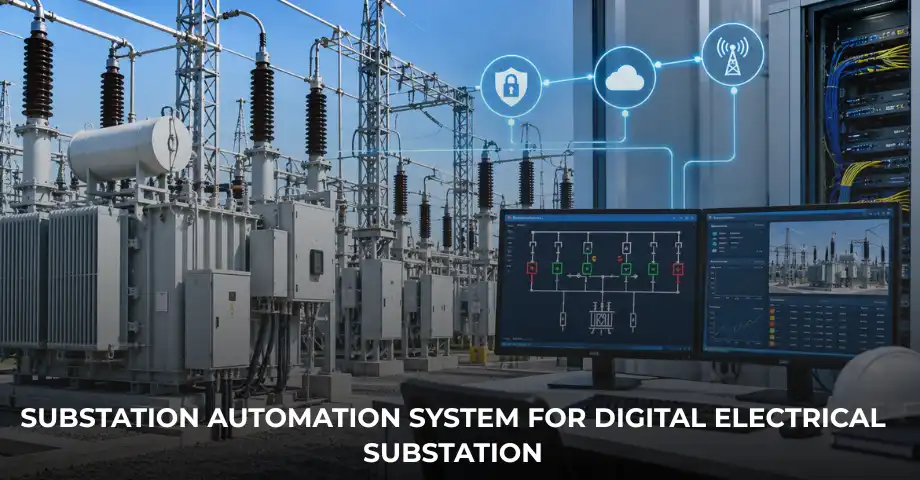
Electrical substations have evolved significantly over the past few decades. Traditional substations relied heavily on manual operation, electromechanical relays, and routine site inspections to monitor and control electrical equipment. While these systems served the industry for many years, growing power demand, increasing network complexity, and the need for higher reliability have accelerated the adoption of intelligent digital technologies.
Substation Automation has transformed the way utilities and industries operate electrical substations by integrating intelligent electronic devices (IEDs), numerical protection relays, communication networks, SCADA systems, and advanced monitoring software into a single coordinated system. Instead of relying on manual intervention, operators can monitor, control, protect, and analyse the entire substation remotely in real time.
Modern Substation Automation Systems (SAS) improve operational efficiency, reduce downtime, enhance equipment protection, simplify maintenance, and provide valuable operational data for predictive maintenance and asset management. They have become an essential part of transmission substations, distribution networks, industrial plants, renewable energy projects, and smart grid infrastructure.
In this guide, you’ll learn what Substation Automation is, how it works, its major components, communication standards, and why it has become the foundation of modern electrical power systems.
What Is Substation Automation?
Substation Automation is the integration of intelligent hardware, software, communication systems, and protection devices that enable automatic monitoring, control, protection, and supervision of electrical substations without requiring continuous manual operation.
A modern Substation Automation System (SAS) collects real-time data from transformers, circuit breakers, protection relays, switchgear, busbars, meters, sensors, and other field devices. This information is transmitted through high-speed communication networks to Human Machine Interfaces (HMIs), SCADA systems, and central control centres, allowing operators to monitor the complete substation remotely.
Automation systems also enable automatic fault detection, equipment diagnostics, alarm management, event recording, and remote switching operations, significantly improving system reliability and operational efficiency.
Quick Definition
Substation Automation is a digital system that combines intelligent electronic devices, communication networks, protection relays, and SCADA to automatically monitor, control, protect, and manage electrical substations in real time.
Substation automation works closely with supervisory control systems. If you’re new to this technology, read our detailed guide on SCADA for Electrical Substations to understand how remote monitoring and control support automated substations.
Evolution from Conventional to Digital Substations
Traditional substations depended on electromechanical relays, hardwired control circuits, analogue meters, and manual switching operations. Operators needed to visit substations regularly to collect readings, inspect equipment, and perform switching activities.
Modern digital substations replace many of these conventional systems with intelligent electronic devices (IEDs), numerical protection relays, fibre optic communication networks, and advanced automation software.
The transition from conventional to digital substations provides:
- Real-time monitoring.
- Remote operation of equipment.
- High-speed communication.
- Automatic fault detection.
- Digital event recording.
- Predictive maintenance capabilities.
- Reduced wiring complexity.
- Improved operational reliability.
As utilities continue modernising electrical infrastructure, digital substations are becoming the preferred choice for new transmission, distribution, and industrial projects.
Why Substation Automation Is Important
Electrical substations play a critical role in maintaining the continuity and reliability of power systems. Any equipment failure, delayed fault clearance, or operational error can interrupt power supply and result in significant financial losses.
Substation automation improves overall system performance by providing intelligent monitoring, faster fault response, and centralised operational control.
The key advantages include:
- Improved system reliability.
- Reduced downtime.
- Remote monitoring and operation.
- Faster fault identification.
- Lower maintenance costs.
- Improved personnel safety.
- Enhanced equipment utilisation.
- Support for predictive maintenance.
Automation also reduces dependence on manual inspections while improving the speed and accuracy of operational decision-making.
Main Components of a Substation Automation System
A Substation Automation System consists of several intelligent devices that work together to monitor, control, protect, and communicate throughout the electrical network.
Intelligent Electronic Devices (IEDs)
IEDs are microprocessor-based devices that perform protection, monitoring, metering, and control functions. They collect operational data from field equipment and communicate with SCADA and automation systems.
Examples of IEDs include:
- Numerical protection relays.
- Bay control units.
- Energy meters.
- Fault recorders.
- Power quality analysers.
Numerical Protection Relays
Modern numerical relays protect transformers, generators, feeders, motors, busbars, and transmission lines while also providing communication, event recording, and self-diagnostic capabilities.
Compared with conventional relays, numerical relays offer higher accuracy, flexibility, and integration capabilities. Learn more in our guide on Numerical vs Conventional Protection Relays.
Remote Terminal Units (RTUs)
RTUs collect data from field devices, convert analogue and digital signals into communication data, and transmit this information to SCADA or central control systems.
They also receive control commands from operators and execute remote switching operations.
Programmable Logic Controllers (PLCs)
PLCs perform automation logic for equipment such as cooling systems, auxiliary power supplies, pump control, lighting systems, and other station services.
SCADA System
The SCADA system serves as the central monitoring and control platform for the entire substation. Operators can monitor equipment status, electrical parameters, alarms, and fault events while performing remote control operations from a central control room.
Learn more in our comprehensive article on SCADA for Electrical Substations.
Human Machine Interface (HMI)
The Human Machine Interface provides operators with a graphical representation of the electrical substation, displaying breaker status, transformer loading, alarms, measurements, and operational trends.
HMIs improve situational awareness and simplify substation operation.
Communication Network
Reliable communication is the backbone of every Substation Automation System. Fibre optic Ethernet networks are commonly used to ensure fast and secure data exchange between intelligent devices.
The communication infrastructure connects:
- Protection relays.
- RTUs.
- PLCs.
- SCADA servers.
- Engineering workstations.
- Remote control centres.
Communication Standards Used in Substation Automation
Modern automation systems rely on standard communication protocols to ensure interoperability between equipment supplied by different manufacturers.
IEC 61850
IEC 61850 is the international communication standard specifically developed for substation automation. It defines communication architecture, data models, engineering processes, and high-speed messaging between intelligent devices.
Key advantages include:
- Interoperability between vendors.
- Reduced hard wiring.
- High-speed peer-to-peer communication.
- Simplified engineering.
- Scalable automation architecture.
Modbus
Modbus is one of the most widely used industrial communication protocols. It enables communication between automation devices such as PLCs, RTUs, meters, and SCADA systems.
DNP3 (Distributed Network Protocol)
DNP3 is commonly used in electric utilities for reliable communication between substations and remote control centres. It provides secure data transmission and efficient event reporting.
IEC 60870-5-101 / IEC 60870-5-104
These protocols are widely used for telecontrol applications in power systems, enabling communication between substations and utility control centres.
Role of Automation in Modern Protection Systems
Substation automation integrates multiple protection functions into a coordinated digital platform, allowing protection relays, circuit breakers, sensors, and monitoring devices to work together intelligently.
Automation supports:
- Transformer Protection Systems.
- Busbar Protection.
- Feeder Protection.
- Earth Fault Protection.
- Differential Protection.
- Generator Protection.
These protection schemes communicate with SCADA and automation systems to provide real-time fault diagnostics, event recording, alarm management, and remote operational control.
For example, transformer protection is often integrated with automation systems to improve fault response and equipment reliability. Read our guide on Transformer Protection System to understand how intelligent protection contributes to modern substations.
Benefits of Substation Automation
Substation Automation Systems (SAS) provide significant operational, technical, and financial benefits for utilities, industries, and infrastructure projects. By replacing manual operations with intelligent digital systems, organisations can improve power system reliability while reducing operating costs and maintenance requirements.
Real-Time Monitoring
Automation systems continuously monitor electrical parameters such as voltage, current, frequency, power factor, transformer loading, breaker status, and protection relay operation. Operators receive instant visibility into the condition of the entire substation.
Remote Operation
Switching operations that previously required personnel to visit the substation can now be performed safely from a central control room using SCADA and Human Machine Interfaces (HMIs).
Faster Fault Detection
Intelligent protection relays communicate fault information immediately, allowing operators to identify the fault location quickly and restore power faster.
Improved Equipment Reliability
Continuous monitoring enables maintenance teams to identify developing problems before they result in equipment failure, improving the reliability of transformers, switchgear, busbars, and feeders.
Reduced Maintenance Costs
Automation supports predictive maintenance by providing historical operating data, alarm history, and equipment diagnostics. This reduces unnecessary inspections and lowers maintenance costs.
Enhanced Personnel Safety
Remote operation minimises the need for maintenance personnel to enter high-voltage switchyards during switching operations, reducing exposure to electrical hazards.
Higher System Availability
Rapid fault isolation and intelligent protection coordination minimise outages and improve the availability of critical electrical infrastructure.
Applications of Substation Automation
Substation Automation is widely used across power generation, transmission, distribution, and industrial sectors where reliable electrical power is essential.
Transmission Substations
Transmission utilities use Substation Automation to monitor and control high-voltage substations while improving grid reliability and operational efficiency.
Distribution Networks
Distribution companies implement automation to improve feeder management, reduce outage duration, and enhance customer service reliability.
Industrial Plants
Steel plants, cement factories, chemical industries, mining operations, paper mills, and manufacturing facilities rely on automation to maintain uninterrupted electrical power for critical production processes.
Power Generation Plants
Thermal, hydroelectric, nuclear, and renewable energy plants integrate automation systems to supervise generators, transformers, switchgear, and auxiliary systems.
Renewable Energy Projects
Solar farms, wind farms, and hybrid renewable energy installations use Substation Automation to improve grid integration and optimise energy production.
Commercial Infrastructure
Airports, metro rail systems, hospitals, data centres, commercial complexes, and smart cities increasingly adopt automated substations to improve reliability and energy management.
Typical Substation Automation Architecture
A modern Substation Automation System follows a layered architecture that allows field equipment, protection systems, and control centres to communicate efficiently.
| Automation Level | Main Components | Primary Function |
|---|---|---|
| Process Level | CTs, PTs, Sensors, Circuit Breakers | Measurement & Switching |
| Bay Level | IEDs, Protection Relays, Bay Controllers | Protection & Control |
| Station Level | SCADA, HMI, Servers, Engineering Workstations | Monitoring & Supervision |
| Enterprise Level | Control Centre, Cloud, Asset Management Systems | Centralised Monitoring & Analytics |
This architecture allows information to flow seamlessly between field equipment and central control systems while supporting future expansion.
Cybersecurity in Substation Automation
As substations become increasingly connected through Ethernet networks and remote communication systems, cybersecurity has become a critical aspect of automation design.
Modern Substation Automation Systems incorporate multiple security measures, including:
- User authentication and access control.
- Encrypted communication.
- Firewalls and network segmentation.
- Secure remote access.
- Regular firmware updates.
- Continuous network monitoring.
- Compliance with international cybersecurity standards.
Implementing strong cybersecurity practices helps protect critical infrastructure against unauthorised access and cyber threats.
Future Trends in Substation Automation
Substation Automation continues to evolve as utilities and industries adopt digital technologies that improve operational efficiency, reliability, and sustainability.
Digital Substations
Digital substations use IEC 61850 process bus technology, fibre optic communication, and intelligent devices to reduce copper wiring, simplify installation, and improve system flexibility.
Artificial Intelligence (AI)
Artificial Intelligence is increasingly being used to analyse operational data, predict equipment failures, and support intelligent maintenance planning.
Predictive Asset Management
Automation systems are being integrated with online monitoring solutions that continuously assess transformer, breaker, and switchgear health, allowing maintenance teams to detect potential problems before failures occur.
Cloud-Based Monitoring
Cloud platforms enable remote access to operational data, improving collaboration between utilities, maintenance engineers, and service providers.
Smart Grid Integration
Substation Automation plays a vital role in modern smart grids by enabling intelligent power flow management, renewable energy integration, and advanced distribution automation.
Integration with SCADA and Asset Health Monitoring
Substation Automation delivers maximum value when integrated with SCADA systems and online asset health monitoring platforms.
SCADA provides operators with real-time visibility into substation operation, while asset monitoring systems continuously evaluate the condition of transformers, circuit breakers, and other critical equipment.
This integrated approach enables:
- Remote monitoring.
- Centralised control.
- Predictive maintenance.
- Real-time alarms.
- Historical trend analysis.
- Improved maintenance planning.
To explore these technologies in greater detail, read our articles on SCADA for Electrical Substations and Transformer Condition Monitoring.
Why Choose Delta Technocrats?
Delta Technocrats provides complete Substation Automation solutions for utilities, industrial facilities, and infrastructure projects across Eastern India. Our experienced engineering team delivers end-to-end services covering design, engineering, installation, testing, commissioning, and long-term support.
Our expertise includes:
- Substation Automation Systems (SAS)
- SCADA Integration
- Numerical Protection Relays
- Transformer Protection Systems
- Busbar Protection Systems
- Online Asset Health Monitoring
- Power Quality Solutions
- Protection Testing & Commissioning
- Electrical EPC Projects
Whether you are modernising an existing substation or building a new digital substation, Delta Technocrats delivers reliable and future-ready automation solutions tailored to your operational requirements.
Frequently Asked Questions (FAQs)
1. What is Substation Automation?
Substation Automation is the use of intelligent electronic devices, communication networks, SCADA systems, and automation software to monitor, control, and protect electrical substations automatically.
2. What are the main components of a Substation Automation System?
The main components include Intelligent Electronic Devices (IEDs), numerical protection relays, RTUs, PLCs, SCADA systems, HMIs, communication networks, and engineering workstations.
3. What is the role of IEC 61850?
IEC 61850 is the international communication standard for Substation Automation that enables interoperability between intelligent devices from different manufacturers.
4. Why is Substation Automation important?
It improves operational reliability, enables remote monitoring, reduces maintenance costs, enhances safety, and supports predictive maintenance.
5. Can Substation Automation integrate with SCADA?
Yes. SCADA is one of the core components of a modern Substation Automation System and provides centralised monitoring, control, alarm management, and data acquisition.
6. Which industries use Substation Automation?
Utilities, power generation plants, manufacturing industries, steel plants, cement plants, renewable energy projects, mining operations, and commercial infrastructure all use Substation Automation.
7. How does automation improve maintenance?
Automation provides continuous monitoring, event recording, and equipment diagnostics, allowing maintenance teams to implement predictive maintenance strategies rather than relying solely on periodic inspections.
8. Is Substation Automation suitable for existing substations?
Yes. Many conventional substations can be upgraded with intelligent relays, communication networks, and SCADA systems without requiring complete replacement of existing equipment.
Conclusion
Substation Automation has become the foundation of modern electrical infrastructure by combining intelligent protection, high-speed communication, real-time monitoring, and remote control into a single integrated platform. It enables utilities and industries to improve operational reliability, enhance safety, reduce maintenance costs, and support the growing demand for smarter and more resilient power systems.
With technologies such as IEC 61850, numerical protection relays, SCADA integration, and online asset health monitoring, automated substations are transforming the way electrical networks are designed and operated. As the power industry moves toward digital substations and smart grids, Substation Automation will continue to play a critical role in ensuring efficient, secure, and sustainable energy delivery.
To expand your knowledge of electrical protection, monitoring, and automation, you may also find these guides helpful:
- SCADA for Electrical Substations
- Busbar Protection System
- Transformer Protection System
- Differential Protection Relay
- Earth Fault Protection Relay
- Feeder Protection Relays
- Transformer Condition Monitoring
- Active Harmonic Filter
- APFC Panel Explained
- Power Factor Correction
Build Intelligent Substations with Delta Technocrats
Delta Technocrats specialises in Substation Automation Systems, SCADA integration, numerical protection relays, online asset health monitoring, power quality solutions, and complete EPC services for industrial and utility applications. Contact our experts to design a reliable, scalable, and future-ready automation solution that enhances the performance and safety of your electrical infrastructure.