
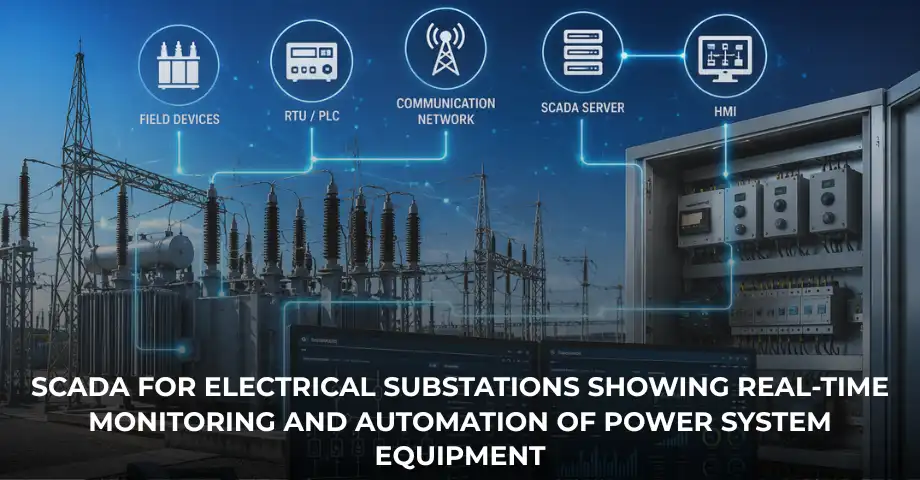
Modern electrical substations are no longer limited to manually operated switchgear and periodic equipment inspections. As power systems become more complex and industries demand higher reliability, utilities and industrial facilities are increasingly adopting SCADA (Supervisory Control and Data Acquisition) systems to monitor, control, and automate their electrical substations.
SCADA for Electrical Substations enables operators to remotely monitor electrical equipment, collect real-time operational data, control circuit breakers and switches, analyse system performance, and respond quickly to faults. By integrating intelligent electronic devices (IEDs), protection relays, sensors, communication networks, and Human Machine Interfaces (HMIs), SCADA improves operational efficiency, reduces downtime, and enhances the safety of electrical infrastructure.
Whether used in power utilities, manufacturing plants, steel plants, renewable energy projects, or industrial facilities, SCADA has become a critical component of modern substation automation. It helps operators make informed decisions, optimise maintenance, and ensure the reliable delivery of electrical power.
In this guide, you’ll learn what SCADA for electrical substations is, how it works, its major components, and why it has become an essential technology for today’s industrial power systems.
What Is SCADA for Electrical Substations?
SCADA (Supervisory Control and Data Acquisition) is an advanced automation system that enables the remote monitoring, control, and management of electrical substations. It continuously collects operational data from field devices, processes the information, and presents it to operators through a central control system.
Unlike traditional substations that require manual inspection and switching operations, SCADA-equipped substations allow operators to supervise equipment remotely, receive instant alarms, analyse system trends, and control electrical devices from a central control room.
A typical SCADA system monitors equipment such as:
- Power Transformers
- Circuit Breakers
- Isolators and Disconnectors
- Current Transformers (CTs)
- Potential Transformers (PTs)
- Protection Relays
- Busbars
- Feeder Panels
- Energy Meters
- Capacitor Banks
Quick Definition
SCADA for Electrical Substations is a computer-based automation system that enables real-time monitoring, remote control, data acquisition, fault detection, and operational management of substation equipment.
Modern SCADA systems work closely with digital protection devices to ensure safe and reliable operation. If you’re new to electrical protection, read our guide on Transformer Protection System to understand how protection schemes integrate with automation systems.
Why SCADA Is Important in Modern Electrical Substations
Today’s electrical substations handle significantly more data and operational complexity than conventional substations. Manual monitoring alone is no longer sufficient for maintaining reliability and responding quickly to abnormal operating conditions.
SCADA addresses these challenges by providing operators with real-time visibility of the entire electrical network.
Major advantages include:
- Remote monitoring of electrical equipment
- Faster fault identification
- Reduced operational downtime
- Improved personnel safety
- Real-time alarm management
- Historical data recording
- Predictive maintenance support
- Improved system reliability
- Reduced operating costs
By automating routine monitoring tasks, SCADA enables maintenance teams to focus on preventive maintenance rather than reactive repairs.
How SCADA Works in an Electrical Substation
A SCADA system continuously gathers information from field devices installed throughout the substation. These devices transmit operational data to a central controller, where the information is processed, displayed, and archived for future analysis.
The process generally follows these steps:
1. Data Collection
Sensors, Current Transformers (CTs), Potential Transformers (PTs), Intelligent Electronic Devices (IEDs), and protection relays continuously measure electrical parameters such as voltage, current, frequency, power factor, breaker status, transformer temperature, and energy consumption.
2. Data Transmission
The collected information is transmitted through communication networks using industrial communication protocols such as IEC 61850, Modbus, DNP3, or IEC 60870-5-104.
3. Data Processing
The SCADA server processes incoming data, stores it in a historical database, and checks for abnormal operating conditions such as overloads, equipment failures, or protection trips.
4. Visualisation
Operators access the information through a Human Machine Interface (HMI), where they can view single-line diagrams, equipment status, alarms, historical trends, and electrical measurements in real time.
5. Remote Control
Authorised operators can remotely operate circuit breakers, isolators, capacitor banks, and other electrical equipment directly from the control room while maintaining appropriate safety interlocks.
Key Advantage
Instead of relying on periodic manual inspections, SCADA provides continuous 24×7 monitoring of electrical substations, allowing operators to detect problems before they develop into major failures.
Main Components of a SCADA System
A modern SCADA system consists of several integrated hardware and software components that work together to monitor and control electrical substations.
Human Machine Interface (HMI)
The Human Machine Interface is the graphical interface used by operators to view real-time electrical data, alarms, equipment status, and historical trends. It enables operators to control substation equipment through an intuitive graphical display.
SCADA Server
The SCADA server acts as the central processing unit of the automation system. It collects data from field devices, processes alarms, records historical information, and communicates with operator workstations.
Remote Terminal Unit (RTU)
RTUs collect field data from sensors, meters, and electrical equipment before transmitting the information to the SCADA server. They also receive remote control commands and execute switching operations.
Programmable Logic Controller (PLC)
In many industrial substations, PLCs perform local automation tasks while communicating with the SCADA system. They are commonly used for equipment sequencing, interlocking, and automatic control.
Intelligent Electronic Devices (IEDs)
IEDs include modern numerical protection relays, digital meters, bay controllers, and monitoring devices that provide detailed operational data to the SCADA system.
Modern substations increasingly use digital protection relays for improved monitoring and communication. Learn more in our article on Numerical vs Conventional Protection Relays.
Communication Network
The communication infrastructure connects all field devices to the SCADA server using Ethernet, fibre optic networks, wireless communication, or serial communication depending on system requirements.
Current Transformers (CTs) and Potential Transformers (PTs)
CTs and PTs provide accurate measurement signals for monitoring, protection, and automation systems.
If you’re unfamiliar with instrument transformers, read our guides on What Is an Instrument Transformer? and CT vs PT (Current Transformer vs Potential Transformer).
Communication Protocols Used in SCADA Systems
Reliable communication is essential for successful SCADA implementation. Modern substations use internationally recognised communication protocols to exchange data between field devices and the control centre.
The most widely used protocols include:
- IEC 61850
- Modbus RTU
- Modbus TCP/IP
- DNP3
- IEC 60870-5-101
- IEC 60870-5-104
- OPC UA
These protocols enable seamless communication between protection relays, RTUs, PLCs, HMIs, and SCADA servers, ensuring reliable operation across the entire electrical network.
Types of SCADA Systems
SCADA technology has evolved significantly over the years. Modern substations typically use one of the following system architectures depending on operational requirements.
Standalone SCADA
Standalone SCADA systems are used for smaller facilities where monitoring and control are performed locally without external communication networks.
Networked SCADA
Networked SCADA systems connect multiple substations through Ethernet or fibre optic communication, enabling centralised monitoring and control from a remote control centre.
Distributed SCADA
Distributed SCADA systems spread processing tasks across multiple servers and controllers, improving system reliability and reducing the risk of a single point of failure.
Cloud-Based SCADA
Modern cloud-enabled SCADA solutions provide secure remote access, advanced analytics, and easier scalability for organisations managing multiple substations across different locations.
The choice of SCADA architecture depends on the size of the electrical network, communication infrastructure, cybersecurity requirements, and future expansion plans.
Benefits of SCADA for Electrical Substations
Implementing a SCADA system offers significant operational, technical, and financial advantages for utilities and industrial facilities. By providing continuous monitoring and intelligent automation, SCADA improves the overall reliability and efficiency of electrical substations.
Real-Time Monitoring
SCADA provides operators with instant access to critical electrical parameters such as voltage, current, frequency, power factor, transformer temperature, breaker status, and energy consumption. Continuous monitoring allows abnormalities to be detected before they lead to equipment failures.
Remote Operation
One of the biggest advantages of SCADA is the ability to operate substations remotely. Circuit breakers, isolators, capacitor banks, and other electrical equipment can be controlled safely from a central control room, reducing the need for manual field operations.
Faster Fault Detection
SCADA immediately generates alarms whenever abnormal operating conditions occur. Operators receive real-time notifications of equipment faults, overloads, protection trips, communication failures, and voltage abnormalities, allowing faster corrective action.
Improved Reliability
Continuous monitoring and automated control reduce the risk of unexpected outages and improve the reliability of electrical distribution systems.
Reduced Downtime
Early fault identification enables maintenance teams to resolve issues quickly, reducing production interruptions and improving plant availability.
Historical Data and Trend Analysis
SCADA stores historical operational data that can be analysed to identify recurring issues, monitor equipment performance, and support predictive maintenance strategies.
Enhanced Safety
Remote operation reduces the need for personnel to enter high-voltage switchyards during switching operations, improving workplace safety and reducing operational risks.
Lower Operating Costs
Automation reduces manual inspections, improves maintenance planning, and minimises equipment failures, helping organisations reduce long-term operating costs.
Industrial Applications of SCADA
SCADA systems are used across a wide range of industries where reliable electrical power and continuous monitoring are essential.
Power Utilities
Electricity transmission and distribution companies use SCADA to monitor substations, transmission lines, circuit breakers, transformers, and feeders from central control centres.
Steel Plants
Steel manufacturing facilities require uninterrupted electrical power for furnaces, rolling mills, and heavy industrial drives. SCADA enables operators to monitor electrical loads, respond quickly to faults, and improve plant reliability.
Cement Plants
Cement plants use SCADA to supervise crushers, kilns, conveyors, motors, and electrical substations, ensuring efficient operation of critical production equipment.
Manufacturing Industries
Modern manufacturing facilities integrate SCADA with production automation systems to monitor electrical infrastructure, improve energy management, and reduce downtime.
Renewable Energy Plants
Solar and wind power plants use SCADA to monitor inverters, transformers, switchgear, weather conditions, and power generation performance in real time.
Oil and Gas Facilities
SCADA supports the monitoring and control of electrical distribution systems, pumping stations, substations, and critical process equipment in oil and gas installations.
Water Treatment Plants
Water utilities rely on SCADA to supervise pumps, motors, electrical panels, substations, and process control equipment while ensuring uninterrupted plant operation.
SCADA Integration with Protection Relays
Modern substations combine SCADA with numerical protection relays to create intelligent automation systems capable of monitoring equipment and responding to faults in real time.
Protection relays continuously monitor electrical parameters, detect abnormal conditions, and trip circuit breakers when faults occur. SCADA receives this information instantly, displays alarms, records events, and provides operators with complete fault diagnostics.
SCADA commonly integrates with:
- Transformer Protection Relays
- Generator Protection Relays
- Feeder Protection Relays
- Motor Protection Relays
- Busbar Protection Systems
- Differential Protection Relays
Learn more about modern protection technologies in our articles on Transformer Protection Relays, Feeder Protection Relays, and Generator Protection Relays.
SCADA vs Conventional Substation Monitoring
| Feature | SCADA System | Conventional Monitoring |
|---|---|---|
| Equipment Monitoring | Real-time | Manual inspection |
| Remote Control | Available | Not Available |
| Alarm Management | Automatic | Manual |
| Historical Data | Stored Automatically | Limited |
| Fault Response | Immediate | Delayed |
| Operational Efficiency | High | Moderate |
| Maintenance Planning | Predictive | Reactive |
For organisations operating multiple substations, SCADA significantly improves visibility, operational control, and maintenance efficiency compared to conventional monitoring methods.
How to Choose the Right SCADA Solution
Selecting the right SCADA system depends on the complexity of the electrical network and future operational requirements.
Important factors to consider include:
- Number of substations to be monitored
- Voltage level and equipment type
- Communication infrastructure
- Cybersecurity requirements
- Integration with existing protection relays
- SCADA software scalability
- Remote access requirements
- Compliance with IEC communication standards
- Future plant expansion plans
A detailed engineering study helps determine the most suitable SCADA architecture for long-term reliability and operational flexibility.
Maintenance Best Practices
Routine maintenance ensures reliable SCADA operation and reduces the risk of communication failures or unexpected equipment downtime.
Recommended maintenance activities include:
- Verify communication network health.
- Inspect fibre optic and Ethernet connections.
- Test RTUs and PLCs periodically.
- Update SCADA software and firmware.
- Back up databases and configuration files.
- Review alarm settings and event logs.
- Inspect UPS and auxiliary power supplies.
- Test cybersecurity protection measures.
Preventive maintenance improves system reliability and extends the service life of automation equipment.
Why Choose Delta Technocrats?
Delta Technocrats delivers complete substation automation and SCADA solutions for industrial facilities, utilities, and infrastructure projects across Eastern India. Our engineering team provides complete support from system design and equipment selection to installation, testing, commissioning, and long-term maintenance.
Our expertise includes:
- Substation Automation Systems
- SCADA Design & Integration
- Numerical Protection Relays
- Transformer Protection Systems
- Power Quality Solutions
- Current & Potential Transformers
- Protection Testing & Commissioning
- Industrial Electrical EPC Projects
Whether you are upgrading an existing substation or developing a new automation project, Delta Technocrats can deliver reliable, scalable, and future-ready SCADA solutions tailored to your operational requirements.
Frequently Asked Questions (FAQs)
1. What is SCADA in an electrical substation?
SCADA is an automation system that enables real-time monitoring, remote control, data acquisition, alarm management, and operational supervision of electrical substation equipment.
2. What are the main components of a SCADA system?
The main components include the SCADA server, Human Machine Interface (HMI), Remote Terminal Units (RTUs), Programmable Logic Controllers (PLCs), Intelligent Electronic Devices (IEDs), communication networks, and field sensors.
3. Why is SCADA important for substations?
SCADA improves operational efficiency, reduces downtime, enhances safety, enables remote monitoring, and provides real-time fault detection.
4. Which communication protocols are commonly used in SCADA?
Common protocols include IEC 61850, Modbus, DNP3, IEC 60870-5-101, IEC 60870-5-104, and OPC UA.
5. Can SCADA work with protection relays?
Yes. Modern SCADA systems integrate seamlessly with numerical protection relays to monitor faults, record events, and improve system reliability.
6. Is SCADA suitable for existing substations?
Yes. Many existing substations can be modernised by integrating SCADA with existing switchgear and protection systems, improving monitoring without replacing the complete infrastructure.
7. Which industries use SCADA?
SCADA is widely used in power utilities, manufacturing plants, steel industries, cement plants, renewable energy projects, water treatment facilities, mining operations, and oil & gas industries.
8. How often should a SCADA system be maintained?
Regular preventive maintenance, communication testing, software updates, and system health checks should be performed according to the manufacturer’s recommendations and plant maintenance schedule.
Conclusion
SCADA for Electrical Substations has transformed the way modern electrical networks are monitored and managed. By providing real-time visibility, intelligent automation, remote operation, and advanced data analysis, SCADA enables industries and utilities to improve reliability, reduce downtime, and optimise maintenance activities.
As substations continue to become more digital and interconnected, integrating SCADA with intelligent protection relays, communication networks, and modern automation systems is essential for achieving safe, efficient, and future-ready power distribution.
Whether you’re planning a new substation or upgrading an existing one, implementing a well-designed SCADA system can significantly improve operational performance while supporting long-term business growth.
To expand your knowledge of electrical protection and automation, you may also find these guides useful:
- Transformer Protection System
- Transformer Protection Relays for Industries
- Numerical vs Conventional Protection Relays
- Feeder Protection Relays
- Generator Protection Relays
- Current Transformer Accuracy Class
- CT vs PT (Current Transformer vs Potential Transformer)
- Power Factor Correction
- Active Harmonic Filter
Looking for SCADA & Substation Automation Solutions?
Delta Technocrats provides end-to-end SCADA systems, substation automation, numerical protection relays, power quality solutions, testing, commissioning, and EPC services for industrial and utility applications. Contact our experts to build a reliable, scalable, and intelligent electrical substation tailored to your operational requirements.