
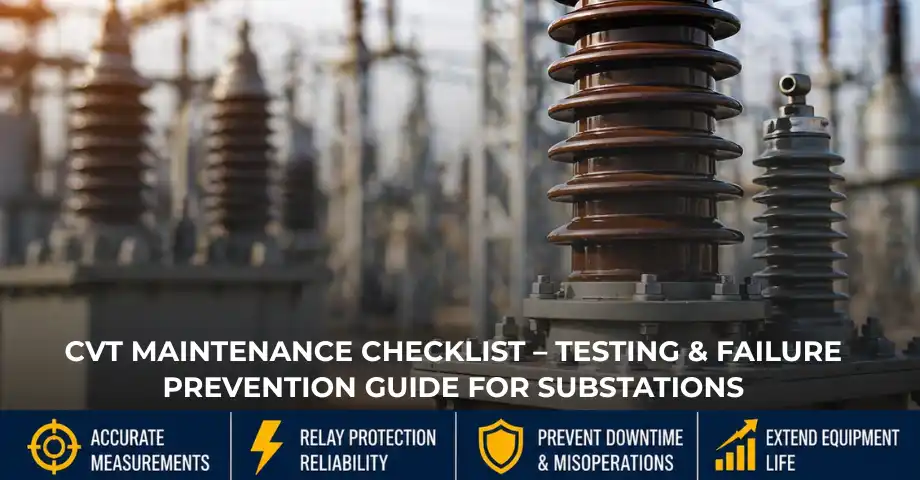
In many substations, when a feeder trips unexpectedly or a relay behaves inconsistently, the investigation often begins with relays, breakers, or transformers. However, in a surprising number of cases, the root cause lies elsewhere — in the accuracy of the voltage signal itself.
A slowly degrading Capacitor Voltage Transformer (CVT) can introduce small measurement errors that go unnoticed during routine checks. These errors gradually influence relay decisions, leading to false tripping, delayed fault detection, or, in critical situations, complete protection failure. The problem does not appear suddenly — it develops quietly over time.
This is why Capacitor Voltage Transformer maintenance in substations is not just a routine activity. It is a fundamental requirement for maintaining the reliability and safety of the entire protection system.
For a broader understanding of how CVTs function across industrial applications, you can explore this guide on constant voltage transformer industrial use.
Why CVT Accuracy Directly Impacts Substation Reliability
CVTs do not directly interrupt faults or control current flow. Their role is more subtle but equally critical — they provide the voltage reference on which protection systems rely. Every relay decision assumes that the voltage input it receives is accurate.
When this assumption fails, the consequences may not be immediately visible but can be significant over time. Inaccurate voltage signals can lead to:
- False tripping during normal operating conditions
- Failure to detect actual faults when they occur
- Voltage instability across feeders and transformers
- Increased stress on connected electrical equipment
This dependency becomes even more critical in systems using feeder protection relays and transformer protection relays, where accurate voltage input is essential for correct operation.
How CVTs Influence Protection System Decisions
In a substation, CVTs act as the interface between high-voltage networks and protection systems. They convert transmission-level voltages into safe, measurable values that relays can interpret.
During abnormal conditions, relays analyze these voltage signals to decide whether to trip or isolate a section of the system. If the CVT output is slightly inaccurate, the relay’s decision-making process is affected.
What makes this challenging is that these inaccuracies often remain undetected until a fault occurs. At that point, the system response may already be compromised.
Understanding CVT Failures in Real Substation Conditions
In practical environments, CVT failures rarely occur as sudden breakdowns. They develop gradually due to electrical stress, environmental exposure, and aging components. Many of these issues remain hidden during early stages, making them difficult to detect without proper analysis.
Insulation Degradation and Moisture Ingress
Insulation inside a CVT weakens over time due to temperature variations, humidity, and operational stress. Moisture ingress is particularly common in outdoor substations, where environmental exposure is unavoidable.
As insulation degrades, dielectric strength reduces, increasing the risk of internal faults and inaccurate voltage output.
Capacitance Drift and Measurement Inaccuracy
CVTs rely on stable capacitance values to maintain accurate voltage transformation. Over time, these values can change due to aging or electrical stress.
This results in gradual deviation in voltage output. Since this change is not visible externally, it often remains undetected until it affects relay performance.
Ferroresonance and Overvoltage Stress
Ferroresonance is a complex condition that can occur under specific switching or light-load situations. It produces abnormal voltage oscillations that place significant stress on the CVT.
In many cases, ferroresonance is not immediately identified, leading to long-term internal damage.
Connection and Mechanical Degradation
Substations operate under continuous vibration and varying load conditions. Over time, this affects mechanical integrity.
Loose terminals, corroded contacts, and weakened connections can introduce instability in voltage signals, which directly impacts protection system performance.
Environmental Stress in Indian Substations
Environmental conditions play a major role in CVT performance, especially in outdoor installations. Common challenges include:
- Dust accumulation affecting insulation performance
- High ambient temperatures accelerating aging
- Humidity leading to moisture-related degradation
These factors often act together, increasing the likelihood of gradual performance deterioration.
Such issues can extend beyond the CVT itself and impact systems protected by motor protection relays and generator protection relays, creating broader operational risks.
CVT Maintenance Checklist (Quick Overview)
A structured maintenance approach helps engineers detect early signs of degradation and maintain consistent performance.
| Frequency | Key Focus Areas |
|---|---|
| Daily | Visual condition, noise, voltage stability |
| Monthly | Connections, insulation resistance |
| Quarterly | Corrosion, environmental exposure |
| Annual | Capacitance testing, detailed inspection |
Practical CVT Maintenance Approach for Substations
Effective maintenance goes beyond following a checklist. Each activity should be understood in terms of its purpose and impact on system reliability.
Routine inspections help identify visible issues such as physical damage or overheating. These checks are simple but essential, as they provide early warning signs of deeper problems.
Periodic maintenance focuses on electrical integrity. Ensuring tight connections, proper grounding, and insulation health helps maintain stable operation under varying conditions.
Long-term maintenance involves deeper evaluation through testing. This allows engineers to assess internal condition and anticipate potential failures before they occur.
Common Mistakes That Reduce CVT Reliability
Many CVT-related issues arise not from lack of maintenance, but from incorrect practices or incomplete evaluation.
Some of the most common mistakes include:
- Relying only on visual inspection without electrical testing
- Ignoring minor voltage fluctuations or relay inconsistencies
- Using uncalibrated instruments for measurement
- Neglecting environmental protection measures
Avoiding these mistakes significantly improves system reliability and reduces unexpected failures.
Early Warning Signs Engineers Should Not Ignore
CVTs typically provide early indications before a major failure occurs. Recognizing these signs allows timely intervention.
Key warning signals include:
- Unstable or fluctuating voltage readings
- Frequent relay misoperations
- Unusual heating or noise
- Visible insulation deterioration
These symptoms often indicate deeper issues that require detailed inspection and testing.
Where Routine Maintenance Becomes Insufficient
Routine maintenance is essential, but it has limitations. Many critical issues — such as capacitance drift and dielectric losses — cannot be identified through visual inspection alone.
To ensure complete reliability, advanced capacitor voltage transformer testing and diagnostic methods are required.
Advanced CVT Testing Methods for Substations
Routine maintenance helps identify visible issues, but it does not reveal what is happening inside a Capacitor Voltage Transformer. In many substations, CVTs continue to operate even when internal degradation has already begun. This creates a hidden risk — the system appears stable, but the data it relies on is no longer fully accurate.
To address this gap, structured testing becomes essential. Advanced testing allows engineers to validate performance, detect internal deterioration, and ensure that the CVT continues to provide reliable input to protection systems.
Key Testing Methods and Their Practical Importance
- Ratio Testing: Confirms that the CVT is converting primary voltage to the correct secondary value. Even a small deviation can affect relay decision-making.
- Capacitance and Tan Delta Testing: Provides insight into internal aging and dielectric losses. This is one of the most reliable ways to detect early-stage degradation.
- Insulation Resistance Testing: Evaluates insulation strength and helps identify moisture ingress, which is common in outdoor substations.
- Thermal Inspection: Detects abnormal heat patterns that may indicate internal losses, loose connections, or developing faults.
- Ferroresonance Monitoring: Identifies abnormal voltage oscillations that can occur under specific switching or load conditions.
Each of these tests contributes a different perspective. When combined, they provide a comprehensive understanding of CVT health.
Practical insight: In many cases, capacitance variation is detected only after relay misoperation occurs. Regular testing helps identify such issues before they impact system performance.
Practical CVT Diagnostic Approach: From Symptoms to Root Cause
In real substation environments, problems rarely present themselves as clearly defined faults. Engineers typically observe symptoms and must determine their underlying cause.
A structured diagnostic approach helps connect these symptoms with actual issues:
- Fluctuating voltage readings often indicate capacitance drift or internal degradation.
- Frequent relay misoperations may point to incorrect voltage input rather than relay failure.
- Overheating can result from insulation breakdown or ferroresonance conditions.
- Intermittent signals are usually linked to loose or corroded connections.
- Delayed relay response may indicate unstable or distorted voltage signals.
The effectiveness of maintenance depends on correctly interpreting these signals. Without proper diagnosis, corrective actions may address symptoms rather than root causes.
Since CVTs directly influence protection systems, incorrect diagnosis can affect equipment connected through feeder protection relays and transformer protection relays, increasing the risk of system-wide issues.
Preventive Maintenance Strategy for Long-Term Reliability
Modern substations require a shift from routine maintenance to a more structured and predictive approach. Instead of reacting to failures, engineers must focus on preventing them.
An effective preventive strategy typically includes:
- Using testing data and historical trends to plan maintenance activities
- Monitoring environmental conditions such as dust, humidity, and temperature
- Ensuring proper installation, grounding, and commissioning practices
- Integrating CVT performance with overall protection system health
CVTs should not be treated as isolated components. Their performance directly affects systems such as motor protection relays and generator protection relays. A system-level perspective improves coordination and reduces operational risk.
When Should You Replace a CVT Instead of Repairing?
While maintenance can extend the life of a CVT, there comes a point where repair is no longer the most reliable option. Identifying this point is critical for maintaining system stability.
Replacement should be considered when:
- Insulation degradation becomes severe or recurring
- Capacitance deviation continues despite corrective actions
- Relay misoperations persist even after maintenance
- The equipment has reached the end of its reliable service life
Decision perspective: In critical substations, reliability is more valuable than short-term cost savings. Replacing a deteriorated CVT often reduces long-term operational risk.
Best Practices for CVT Maintenance in Indian Substations
Substations in India operate under demanding environmental and operational conditions. Maintenance strategies must account for these realities.
- Frequent cleaning to manage dust accumulation
- Regular insulation monitoring in high-humidity environments
- Additional testing under fluctuating load conditions
- Improved enclosure and protection for outdoor installations
Adapting maintenance practices to local conditions significantly improves performance and extends equipment life.
Industrial Cost Impact of Poor CVT Maintenance
The impact of CVT failure is not limited to the equipment itself. It affects the entire operational chain of the substation and connected systems.
Common consequences include:
- Unplanned downtime disrupting operations
- Production losses in industrial environments
- Damage to connected electrical equipment
- Increased maintenance and replacement costs
Compared to these risks, preventive maintenance and testing represent a relatively small but highly effective investment.
Looking for Reliable CVT Solutions?
In many substations, accurate testing and maintenance require specialized expertise and equipment. When systems show signs of instability or require deeper evaluation, working with experienced professionals becomes essential.
Delta Technocrats supports industries with capacitor voltage transformer solutions, testing support, and protection system integration across a wide range of applications.
Frequently Asked Questions (FAQs)
What is a CVT in a substation?
A Capacitor Voltage Transformer is used to step down high transmission voltage to measurable levels for protection and monitoring systems.
How often should a CVT be tested?
Routine inspections should be performed regularly, while detailed testing is typically carried out annually or based on equipment condition.
What causes CVT failure?
Common causes include insulation degradation, capacitance drift, ferroresonance, and environmental stress.
Why is CVT maintenance important?
It ensures accurate voltage measurement, reliable protection system operation, and prevents costly failures in substations.