
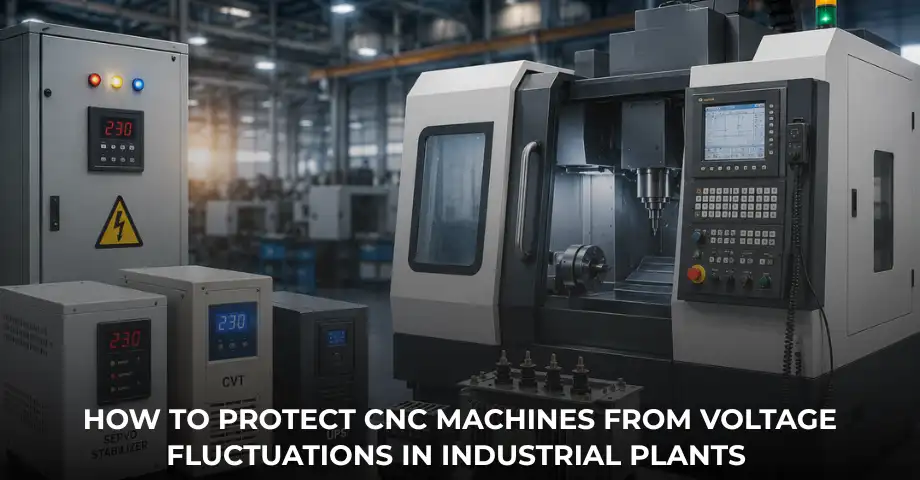
Unexpected CNC machine shutdowns, servo drive trips, PCB failures, and machining inaccuracies are becoming increasingly common in industrial plants facing unstable power conditions. Many factories invest heavily in advanced CNC machinery but often overlook one critical factor that directly affects machine performance and reliability — power quality.
Modern CNC machines depend on highly stable voltage for precision operation. Even minor voltage fluctuations can disturb sensitive electronic systems, interrupt machining programs, and create long-term damage to expensive machine components. In Indian industrial environments where power instability, transformer overload, and fluctuating utility supply are common, CNC machines remain continuously exposed to electrical stress.
Poor power quality not only affects production continuity but also increases maintenance costs, emergency downtime, and component replacement expenses. For industries operating high-value CNC equipment, voltage protection is no longer an optional electrical upgrade. It has become an essential part of maintaining operational efficiency and preventing costly production losses.
Companies like Delta Technocrats provide industrial power protection solutions designed to improve electrical reliability and protect sensitive industrial equipment from voltage-related failures.
Why CNC Machines Are Highly Sensitive to Voltage Fluctuations
Unlike conventional industrial machines, CNC systems rely heavily on precision electronics, automated controls, and digitally synchronized motion systems. These machines are designed to operate within specific voltage limits, and even small electrical disturbances can affect overall machine performance.
Modern CNC machines contain several sensitive components, including:
- CNC controllers
- Servo drives
- Spindle drives
- PLC systems
- Encoder feedback systems
- Industrial PCs
- SMPS-based control circuits
All these systems require stable and clean electrical power for accurate operation. When voltage fluctuates frequently, the CNC controller may lose synchronization with servo systems, resulting in unexpected shutdowns, axis instability, or machining interruption.
Servo drives are particularly sensitive to sudden voltage dips and spikes. In many industrial plants, unstable power conditions trigger frequent servo alarms and drive trips, causing repeated machine stoppages during production cycles. Similarly, spindle drives may experience unstable speed control, affecting machining precision and surface finish quality.
Voltage instability also creates electrical stress on internal PCBs and electronic circuits. Over time, this stress reduces component lifespan and increases the possibility of controller failure, communication errors, and random machine restarting issues.
For precision manufacturing industries, even slight voltage-related disturbances can create positioning inaccuracies, dimensional variation, and rejected production batches. This is why CNC machine power supply issues should never be ignored in modern manufacturing plants.
Common Causes of Voltage Fluctuation in Industrial Plants
Voltage fluctuation in industrial facilities is usually caused by a combination of internal electrical load conditions and external utility supply problems. While many factories experience unstable voltage regularly, the root causes often remain unidentified until CNC machines begin showing operational issues.
Internal Factory Causes
Heavy industrial loads are one of the most common reasons for voltage instability inside manufacturing plants. Large induction motors used in compressors, hydraulic systems, pumps, and material handling equipment draw very high starting current, creating temporary voltage dips across the electrical network.
Welding machines and heavy fabrication equipment also generate sudden load variations that disturb voltage stability. In plants where multiple high-capacity machines operate simultaneously, sudden load switching can create inconsistent voltage conditions that directly affect sensitive CNC systems.
Factories with poor load balancing or undersized electrical infrastructure often experience more severe voltage fluctuation problems during peak production hours.
External Power Supply Causes
External utility-related issues also play a major role in industrial voltage instability. Many industrial zones experience fluctuating voltage due to overloaded distribution networks, transformer overloading, poor grid infrastructure, and unstable utility supply during high-demand periods.
Factories operating on DG sets may also experience unstable voltage during load transfer or varying generator load conditions. In some facilities, loose neutral connections, improper earthing, and phase imbalance create additional power quality problems that continuously affect CNC machine operation.
Different industries experience different levels of power quality issues depending on their electrical infrastructure, connected load, production process, and utility supply conditions. Understanding these root causes is essential before selecting any CNC machine voltage protection solution.
Industries facing unstable supply conditions can also explore the major causes of industrial voltage fluctuation and practical solutions to improve overall plant electrical reliability.
Warning Signs of CNC Machine Power Supply Problems
In many cases, CNC machines start showing early warning signs long before complete electrical failure occurs. Unfortunately, these symptoms are often ignored until production downtime becomes unavoidable.
One of the most common indicators of unstable voltage is frequent machine alarms without any visible mechanical issue. CNC controllers may suddenly reboot during operation, interrupt machining programs, or display random communication errors.
Some other common warning signs include:
- Frequent servo drive trips
- Unexpected machine shutdowns
- Display flickering or unstable screen behavior
- Spindle speed instability
- Axis movement inconsistency
- Interrupted machining cycles
- Random machine restarting problems
Another major sign is inconsistent machining accuracy. If finished components start showing dimensional variation despite proper tooling and programming, unstable power supply may be affecting machine synchronization and positioning precision.
These warning signs should never be ignored because continuous exposure to unstable voltage gradually damages sensitive electronics and increases the possibility of complete CNC machine failure.
How Voltage Fluctuation Damages CNC Machines
Voltage fluctuation affects CNC machines both electrically and operationally. While some damage appears immediately in the form of machine trips or shutdowns, many electrical failures develop gradually over time due to continuous power instability.
Electrical Damage to CNC Components
One of the most serious consequences of unstable voltage is PCB failure. CNC controllers, servo drives, spindle drives, and SMPS circuits are highly sensitive to repeated voltage spikes and dips. Continuous electrical stress causes overheating, insulation deterioration, and gradual weakening of internal electronic components.
In severe cases, sudden voltage surges may completely damage expensive drive systems or machine control boards, leading to costly repairs and long machine downtime.
Operational and Production Impact
Voltage instability also affects overall machine performance and production efficiency. Frequent machine stoppages interrupt machining cycles, damage cutting tools, and reduce production consistency.
Many industries experience:
- Production downtime
- Rejected machined components
- Increased maintenance frequency
- Tool wear and breakage
- Delayed production schedules
For high-volume manufacturing facilities, even a few hours of CNC downtime can create major operational disruption and customer delivery delays.
Financial Losses Often Go Beyond Repair Cost
The financial impact of voltage fluctuation is often much larger than the actual repair expense. Industries must also consider idle labor cost, emergency maintenance charges, spare replacement expenses, production loss, and delayed dispatch penalties.
This is why CNC machine voltage protection should be viewed as a downtime prevention investment rather than simply an electrical accessory cost. Proper industrial voltage protection systems help improve machine reliability, reduce unexpected breakdowns, and protect long-term production continuity.
Industries looking to improve machine protection can explore practical industrial voltage fluctuation solutions designed for sensitive manufacturing equipment and industrial applications.
Best Protection Systems for CNC Machines
Protecting CNC machines from voltage fluctuation requires more than a basic electrical setup. Since modern CNC systems operate through sensitive electronics and precision automation controls, industries must ensure stable, clean, and reliable power conditions to avoid unexpected machine failures and production interruptions.
The right protection system depends on the severity of voltage fluctuation, machine sensitivity, and overall plant power quality conditions. In many industrial environments, a combination of protection systems is used to improve machine reliability and reduce electrical risk.
Servo Voltage Stabilizer
Servo-controlled voltage stabilizers are widely used in industrial plants to maintain stable output voltage during fluctuating input conditions. These systems continuously monitor incoming voltage and automatically correct variations before they affect connected CNC machines.
In facilities where moderate voltage fluctuation is common, servo stabilizers help reduce:
- Frequent CNC machine tripping
- Servo drive interruption
- Controller instability
- Unexpected machine shutdowns
Servo stabilizers are suitable for many industrial applications because they provide continuous voltage correction and improve operational reliability. However, they mainly address voltage variation and may not completely eliminate electrical noise or transient disturbances affecting highly sensitive CNC electronics.
CVT (Constant Voltage Transformer)
For industries operating high-precision CNC machines, Constant Voltage Transformers (CVTs) provide a more advanced level of electrical protection. Unlike standard stabilizers, CVTs help regulate voltage while also filtering electrical noise and maintaining cleaner output power.
Sensitive CNC controllers, industrial PCs, encoder systems, and automation electronics are highly vulnerable to voltage spikes, line disturbances, and transient fluctuations. CVTs help minimize these issues by delivering highly stable output voltage even when incoming supply conditions remain unstable.
CVTs are particularly beneficial for:
- Advanced CNC machining centers
- Automated manufacturing lines
- Plants with unstable utility supply
- Factories operating on DG sets
- Sensitive industrial electronic systems
Industries looking for advanced CNC machine voltage protection solutions can explore industrial CVT systems for sensitive equipment protection.
UPS Systems
UPS (Uninterruptible Power Supply) systems are primarily used to provide temporary backup power during sudden power failure or supply interruption. In CNC applications, UPS systems help protect machine controllers and automation systems from abrupt shutdowns that may interrupt production or damage machining data.
A properly configured UPS system helps:
- Protect machining programs and controller data
- Allow safe machine shutdown during power failure
- Reduce control system interruption
- Minimize sudden operational stoppages
However, UPS systems alone cannot solve all industrial power quality problems. While they provide backup support, additional voltage regulation and protection systems may still be necessary in facilities experiencing severe fluctuation or unstable power conditions.
Isolation Transformers
Isolation transformers help electrically isolate CNC machines from incoming supply disturbances and line interference. These systems improve power quality by reducing electrical noise, suppressing disturbances, and improving overall supply stability.
In industrial environments where harmonics, grounding problems, or electrical interference affect machine operation, isolation transformers can improve communication stability and reduce control-related faults.
They are often used alongside stabilizers or CVTs in manufacturing plants requiring higher levels of electrical isolation and cleaner power supply conditions.
Protection Relays
Protection relays are essential for safeguarding industrial electrical systems against abnormal operating conditions such as overvoltage, undervoltage, overload, phase failure, and short circuits.
In CNC manufacturing plants, these systems help isolate faults before they damage connected machinery and improve overall plant electrical safety.
Industries can strengthen their electrical protection infrastructure using industrial protection relays and transformer protection relay systems for enhanced industrial reliability.
How to Choose the Right Voltage Protection System for CNC Machines
Selecting the correct voltage protection system requires proper evaluation of both machine requirements and plant electrical conditions. Since every manufacturing facility experiences different power quality challenges, industries should avoid selecting protection systems based only on machine capacity or price.
One of the most important factors is the sensitivity level of the CNC machine itself. High-precision machining centers with advanced automation controls generally require cleaner and more stable power compared to standard industrial equipment.
Industries should also evaluate:
- Severity and frequency of voltage fluctuation
- Presence of harmonics or electrical noise
- Generator operation conditions
- Production criticality and downtime risk
- Plant load variation and electrical infrastructure quality
Factories experiencing moderate fluctuation may achieve reliable operation using servo stabilizers, while facilities facing unstable DG supply, frequent voltage dips, or severe power disturbances may require advanced solutions such as CVTs combined with additional protection systems.
It is also important to select properly sized equipment based on actual CNC load conditions and future production expansion plans. Undersized systems often fail to provide stable protection during peak operating conditions, leading to reduced reliability and repeated machine interruptions.
A proper electrical assessment helps industries implement the most effective CNC machine protection strategy for long-term operational stability and equipment safety.
Maintenance Best Practices for Reliable CNC Power Protection
Even the best voltage protection systems require regular inspection and preventive maintenance to ensure reliable long-term performance. Poor maintenance can gradually reduce protection efficiency and expose CNC machines to avoidable electrical risk.
Industries should periodically inspect:
- Input and output voltage conditions
- Grounding and earthing quality
- Protection relay operation
- Load balancing across phases
- Cable connections and terminal tightness
Routine maintenance of stabilizers, CVTs, transformers, and relay systems helps identify early electrical issues before they affect CNC machine operation or create production downtime.
Industries can also follow recommended CVT maintenance and inspection practices to improve long-term protection reliability and equipment performance.
Conclusion
Voltage fluctuation is one of the most common causes of CNC machine instability, unexpected downtime, and electronic failure in industrial plants. Without proper protection, unstable power conditions can gradually damage sensitive machine components and affect overall production reliability.
Implementing the right combination of stabilizers, CVTs, UPS systems, isolation transformers, and protection relays helps industries improve machine performance, reduce downtime, and protect high-value CNC equipment from long-term electrical stress.
More importantly, CNC voltage protection should be considered a preventive reliability investment rather than an additional operational expense. Stable power supply directly supports machining accuracy, production continuity, machine life, and long-term operational efficiency.
Companies like Delta Technocrats provide industrial power protection solutions designed to help manufacturing facilities improve electrical reliability and safeguard sensitive CNC systems from voltage-related failures.