
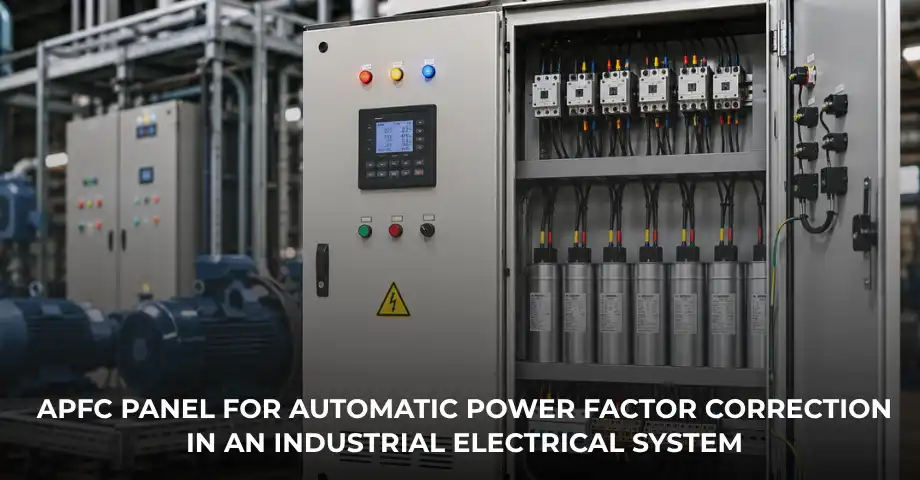
Industrial facilities rely on efficient electrical systems to maintain uninterrupted production, reduce operating costs, and maximise equipment performance. However, many industrial loads such as induction motors, compressors, pumps, welding machines, HVAC systems, and Variable Frequency Drives (VFDs) consume reactive power, resulting in a low power factor. A poor power factor not only increases electricity bills but also causes higher current flow, additional energy losses, and unnecessary stress on electrical equipment.
An APFC Panel (Automatic Power Factor Correction Panel) is designed to solve this problem by automatically monitoring the power factor of an electrical system and switching capacitor banks as required. By maintaining the desired power factor, an APFC panel improves electrical efficiency, reduces power losses, prevents utility penalties, and enhances the overall reliability of industrial power distribution systems.
Today, APFC panels are widely used in manufacturing plants, commercial buildings, hospitals, data centres, steel plants, cement industries, and other facilities where maintaining a high power factor is essential for efficient and economical operation.
In this guide, you’ll learn what an APFC panel is, how it works, its main components, different types, and why it has become an essential part of modern industrial electrical systems.
What Is an APFC Panel?
An APFC Panel (Automatic Power Factor Correction Panel) is an intelligent electrical control panel that automatically improves the power factor of an electrical installation by switching capacitor banks according to the reactive power demand.
Unlike manual capacitor banks, which require operator intervention, an APFC panel continuously measures the system’s power factor through a power factor controller. Whenever the power factor drops below the preset value, the controller automatically connects the required capacitor stages. As the load changes, unnecessary capacitor banks are disconnected, ensuring optimum reactive power compensation at all times.
This automatic operation helps industries maintain a power factor close to unity, improve energy efficiency, and avoid penalties imposed by electricity distribution companies.
Quick Definition
An APFC Panel is an Automatic Power Factor Correction system that continuously monitors the electrical load and automatically switches capacitor banks to maintain the desired power factor, reduce reactive power, and improve overall electrical efficiency.
If you’re new to the concept of power factor, we recommend reading our detailed guide on Power Factor Correction, which explains why maintaining a good power factor is essential for industrial electrical systems.
Why Power Factor Matters
Every electrical system consumes two types of power:
- Active Power (kW) – The useful power that performs actual work, such as running motors or lighting.
- Reactive Power (kVAR) – The power required to establish magnetic fields in inductive equipment such as motors and transformers.
When reactive power increases, the power factor decreases. A low power factor means more current is required to deliver the same amount of useful power. This increases energy losses, reduces system efficiency, and places additional stress on transformers, cables, generators, and switchgear.
Maintaining a high power factor helps industries:
- Reduce electricity costs.
- Improve transformer loading.
- Lower cable losses.
- Increase system efficiency.
- Avoid utility penalties.
- Improve voltage stability.
Modern APFC panels automatically perform this correction without requiring manual intervention.
Why Industries Need an APFC Panel
Most industrial facilities operate a large number of inductive loads that continuously affect the power factor. Without automatic correction, the power factor fluctuates throughout the day as different equipment starts and stops.
An APFC panel continuously compensates for these variations, ensuring stable electrical performance under changing operating conditions.
Industries commonly install APFC panels to:
- Reduce electricity bills.
- Avoid low power factor penalties.
- Improve energy efficiency.
- Increase transformer capacity utilisation.
- Reduce heating in electrical equipment.
- Improve voltage regulation.
- Increase the lifespan of electrical assets.
- Support sustainable energy management.
In facilities with significant harmonic distortion caused by VFDs or power electronic equipment, APFC panels are often used alongside Active Harmonic Filters to improve overall power quality.
How an APFC Panel Works
An APFC panel continuously monitors the electrical system and automatically switches capacitor banks according to the reactive power demand.
The operating sequence generally follows these steps.
1. Measurement of Electrical Parameters
Current Transformers (CTs) continuously measure load current and provide feedback to the Power Factor Controller.
Accurate Current Transformer selection is essential for reliable APFC operation. Learn more in our guide on Current Transformer Accuracy Class.
2. Power Factor Calculation
The Power Factor Controller continuously calculates the system’s power factor by analysing voltage and current signals.
3. Automatic Capacitor Switching
If the power factor falls below the preset value, the controller automatically energises one or more capacitor stages using contactors or thyristor switching modules.
When the power factor improves beyond the target level, unnecessary capacitor banks are disconnected automatically.
4. Continuous Monitoring
The controller repeats this process continuously, ensuring optimum reactive power compensation regardless of changing electrical loads.
Key Advantage
Unlike manual capacitor banks, an APFC panel automatically adjusts capacitor switching according to the real-time reactive power demand, maintaining an optimum power factor without operator intervention.
Main Components of an APFC Panel
An APFC panel consists of several electrical components that work together to provide automatic power factor correction.
Power Factor Controller
The Power Factor Controller is the brain of the APFC panel. It continuously measures electrical parameters, calculates the power factor, and determines which capacitor stages should be switched.
Capacitor Banks
Capacitor banks supply reactive power to compensate for inductive loads. Multiple capacitor stages allow the controller to provide accurate power factor correction under varying load conditions.
Current Transformer (CT)
The CT measures load current and provides the feedback signal required for power factor calculation.
If you’re unfamiliar with instrument transformers, read our guides on What Is an Instrument Transformer? and CT vs PT (Current Transformer vs Potential Transformer).
Power Contactors or Thyristor Switching Modules
These devices connect and disconnect capacitor banks automatically according to commands from the Power Factor Controller.
Static APFC panels often use thyristor switching for faster and transient-free capacitor switching.
Protection Devices
Each capacitor stage is protected using suitable circuit breakers, HRC fuses, MCCBs, and protection relays to ensure safe operation during abnormal electrical conditions.
Modern industrial panels frequently integrate numerical protection devices for enhanced reliability. Learn more in our article on Numerical vs Conventional Protection Relays.
Cooling System
Cooling fans and adequate ventilation help maintain acceptable operating temperatures inside the panel enclosure, improving equipment reliability and service life.
Types of APFC Panels
Different industries require different APFC configurations depending on load characteristics and operational requirements.
Contactor-Based APFC Panel
This is the most common type of APFC panel used in industrial and commercial applications. Capacitor stages are switched using electromagnetic contactors, making it suitable for applications where load changes are relatively slow.
Thyristor-Based APFC Panel
Thyristor-switched APFC panels provide extremely fast capacitor switching without generating switching transients. They are ideal for rapidly changing loads such as welding equipment, cranes, presses, and heavy industrial machinery.
Detuned APFC Panel
Detuned APFC panels include series reactors that protect capacitor banks from harmonic resonance. They are widely used in facilities operating VFDs, UPS systems, CNC machines, and other harmonic-generating equipment.
Intelligent APFC Panel
Modern intelligent APFC panels integrate advanced controllers, communication modules, and energy monitoring functions. Many systems support remote monitoring and can be integrated with SCADA for Electrical Substations to provide centralised supervision and energy management.
Selecting the right APFC panel depends on factors such as connected load, harmonic levels, switching frequency, expansion plans, and overall power quality requirements.
Benefits of an APFC Panel
An APFC panel delivers significant technical and financial benefits by automatically maintaining the desired power factor under varying load conditions. Beyond reducing electricity costs, it also improves the efficiency, reliability, and lifespan of the entire electrical distribution system.
Reduced Electricity Bills
Maintaining a high power factor reduces reactive power demand, lowering electricity charges and helping industries avoid penalties imposed by utility companies.
Avoids Low Power Factor Penalties
Many electricity distribution companies apply penalties when the power factor falls below the prescribed limit. An APFC panel automatically maintains the required power factor, helping industries comply with utility regulations.
Improved Energy Efficiency
Lower reactive power means reduced current flow through cables, transformers, and switchgear. This decreases power losses and improves the overall efficiency of the electrical system.
Increased Transformer Capacity
By reducing unnecessary reactive current, transformers can deliver more useful active power without exceeding their rated capacity.
Lower Equipment Heating
Reduced current flow decreases heat generation in transformers, motors, cables, and electrical panels, extending equipment life.
Improved Voltage Stability
Power factor correction helps maintain stable voltage levels across the electrical distribution network, improving the performance of connected equipment.
Automatic Operation
Unlike manual capacitor banks, APFC panels continuously monitor changing loads and automatically switch capacitor stages without operator intervention.
Supports Sustainable Energy Management
Improved electrical efficiency reduces unnecessary energy consumption and contributes to more sustainable industrial operations.
Industrial Applications of APFC Panels
APFC panels are widely used wherever inductive electrical loads cause poor power factor and increased energy costs.
Manufacturing Industries
Manufacturing plants use large induction motors, compressors, conveyors, and automated production lines that continuously consume reactive power. APFC panels improve electrical efficiency while reducing utility penalties.
Steel Plants
Steel industries operate rolling mills, furnaces, cranes, and heavy motor drives that place substantial reactive loads on the electrical system. Automatic power factor correction improves system performance and transformer utilisation.
Cement Plants
Cement plants use crushers, kilns, grinding mills, and conveyor systems powered by large motors. APFC panels help improve voltage stability and reduce operating costs.
Commercial Buildings
Large commercial buildings use HVAC systems, elevators, pumps, and lighting systems that affect the power factor. APFC panels improve electrical efficiency and reduce energy bills.
Hospitals
Hospitals require reliable electrical systems for medical equipment, HVAC installations, and emergency power systems. APFC panels help maintain stable electrical performance.
Data Centres
UPS systems, cooling equipment, and IT infrastructure generate varying electrical loads. Automatic power factor correction supports efficient and reliable power distribution.
Water Treatment Plants
Water treatment facilities operate multiple pumps and motor-driven equipment where APFC panels improve energy efficiency and reduce electrical losses.
APFC Panel vs Manual Capacitor Bank
| Feature | APFC Panel | Manual Capacitor Bank |
|---|---|---|
| Power Factor Control | Automatic | Manual |
| Capacitor Switching | Automatic | Operator Dependent |
| Response to Load Changes | Real-Time | Slow |
| Energy Efficiency | High | Moderate |
| Utility Penalty Reduction | Excellent | Limited |
| Maintenance | Low | Moderate |
| Suitable for Variable Loads | Yes | No |
For facilities with continuously changing electrical loads, an APFC panel provides significantly better performance and energy savings than a manually operated capacitor bank.
How to Select the Right APFC Panel
Selecting the correct APFC panel requires a proper assessment of the electrical system and reactive power demand.
Important selection factors include:
- Total connected load (kW).
- Required reactive power compensation (kVAR).
- Existing power factor.
- Load variation throughout the day.
- Presence of harmonic distortion.
- System voltage.
- Future expansion requirements.
- Communication and monitoring needs.
If the electrical system contains significant harmonic-producing equipment such as VFDs, UPS systems, CNC machines, or welding equipment, a Detuned APFC Panel or an Active Harmonic Filter should be considered to prevent resonance and improve overall power quality.
Installation and Maintenance Best Practices
Proper installation and regular maintenance ensure reliable operation and maximise the service life of an APFC panel.
Recommended maintenance practices include:
- Inspect capacitor banks regularly.
- Check contactors or thyristor switching modules.
- Verify Current Transformer (CT) polarity and wiring.
- Inspect electrical connections for overheating.
- Clean ventilation filters and cooling fans.
- Monitor capacitor health and capacitance values.
- Verify Power Factor Controller settings.
- Maintain maintenance and inspection records.
Routine preventive maintenance reduces the risk of capacitor failures and ensures the APFC system continues operating at peak efficiency.
Integration with Active Harmonic Filters and SCADA
Modern industrial electrical systems increasingly integrate APFC panels with Active Harmonic Filters (AHFs) and SCADA platforms to achieve complete power quality management.
While an APFC panel improves the power factor by compensating reactive power, an Active Harmonic Filter eliminates harmonic distortion generated by non-linear loads. Together, these systems improve voltage stability, reduce electrical losses, and enhance equipment reliability.
Integration with SCADA allows operators to monitor:
- Power factor
- Reactive power (kVAR)
- Capacitor bank status
- Alarm conditions
- Electrical energy consumption
- Historical operating trends
To learn more about these technologies, read our articles on Active Harmonic Filter and SCADA for Electrical Substations.
Why Choose Delta Technocrats?
Delta Technocrats provides advanced Power Quality Solutions designed to improve energy efficiency, reduce operating costs, and enhance the reliability of industrial electrical systems.
Our expertise includes:
- Automatic Power Factor Correction (APFC) Panels
- Active Harmonic Filters (AHFs)
- Power Quality Analysis
- Transformer Protection Systems
- Substation Automation & SCADA
- Current & Potential Transformers
- Electrical Protection Solutions
- Testing & Commissioning Services
From system assessment and equipment selection to installation, commissioning, and after-sales support, our experienced engineers deliver customised power quality solutions for industrial and commercial applications across Eastern India.
Frequently Asked Questions (FAQs)
1. What is an APFC Panel?
An APFC Panel is an Automatic Power Factor Correction system that automatically switches capacitor banks to maintain the desired power factor and reduce reactive power demand.
2. Why is an APFC Panel used?
It improves the power factor, reduces electricity bills, avoids utility penalties, improves energy efficiency, and protects electrical equipment from unnecessary loading.
3. How does an APFC Panel work?
The Power Factor Controller continuously monitors the electrical system and automatically switches capacitor stages according to the reactive power requirement.
4. What is the difference between an APFC Panel and a capacitor bank?
An APFC panel automatically controls capacitor switching based on real-time load conditions, whereas a manual capacitor bank requires operator intervention.
5. Can APFC Panels eliminate harmonics?
No. APFC panels improve the power factor but do not remove harmonic distortion. Where harmonics are significant, Active Harmonic Filters or detuned capacitor banks should be used.
6. Which industries use APFC Panels?
Manufacturing plants, steel industries, cement plants, hospitals, commercial buildings, data centres, water treatment plants, and many other industrial facilities use APFC panels.
7. How often should an APFC Panel be maintained?
Regular preventive maintenance should include inspection of capacitor banks, contactors, electrical connections, cooling systems, and controller settings according to the manufacturer’s recommendations.
8. Can an APFC Panel integrate with SCADA?
Yes. Modern APFC panels support communication protocols that enable integration with SCADA systems for remote monitoring, alarm management, and energy reporting.
Conclusion
APFC Panels play a vital role in improving the efficiency and reliability of modern industrial electrical systems. By automatically maintaining the desired power factor, they reduce reactive power demand, minimise energy losses, prevent utility penalties, and optimise the performance of transformers, cables, motors, and other electrical equipment.
When combined with technologies such as Active Harmonic Filters, SCADA, and modern power quality solutions, APFC panels provide a comprehensive approach to energy management and electrical system optimisation.
As industries continue focusing on energy efficiency, sustainability, and operational reliability, investing in an appropriately designed APFC panel offers long-term technical and financial benefits.
To further explore electrical power quality and protection solutions, you may also find these guides useful:
- Power Factor Correction
- Active Harmonic Filter
- SCADA for Electrical Substations
- Transformer Condition Monitoring
- Transformer Protection System
- Current Transformer Accuracy Class
- CT vs PT (Current Transformer vs Potential Transformer)
Improve Your Power Quality with Delta Technocrats
Delta Technocrats offers high-performance APFC Panels, Active Harmonic Filters, power quality analysis, transformer protection solutions, and substation automation services for industrial and commercial applications. Contact our engineering team to design a customised power factor correction solution that improves energy efficiency, reduces operating costs, and enhances the reliability of your electrical infrastructure.