
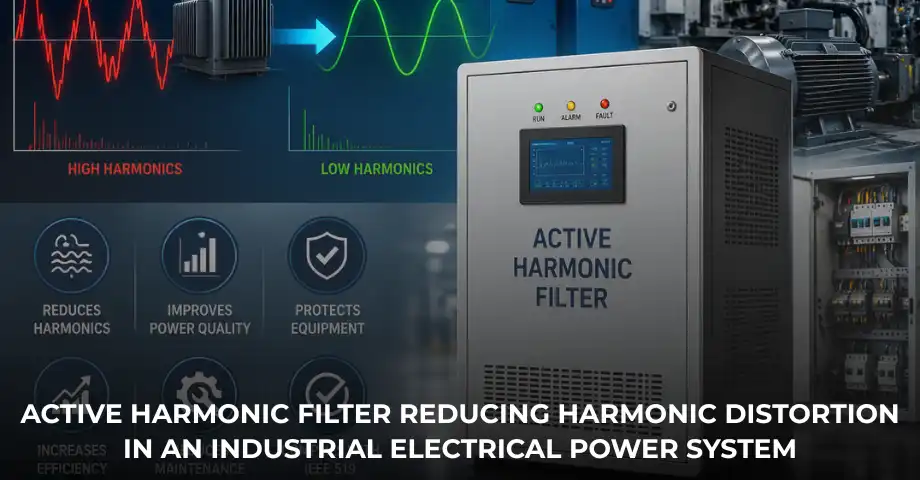
Modern industrial facilities rely heavily on electronic equipment such as Variable Frequency Drives (VFDs), CNC machines, UPS systems, PLCs, welding equipment, and automation systems. While these technologies improve efficiency and productivity, they also introduce electrical harmonics into the power system. Excessive harmonics can reduce power quality, increase energy losses, overheat transformers and motors, trip protection devices, and shorten the lifespan of critical electrical equipment.
An Active Harmonic Filter (AHF) is one of the most effective solutions for eliminating harmonic distortion and improving power quality in industrial electrical systems. Unlike traditional passive filters, an active harmonic filter continuously monitors the electrical network, detects harmonic currents in real time, and injects equal but opposite harmonic currents to cancel them before they affect connected equipment.
As industries continue adopting automation and power electronics, active harmonic filters have become an essential part of modern power quality management. They help industries comply with IEEE 519 harmonic standards, improve equipment reliability, reduce maintenance costs, and optimise overall electrical system performance.
In this guide, you’ll learn what an Active Harmonic Filter is, how it works, its benefits, industrial applications, and how to select the right solution for your facility.
What Is an Active Harmonic Filter?
An Active Harmonic Filter (AHF) is a power electronic device designed to detect and eliminate harmonic currents generated by non-linear electrical loads. Instead of absorbing harmonics like passive filters, an active harmonic filter actively injects compensating currents into the electrical network, effectively cancelling harmonic distortion.
The filter continuously analyses the incoming electrical waveform using digital signal processing technology. Whenever harmonic currents are detected, the system instantly generates equal and opposite currents that neutralise the distortion before it spreads through the electrical distribution system.
Because the compensation process occurs in real time, active harmonic filters can adapt to changing load conditions without requiring manual adjustment. This makes them highly suitable for modern industrial facilities where electrical loads frequently vary throughout the day.
Quick Definition
An Active Harmonic Filter is an electronic power quality device that continuously detects harmonic currents and injects equal but opposite currents into the electrical system to eliminate harmonic distortion and improve overall power quality.
In many industrial facilities, active harmonic filters are installed alongside Power Factor Correction systems to improve overall power quality, reduce energy losses, and enhance the efficiency of electrical equipment.
Understanding Harmonics in Electrical Systems
Before understanding how an Active Harmonic Filter works, it is important to know what electrical harmonics are.
In an ideal AC power system, voltage and current follow a smooth sinusoidal waveform operating at a fundamental frequency of 50 Hz (or 60 Hz in some countries). However, many modern electronic devices draw current in short pulses rather than smooth sine waves. These distorted current waveforms create additional frequencies known as harmonics.
These harmonic frequencies are integer multiples of the fundamental frequency.
For example:
- 1st Harmonic = 50 Hz (Fundamental)
- 3rd Harmonic = 150 Hz
- 5th Harmonic = 250 Hz
- 7th Harmonic = 350 Hz
- 11th Harmonic = 550 Hz
As harmonic levels increase, the electrical waveform becomes increasingly distorted, leading to poor power quality and reduced system efficiency.
Why Harmonics Are a Problem in Industrial Power Systems
Harmonic distortion can negatively affect almost every component connected to an electrical distribution network. Even when the equipment continues operating, excessive harmonics increase thermal stress and reduce overall efficiency.
Common problems caused by harmonic distortion include:
- Transformer overheating
- Motor overheating
- Higher cable losses
- Nuisance tripping of circuit breakers
- Reduced equipment lifespan
- Voltage distortion
- Poor power factor
- Capacitor bank failures
- Unexpected downtime
- Higher electricity costs
Harmonics can also affect the performance of protection systems. Sensitive numerical relays and protection devices depend on accurate current and voltage measurements for reliable operation. Learn more about modern protection technology in our guide on Numerical vs Conventional Protection Relays.
Common Sources of Harmonics
Most harmonics are generated by non-linear electrical loads. As industries adopt automation and energy-efficient equipment, harmonic generation continues to increase.
The most common sources include:
Variable Frequency Drives (VFDs)
VFDs are among the largest harmonic-producing devices in industrial plants. Since they use power electronic converters to control motor speed, they generate significant harmonic currents that affect the entire electrical system.
CNC Machines
Modern CNC machines use servo drives and electronic controllers that introduce harmonic distortion into industrial power networks. Facilities operating multiple CNC machines often require dedicated harmonic mitigation solutions.
UPS Systems
UPS systems rely on rectifiers and inverters that generate harmonics, especially in data centres, hospitals, and commercial buildings.
Welding Equipment
Arc welding machines create rapidly changing non-linear loads that produce significant harmonic currents.
Industrial Rectifiers
Rectifiers used in electroplating, battery charging, and DC power supplies are another common source of harmonic distortion.
LED Lighting Systems
Large LED lighting installations equipped with electronic drivers can contribute to harmonic distortion, particularly in commercial buildings and industrial facilities.
How an Active Harmonic Filter Works
An Active Harmonic Filter operates continuously by monitoring the electrical network and compensating for harmonic currents in real time.
The working process generally involves four main stages.
1. Harmonic Detection
Current Transformers (CTs) continuously measure the load current flowing through the electrical system. The Active Harmonic Filter analyses these measurements to identify harmonic components.
The accuracy of Current Transformers plays a crucial role in achieving effective harmonic compensation. Learn more in our guide on Current Transformer Accuracy Class.
2. Digital Signal Processing
The controller separates the fundamental frequency from harmonic frequencies using advanced digital signal processing (DSP) algorithms. This enables the system to calculate the exact harmonic current that needs to be compensated.
3. Harmonic Current Generation
The inverter section of the Active Harmonic Filter generates equal but opposite harmonic currents based on the calculated values.
4. Harmonic Cancellation
The compensating current is injected into the electrical network. Because it is equal in magnitude and opposite in phase to the harmonic current, both waveforms cancel each other, significantly reducing Total Harmonic Distortion (THD).
Key Advantage
Unlike passive harmonic filters, Active Harmonic Filters automatically adjust their compensation according to changing load conditions, ensuring consistent power quality without manual tuning.
Main Components of an Active Harmonic Filter
Current Transformers (CTs)
Current Transformers continuously monitor load current and provide measurement signals to the controller.
Power Electronic Inverter
The inverter generates compensating harmonic currents that are injected back into the electrical network.
Digital Controller
The controller analyses harmonic content using advanced DSP algorithms and determines the required compensation current.
Power Modules
IGBT or similar semiconductor devices enable high-speed switching required for accurate harmonic compensation.
Cooling System
Efficient air or liquid cooling maintains reliable operation under continuous industrial loading conditions.
Types of Harmonic Filters
Several harmonic filtering technologies are available for industrial electrical systems. The most suitable option depends on load characteristics, harmonic levels, and application requirements.
Active Harmonic Filter (AHF)
Active Harmonic Filters provide dynamic, real-time harmonic compensation. They automatically adapt to changing electrical loads, making them ideal for modern industrial applications with fluctuating demand.
Passive Harmonic Filter (PHF)
Passive harmonic filters use combinations of capacitors, inductors, and resistors tuned to specific harmonic frequencies. While they are economical for fixed-load applications, they are less effective where harmonic levels change frequently.
Hybrid Harmonic Filter
A hybrid harmonic filter combines the advantages of active and passive technologies. It provides cost-effective harmonic reduction while improving overall power quality in facilities with mixed electrical loads.
Selecting the right harmonic filter depends on factors such as harmonic spectrum, load variation, expansion plans, and compliance requirements. In most modern industrial facilities, Active Harmonic Filters offer the highest flexibility and long-term performance.
Benefits of Active Harmonic Filters
Active Harmonic Filters provide far more than harmonic mitigation. They improve the overall performance, efficiency, and reliability of industrial electrical systems while helping organisations comply with international power quality standards.
The key benefits include:
Excellent Harmonic Reduction
Active Harmonic Filters continuously reduce Total Harmonic Distortion (THD) by injecting compensating harmonic currents. This significantly improves voltage and current waveform quality throughout the electrical distribution system.
Real-Time Compensation
Unlike passive filters, an Active Harmonic Filter automatically adjusts its output according to changing electrical loads. This makes it ideal for industries where equipment starts, stops, or operates at varying loads throughout the day.
Improved Equipment Life
Reducing harmonic distortion lowers thermal stress on transformers, motors, cables, generators, and switchgear, helping increase equipment lifespan and reducing maintenance requirements.
Lower Energy Losses
Harmonics increase copper losses, transformer heating, and cable losses. By reducing these unwanted currents, Active Harmonic Filters improve overall electrical efficiency and reduce energy wastage.
Better Power Quality
Improved waveform quality results in stable voltage levels, fewer electrical disturbances, and more reliable operation of sensitive industrial equipment.
Compliance with IEEE 519 Standards
Many industries use Active Harmonic Filters to meet IEEE 519 recommendations for harmonic distortion, ensuring safe and reliable operation of their electrical systems.
Reduced Maintenance Costs
By preventing overheating and unnecessary stress on electrical equipment, Active Harmonic Filters help reduce breakdowns, unexpected downtime, and maintenance expenses.
Industrial Applications of Active Harmonic Filters
Active Harmonic Filters are used across a wide range of industries where non-linear electrical loads affect power quality.
Manufacturing Plants
Manufacturing facilities use VFDs, CNC machines, robotic systems, and automated production lines that generate significant harmonic distortion. Active Harmonic Filters improve equipment reliability and reduce production interruptions.
Steel Plants
Steel plants operate electric arc furnaces, rolling mills, and heavy motor drives that create large harmonic currents. Active Harmonic Filters help maintain stable power quality while protecting expensive electrical equipment.
Cement Plants
Large crushers, conveyors, kilns, and grinding mills rely on variable speed drives that introduce harmonics into the electrical system. Installing an Active Harmonic Filter improves operational efficiency and equipment life.
Data Centres
UPS systems, servers, precision cooling equipment, and power electronic devices continuously generate harmonics. Active Harmonic Filters ensure reliable operation of mission-critical IT infrastructure.
Hospitals
Medical facilities depend on clean and stable electrical power for diagnostic equipment, imaging systems, and life-support devices. Active Harmonic Filters improve power quality and reduce the risk of equipment malfunction.
Commercial Buildings
Large commercial buildings use elevators, HVAC systems, LED lighting, and UPS installations that introduce harmonic distortion. Active Harmonic Filters help maintain reliable electrical performance throughout the facility.
Renewable Energy Plants
Solar inverters and wind turbine converters generate harmonics due to their power electronic interfaces. Active Harmonic Filters improve grid compatibility and enhance system performance.
Active Harmonic Filter vs Passive Harmonic Filter
| Feature | Active Harmonic Filter | Passive Harmonic Filter |
|---|---|---|
| Operating Principle | Injects compensating harmonic current. | Uses tuned inductors and capacitors. |
| Load Adaptability | Excellent | Limited |
| Real-Time Compensation | Yes | No |
| Suitable for Variable Loads | Yes | Limited |
| Maintenance | Low | Moderate |
| Power Quality Performance | Excellent | Good for fixed loads |
Although passive filters remain suitable for some fixed-load applications, Active Harmonic Filters provide greater flexibility, higher efficiency, and better long-term performance in modern industrial facilities.
How to Select the Right Active Harmonic Filter
Selecting an Active Harmonic Filter requires a detailed assessment of the electrical system and harmonic levels.
Important factors include:
- Total connected load
- Existing harmonic distortion (THD)
- Type of non-linear loads
- Future plant expansion plans
- Voltage level
- Current rating
- Available installation space
- Communication requirements
- Compliance with IEEE 519 standards
Before selecting an Active Harmonic Filter, industries should perform a comprehensive power quality study to identify the dominant harmonic sources and determine the required compensation capacity.
Installation and Maintenance Best Practices
Proper installation and routine maintenance ensure maximum performance throughout the service life of an Active Harmonic Filter.
Recommended practices include:
- Install CTs with the correct polarity and ratio.
- Verify wiring before commissioning.
- Maintain adequate ventilation around the filter.
- Periodically inspect electrical connections.
- Monitor Total Harmonic Distortion (THD).
- Review event logs and system alarms.
- Keep firmware updated where applicable.
- Schedule preventive maintenance inspections.
Many installations also integrate Active Harmonic Filters with modern protection systems to improve overall electrical reliability. Learn more about complete protection strategies in our guide on Transformer Protection System.
Active Harmonic Filters and Power Factor Correction
Although both technologies improve electrical system performance, they solve different problems.
Power Factor Correction improves the power factor by supplying reactive power, while an Active Harmonic Filter removes harmonic distortion caused by non-linear loads. In many industrial facilities, both systems are installed together to achieve optimum power quality, improve efficiency, and reduce electricity costs.
If you’d like to learn more about reactive power compensation, read our detailed guide on Power Factor Correction.
Why Choose Delta Technocrats?
Delta Technocrats delivers advanced power quality and electrical protection solutions for industries across Eastern India. Our experienced engineering team provides complete support from system analysis and equipment selection to installation, testing, commissioning, and after-sales service.
Our expertise includes:
- Active Harmonic Filters
- Power Factor Correction Solutions
- Current & Potential Transformers
- Transformer Protection Systems
- Numerical Protection Relays
- Substation Automation & SCADA
- Power Quality Studies
- Protection Testing & Commissioning
Whether you are upgrading an existing plant or designing a new electrical distribution system, our engineers can recommend the most suitable power quality solution for your application.
Frequently Asked Questions (FAQs)
1. What is an Active Harmonic Filter?
An Active Harmonic Filter is an electronic device that detects harmonic currents and injects equal but opposite currents into the electrical system to eliminate harmonic distortion.
2. Why are Active Harmonic Filters used?
They improve power quality, reduce Total Harmonic Distortion (THD), protect electrical equipment, improve efficiency, and help industries comply with IEEE 519 standards.
3. What equipment generates harmonics?
Variable Frequency Drives (VFDs), UPS systems, CNC machines, welding equipment, rectifiers, and LED lighting systems are among the most common harmonic-producing loads.
4. What is the difference between an Active Harmonic Filter and a Passive Harmonic Filter?
Active Harmonic Filters provide dynamic real-time harmonic compensation, whereas Passive Harmonic Filters use tuned inductors and capacitors for fixed harmonic frequencies.
5. Can an Active Harmonic Filter improve power factor?
Some modern Active Harmonic Filters provide limited reactive power compensation, but they are primarily designed to eliminate harmonics. Dedicated Power Factor Correction systems are still recommended where reactive power compensation is required.
6. Do Active Harmonic Filters require maintenance?
Yes. Periodic inspection of CT connections, ventilation systems, electrical terminals, firmware, and operating parameters helps ensure reliable long-term performance.
7. Which industries benefit most from Active Harmonic Filters?
Manufacturing plants, steel industries, cement plants, hospitals, data centres, commercial buildings, mining operations, and renewable energy installations commonly use Active Harmonic Filters.
8. Are Active Harmonic Filters suitable for existing electrical systems?
Yes. Active Harmonic Filters can usually be retrofitted into existing electrical distribution systems without major modifications, making them an effective solution for improving power quality.
Conclusion
Active Harmonic Filters have become an essential component of modern industrial electrical systems. As industries increasingly adopt automation, variable speed drives, and power electronic equipment, harmonic distortion continues to grow, making effective power quality management more important than ever.
By continuously monitoring electrical networks and eliminating harmonic currents in real time, Active Harmonic Filters improve equipment reliability, reduce energy losses, extend equipment life, and help industries comply with international power quality standards. Their flexibility, fast response, and ability to adapt to changing load conditions make them the preferred choice over conventional passive filtering methods.
When combined with technologies such as Power Factor Correction, transformer protection systems, and modern numerical relays, Active Harmonic Filters contribute to a safer, more efficient, and more reliable electrical infrastructure.
To explore related topics, you may also find these guides useful:
- Power Factor Correction
- Transformer Protection System
- Numerical vs Conventional Protection Relays
- Current Transformer Accuracy Class
- CT vs PT (Current Transformer vs Potential Transformer)
- What Is an Instrument Transformer?
Need Reliable Power Quality Solutions?
Delta Technocrats provides advanced Active Harmonic Filters, Power Factor Correction systems, transformer protection solutions, and complete power quality services for industrial and commercial applications. Contact our experts to improve your electrical system efficiency, reduce harmonic distortion, and enhance equipment reliability.