
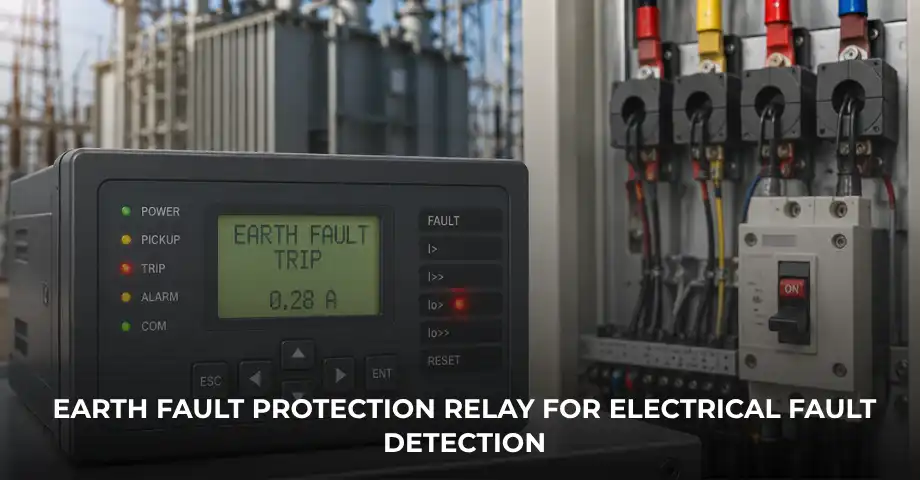
Electrical faults are one of the leading causes of equipment damage, production downtime, and safety hazards in industrial power systems. Among these faults, earth faults are particularly common because they occur when an electrical conductor unintentionally comes into contact with the earth or grounded metal parts of equipment. Even a relatively small earth fault current can damage electrical equipment, degrade insulation, create fire hazards, and endanger personnel if it is not detected quickly.
An Earth Fault Protection Relay is specifically designed to detect leakage current flowing to earth and isolate the faulty section of the electrical system before serious damage occurs. Unlike general overcurrent protection, which responds to excessive current, an earth fault relay is highly sensitive to imbalance between phase currents and neutral current, allowing it to detect even low-level earth leakage currents.
Earth fault protection is widely used in transformers, generators, feeders, motors, switchgear, cable networks, and industrial distribution systems. Modern numerical earth fault relays provide fast operation, adjustable settings, event recording, communication capabilities, and seamless integration with substation automation systems.
In this guide, you’ll learn what an Earth Fault Protection Relay is, how it works, its different types, key components, and why it is an essential part of modern electrical protection systems.
What Is an Earth Fault Protection Relay?
An Earth Fault Protection Relay is a protective device that continuously monitors electrical current flowing in an electrical circuit and detects leakage current returning through the earth instead of the intended neutral path.
Under normal operating conditions, the vector sum of the three-phase currents is nearly zero. However, when insulation fails or a conductor comes into contact with earth, part of the current flows through the ground, creating an imbalance. The relay detects this residual current and sends a trip signal to the associated circuit breaker, isolating the faulty equipment.
Earth fault relays are designed to operate much more sensitively than standard overcurrent relays, making them highly effective for detecting insulation failures before they develop into severe electrical faults.
Quick Definition
An Earth Fault Protection Relay detects leakage current flowing from an electrical system to earth. When the earth fault current exceeds the preset value, the relay trips the circuit breaker to isolate the faulty circuit and protect equipment and personnel.
Earth fault protection is usually implemented alongside transformer, feeder, differential, and overcurrent protection schemes to provide comprehensive protection for industrial electrical systems. To understand the overall protection philosophy, read our guide on Transformer Protection System.
Why Earth Fault Protection Is Important
Earth faults can occur due to insulation deterioration, cable damage, moisture ingress, equipment ageing, mechanical damage, or accidental contact between live conductors and grounded structures. If these faults remain undetected, they can cause severe equipment damage, electrical fires, and dangerous touch voltages.
An Earth Fault Protection Relay provides fast and reliable fault detection, helping industries minimise equipment damage and improve workplace safety.
Key benefits include:
- Early detection of earth leakage currents.
- Improved personnel safety.
- Reduced equipment damage.
- Lower maintenance costs.
- Improved electrical system reliability.
- Reduced production downtime.
- Enhanced fire protection.
- Selective fault isolation.
By isolating only the faulty section of the electrical network, earth fault protection helps maintain continuity of service for healthy equipment.
Working Principle of an Earth Fault Protection Relay
The operating principle of an Earth Fault Protection Relay is based on measuring the imbalance between phase currents and the return current in the electrical system.
During normal operation:
- The sum of all phase currents equals the return current.
- Residual current is approximately zero.
- The relay remains inactive.
When an earth fault occurs:
- Part of the fault current flows through the earth.
- The phase current and return current become unbalanced.
- The relay detects the residual current.
- The circuit breaker trips automatically.
The relay receives its measurement signal from Current Transformers (CTs), either using a residual connection of three CTs or a dedicated Core Balance Current Transformer (CBCT), depending on the application.
Example of Relay Operation
Consider a three-phase feeder carrying balanced currents:
| Operating Condition | Residual Current | Relay Action |
|---|---|---|
| Normal Operation | ≈ 0 A | No Trip |
| Earth Fault | Above Preset Setting | Trips Circuit Breaker |
Key Point
Unlike standard overcurrent relays that respond to excessive current magnitude, an Earth Fault Protection Relay detects the imbalance caused by leakage current flowing to earth, making it highly sensitive to insulation failures.
The accuracy of the Current Transformers used for earth fault detection directly affects relay performance. Learn more in our article on Current Transformer Accuracy Class.
Main Components of an Earth Fault Protection Scheme
An effective earth fault protection system combines several electrical components that work together to detect, analyse, and isolate earth faults quickly.
Earth Fault Protection Relay
The relay continuously monitors residual current and initiates a trip command whenever the earth fault current exceeds the configured operating value.
Current Transformers (CTs)
CTs measure current flowing through the protected circuit and provide the relay with accurate measurement signals.
If you’re unfamiliar with instrument transformers, read our guides on What Is an Instrument Transformer? and CT vs PT (Current Transformer vs Potential Transformer).
Core Balance Current Transformer (CBCT)
A Core Balance Current Transformer, also known as a Zero Sequence Current Transformer (ZSCT), surrounds all phase conductors and measures the residual current directly. It provides high sensitivity and is commonly used for motor feeders, cables, and distribution circuits.
Circuit Breaker
After receiving the trip signal from the relay, the circuit breaker disconnects the faulty circuit from the electrical network.
Auxiliary DC Supply
Modern numerical relays require a dependable auxiliary DC power supply to ensure continuous protection during fault conditions.
Types of Earth Fault Protection Relays
Different types of Earth Fault Protection Relays are available to suit various electrical systems, grounding methods, and protection requirements.
Non-Directional Earth Fault Relay
This is the most commonly used earth fault relay in radial distribution systems. It detects earth fault current regardless of the direction of fault current flow.
Typical applications include:
- Industrial feeders
- Distribution transformers
- Motor feeders
- Low-voltage distribution systems
Directional Earth Fault Relay
Directional Earth Fault Relays determine both the magnitude and direction of earth fault current. They are commonly used in interconnected power systems where fault current may flow from multiple sources.
These relays improve selectivity by ensuring that only the relay nearest the fault operates.
Restricted Earth Fault (REF) Relay
Restricted Earth Fault protection provides highly sensitive protection for transformer and generator windings. It protects only a specific zone between the Current Transformers, enabling rapid detection of internal earth faults.
REF protection is widely used for:
- Power transformers
- Generator stator windings
- Large industrial transformers
Restricted Earth Fault protection is often used together with Differential Protection Relays to provide comprehensive transformer protection.
Sensitive Earth Fault Relay
Sensitive Earth Fault Relays are designed to detect very small leakage currents that conventional earth fault relays may not identify. They are commonly installed where personnel safety and equipment protection require high sensitivity.
Typical applications include:
- Hospitals
- Data centres
- Control panels
- Industrial automation systems
- Critical process industries
Factors Affecting Earth Fault Relay Performance
The reliability of an Earth Fault Protection Relay depends not only on the relay itself but also on the correct selection and installation of associated equipment.
The most important factors include:
- Current Transformer accuracy.
- Correct CT polarity.
- Proper relay settings.
- Grounding system design.
- Relay coordination.
- Circuit breaker operating time.
- Communication system reliability.
Modern numerical relays incorporate advanced filtering algorithms, self-diagnostics, event recording, and communication features that significantly improve protection reliability compared to traditional electromechanical relays. Learn more in our article on Numerical vs Conventional Protection Relays.
Applications of Earth Fault Protection Relays
Earth Fault Protection Relays are used in a wide variety of electrical installations where rapid detection of leakage current is essential for protecting personnel, equipment, and electrical infrastructure. They are an integral part of modern protection schemes in industrial plants, commercial facilities, power utilities, and substations.
Power Transformers
Power transformers are among the most valuable assets in an electrical network. Earth fault protection helps detect insulation failures and internal earth faults at an early stage, reducing the risk of severe transformer damage.
In large transformers, Earth Fault Relays are commonly used together with differential protection and other protection schemes to provide complete transformer protection.
Distribution Feeders
Distribution feeders are exposed to cable damage, insulation deterioration, moisture ingress, and external faults. Earth Fault Protection Relays quickly isolate faulty feeders while maintaining power supply to healthy circuits.
Learn more about feeder protection in our guide on Feeder Protection Relays.
Generators
Earth fault protection safeguards generator stator windings against insulation failures and earth leakage currents. Early detection helps minimise repair costs and prevents extended plant shutdowns.
Explore our article on Generator Protection Relays for Power Plants for additional protection methods used in generator applications.
Industrial Motors
Large industrial motors used in manufacturing plants, mining operations, steel plants, and cement industries require earth fault protection to detect winding insulation failures before they develop into major motor damage.
Switchgear Panels
Earth Fault Relays are widely installed in low-voltage and medium-voltage switchgear to protect outgoing feeders, capacitor banks, transformers, and motor circuits.
Cable Networks
Underground and overhead cable systems are vulnerable to insulation deterioration, moisture ingress, and mechanical damage. Earth Fault Protection Relays provide rapid fault isolation, reducing the risk of cable failure and improving network reliability.
Earth Fault Protection Relay vs Overcurrent Relay
Although both relays contribute to electrical system protection, they perform different functions and are often used together in coordinated protection schemes.
| Feature | Earth Fault Protection Relay | Overcurrent Relay |
|---|---|---|
| Operating Principle | Detects residual (earth leakage) current. | Measures current magnitude. |
| Main Purpose | Earth fault detection. | Overload and short-circuit protection. |
| Sensitivity | Very High | Moderate |
| Typical Faults | Leakage to earth. | Overload and phase faults. |
| Applications | Transformers, motors, feeders, cables. | Feeders, switchgear, distribution systems. |
| Fault Detection | Residual current. | Total load current. |
In most industrial substations, Earth Fault Relays and Overcurrent Relays work together to provide complete protection against both leakage currents and excessive load currents.
To understand overload and short-circuit protection in more detail, read our article on Overcurrent Protection.
Earth Fault Relay Settings Explained
Correct relay settings are essential for achieving dependable protection while avoiding unnecessary tripping. The actual settings depend on the grounding system, equipment rating, fault current level, and protection coordination study.
The most common relay settings include:
- Pickup current setting.
- Time delay setting.
- Instantaneous trip setting.
- Inverse time characteristic.
- Directional setting (where applicable).
- Restricted Earth Fault sensitivity.
Protection engineers typically determine these settings during the protection coordination study to ensure selective operation across the electrical network.
Advantages of Earth Fault Protection Relays
Earth Fault Protection Relays provide several important benefits that improve both equipment protection and personnel safety.
- Highly sensitive earth fault detection.
- Fast isolation of faulty circuits.
- Improved personnel protection.
- Reduced equipment damage.
- Lower maintenance costs.
- Improved system reliability.
- Selective fault clearing.
- Suitable for low-, medium-, and high-voltage systems.
These advantages make earth fault protection one of the most important elements of industrial electrical protection systems.
Limitations of Earth Fault Protection Relays
Although Earth Fault Protection Relays are highly effective, their performance depends on proper engineering, installation, and commissioning.
Potential limitations include:
- Incorrect CT polarity may cause false operation.
- Improper relay settings reduce selectivity.
- Grounding system design affects sensitivity.
- CT saturation may influence relay performance.
- Periodic testing is required to ensure reliability.
Modern numerical relays minimise these limitations through advanced filtering, self-monitoring, disturbance recording, and adaptive protection algorithms.
Integration with SCADA and Numerical Protection Systems
Today’s Earth Fault Protection Relays are commonly integrated with SCADA, Intelligent Electronic Devices (IEDs), and numerical protection systems to provide comprehensive monitoring and control.
Integration enables operators to:
- View real-time relay status.
- Monitor fault currents.
- Receive instant alarms.
- Analyse disturbance records.
- Review historical fault events.
- Perform remote diagnostics.
For a better understanding of modern substation automation, read our guide on SCADA for Electrical Substations.
Installation and Maintenance Best Practices
Proper installation and routine testing ensure reliable Earth Fault Protection throughout the service life of the electrical system.
Recommended maintenance practices include:
- Verify CT polarity and wiring.
- Inspect relay settings periodically.
- Perform secondary injection testing.
- Test circuit breaker trip circuits.
- Inspect auxiliary DC supply.
- Review relay event logs.
- Check communication with SCADA.
- Maintain calibration and maintenance records.
Routine preventive maintenance significantly improves relay dependability and reduces the risk of unexpected protection failures.
Why Choose Delta Technocrats?
Delta Technocrats provides complete electrical protection solutions for industries, utilities, and infrastructure projects across Eastern India. Our experienced engineers design, supply, install, test, and commission advanced protection systems that improve equipment reliability and operational safety.
Our solutions include:
- Earth Fault Protection Relays
- Transformer Protection Systems
- Differential Protection Relays
- Feeder Protection Relays
- Generator Protection Relays
- Numerical Protection Relays
- Substation Automation & SCADA
- Protection Testing & Commissioning
- Electrical EPC Services
Whether you are upgrading an existing protection system or developing a new substation, Delta Technocrats delivers reliable and customised protection solutions tailored to your operational requirements.
Frequently Asked Questions (FAQs)
1. What is an Earth Fault Protection Relay?
An Earth Fault Protection Relay detects leakage current flowing from an electrical system to earth and trips the circuit breaker when the current exceeds the preset limit.
2. Why is Earth Fault Protection important?
It protects electrical equipment and personnel by detecting insulation failures and earth leakage currents before they develop into serious faults.
3. What is the difference between an Earth Fault Relay and an Overcurrent Relay?
An Earth Fault Relay detects residual current flowing to earth, whereas an Overcurrent Relay operates when the load current exceeds a predetermined value.
4. Where are Earth Fault Protection Relays used?
They are commonly used in transformers, generators, feeders, motors, switchgear, cable networks, and industrial electrical distribution systems.
5. What is a Restricted Earth Fault (REF) Relay?
A Restricted Earth Fault Relay provides highly sensitive protection for transformer and generator windings by monitoring a defined protection zone.
6. Can Earth Fault Relays integrate with SCADA?
Yes. Modern numerical Earth Fault Relays support communication protocols that allow integration with SCADA systems for remote monitoring, diagnostics, and event recording.
7. How often should Earth Fault Relays be tested?
Relay testing should be carried out according to the manufacturer’s recommendations and the facility’s preventive maintenance programme, typically during scheduled shutdowns.
8. Can Earth Fault Protection replace Overcurrent Protection?
No. Earth Fault Protection and Overcurrent Protection serve different purposes and are typically used together to provide comprehensive electrical system protection.
Conclusion
Earth Fault Protection Relays are essential components of modern electrical protection systems. Their ability to detect leakage current quickly and isolate faulty circuits helps protect personnel, minimise equipment damage, and improve the overall reliability of industrial power systems.
Whether protecting transformers, generators, motors, feeders, or switchgear, Earth Fault Relays provide highly sensitive fault detection that complements overcurrent, differential, and other protection schemes. Modern numerical relays further enhance system reliability through advanced diagnostics, communication capabilities, and seamless integration with SCADA and substation automation platforms.
By selecting the appropriate relay type, configuring correct protection settings, and following a preventive maintenance programme, industries can significantly improve electrical safety, reduce downtime, and extend the service life of critical assets.
To continue learning about industrial electrical protection, you may also find these guides useful:
- Transformer Protection System
- Differential Protection Relay
- Overcurrent Protection
- Feeder Protection Relays
- Generator Protection Relays
- Numerical vs Conventional Protection Relays
- SCADA for Electrical Substations
- Current Transformer Accuracy Class
- CT vs PT (Current Transformer vs Potential Transformer)
Need Reliable Earth Fault Protection Solutions?
Delta Technocrats supplies advanced Earth Fault Protection Relays, transformer protection systems, numerical relays, substation automation, protection testing, and commissioning services for industrial and utility applications. Contact our experts to design a dependable protection scheme that enhances electrical safety, minimises downtime, and safeguards your critical electrical infrastructure.